The 'Small' Fine Forcing Malaysia’s Financial Sector to Upgrade Its Tech
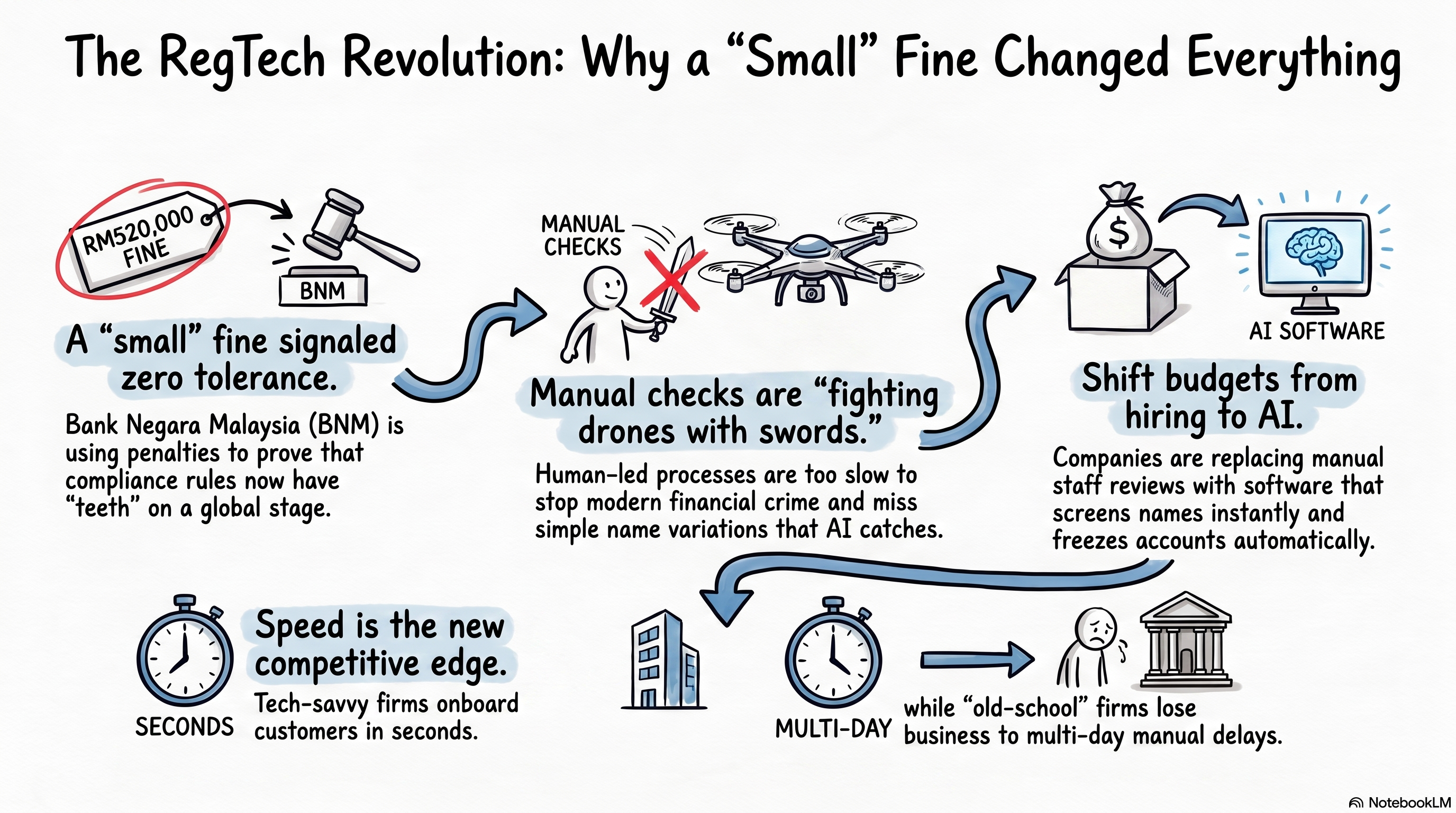
On April 16, 2026, AEON Credit was fined RM520,000 by Bank Negara Malaysia (BNM). For a major listed company making hundreds of millions a year, half a million ringgit is pocket change.
Yet, this small penalty caused a massive panic. Across the country, Compliance Chiefs stayed up all night writing urgent reports to their boards, demanding millions of ringgit to buy new software. Why did such a small fine scare everyone? Because it showed that the rules of the game have completely changed.
1. The Real Mistake: Crossing a Regulatory Red Line
If you look at BNM’s official announcement, two phrases explain the panic: "Domestic List" and "Delay in Freezing."
AEON Credit didn't just fill out a form wrong. They broke a major rule regarding counter-terrorism financing (CFT) watch lists.
BNM found two major security gaps:
System Failure: When opening a new account, AEON Credit's system failed to stop a customer whose name perfectly matched a high-risk terrorism watch list.
Slow Reaction: Even though the system flagged the issue later, the company took too long to freeze the account. By then, the damage was done.
2. The Days of Manual Checking Are Over
BNM blamed the issue on poor staff supervision and weak standard operating procedures (SOPs). This exposed a big secret in the industry: you can no longer fix compliance issues just by hiring more people to check things by hand.
Many mid-sized lenders still have staff check blacklists line-by-line and approve flagged accounts manually. This creates two major problems:
Dumb Systems: Older systems are too rigid. A single typo, abbreviation, or extra space can cause the computer to miss a bad guy. They lack Fuzzy Matching—which is smart software that catches name variations even if they are spelled slightly wrong.
Slow Processes: When a human flags a risk, it requires layers of managers to sign off on it. By the time the paperwork is approved, the money has already left the country.
Trying to stop modern online financial crime with manual paperwork is like fighting a drone with a sword. You simply cannot win.
3. BNM's New Attitude: Zero Tolerance
In the past, Malaysia's central bank was gentle. They usually gave warnings and let companies fix their mistakes slowly. That era is over. BNM has shifted to a strict, "no-excuses" enforcement style.
Also, they aren't just targeting giant traditional banks anymore. Digital banks, e-wallets (like Touch 'n Go), and consumer finance companies like AEON Credit are all being watched just as closely.
The big picture is about Malaysia's global reputation. International financial groups are currently evaluating the country's anti-money laundering rules. BNM needs to show the world that its laws have teeth. In this environment, if your system is slow, your company will be the next example.
4. The RegTech Boom: A New Market Reality
This strict enforcement has suddenly created a massive market for RegTech (Regulatory Technology) in Malaysia:
Buying Software Instead of Hiring People: The AEON Credit case proved that humans get tired and make mistakes. Those mistakes cost companies heavy fines and ruin their reputations. Now, corporate bosses are taking budgets meant for hiring staff and spending it on AI software that screens names instantly, monitors transactions in real time, and freezes accounts automatically.
A Big Win for Local Tech Firms: This forced upgrade is bringing massive business to local tech companies. Malaysia’s top credit agency, CTOS Digital, and identity verification specialist Innov8tif (owned by Datasonic), are seeing a huge wave of new customers and profits.
The Bottom Line
A regulatory fine is never just about the money. BNM used a RM520,000 fine to force the entire Malaysian financial industry to upgrade its technology.
In today's market, smart technology is no longer optional. The companies that automate their security systems first will win the market, while those sticking to old manual ways will get left behind—or fined out of business.