🟦 1. The Event (FACT)
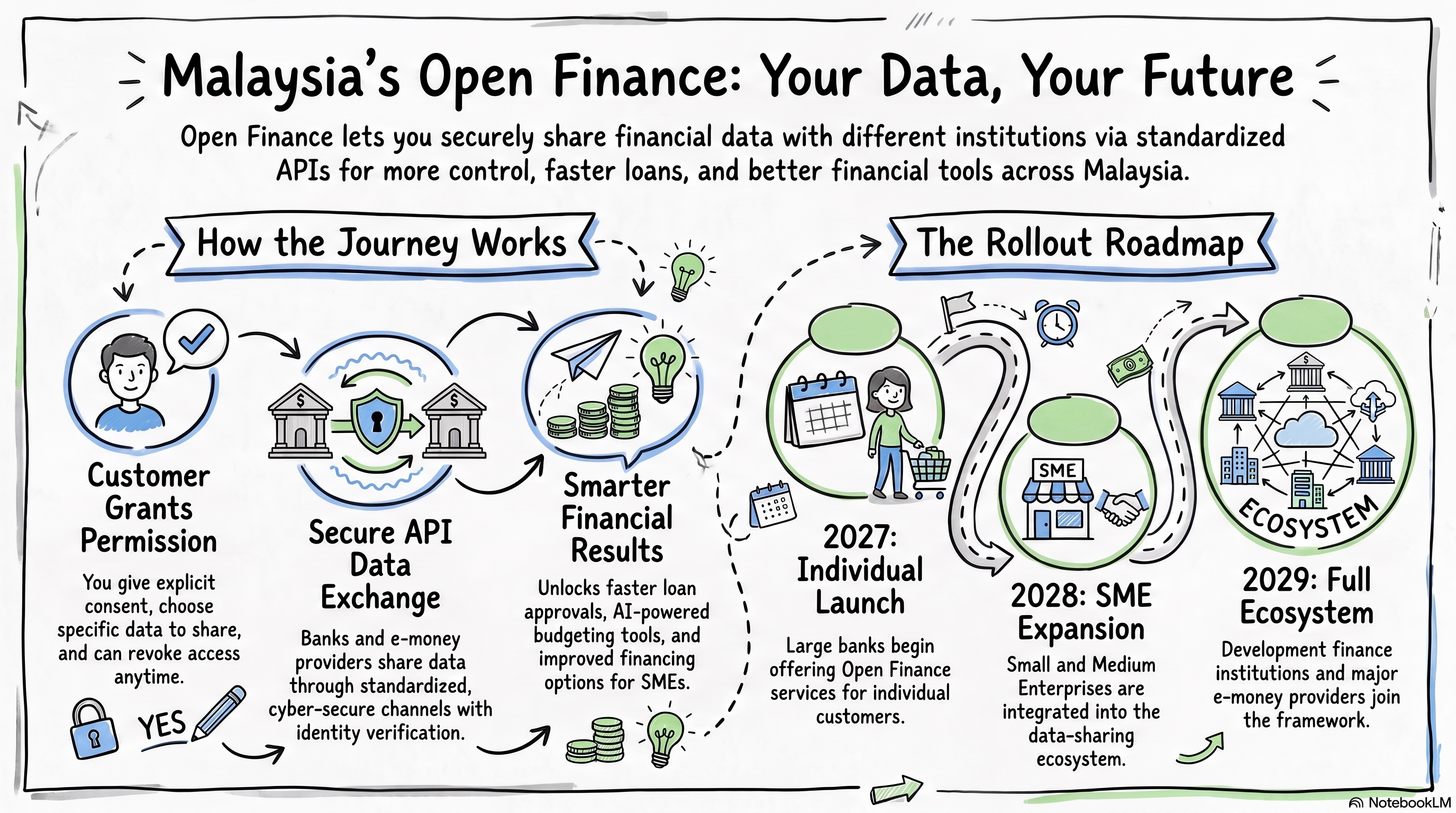
Bank Negara Malaysia announced plans to introduce an open finance framework starting 1 January 2027, allowing consumers to control and consent to the sharing of their financial data (including deposit accounts and credit/charge cards).
The rollout begins with large banks in 2027 (individuals), expands to SMEs in 2028, and fully includes development finance institutions and major e-money providers for individuals and SMEs by 2029; public feedback is open until 1 March 2026.
🟨 2. Affected Channels (MECHANISM)
Regulation: New mandatory consent, data governance, and security requirements
Financing: Potential changes in credit assessment processes using shared transaction data
Competition: Lower switching frictions and increased product comparability
Data Infrastructure: System upgrades for data sharing, dashboards, and APIs
Sentiment: Trust and adoption linked to perceived data protection standards
🟩 3. Malaysia Exposure (WHO)
Exposed sectors: Banking, digital banking, fintech, payments, credit services
Company types: Large domestic banks, smaller banks (later phases), development finance institutions, major e-money issuers, fintech service providers
Geographic relevance: Nationwide, with phased inclusion across the financial system
🟧 4. What to Watch (SIGNALS)
Bank and fintech announcements on open finance readiness or pilot programs
Investments or procurement related to data infrastructure and cybersecurity
Regulatory guidance or technical standards issued by Bank Negara Malaysia
SME-focused product launches tied to data-enabled credit or cashflow tools
1. Policy Objective and Strategic Direction
Bank Negara Malaysia's Open Finance Framework establishes the foundation for a permission-based financial data ecosystem where customers control the sharing of their financial information. Rather than being solely an open banking initiative, the framework introduces the infrastructure required for secure, standardized and regulated financial data portability.
The framework reflects several long-term policy objectives:
Consumer ownership and control of financial data through explicit consent.
Phased implementation to reduce operational and systemic risk, beginning with larger banking institutions before expanding to SMEs, digital banks and e-money issuers.
Controlled competition through standardized APIs, consent management and limited historical data sharing.
The initiative positions Malaysia to support AI-enabled financial services while maintaining financial stability and regulatory oversight.
2. Structural Implications for Malaysia's Financial Sector
The framework changes how competitive advantage is created within the financial industry.
Historically, banks held both customer relationships and exclusive access to transaction data. Under Open Finance, customer relationships remain valuable, but transaction data becomes portable with customer consent. Competitive differentiation increasingly shifts toward the ability to analyze data and deliver better financial products.
This transition accelerates several structural changes:
Greater competition in lending and financial product pricing.
Increased use of cash flow and behavioural data in credit assessment.
Reduced dependence on traditional relationship banking and static credit bureau information.
Higher importance of data analytics, artificial intelligence and personalized financial services.
The framework is expected to improve financial inclusion for SMEs, gig workers and borrowers with limited credit histories while increasing pressure on institutions relying primarily on conventional underwriting models.
3. Stakeholder Impact Assessment
Large Banking Institutions
Short-term
Higher compliance expenditure.
Investment in API infrastructure, cybersecurity and consent management systems.
Operational changes to meet regulatory requirements.
Long-term
Greater competition in consumer lending and fee-based products.
Margin pressure from increased pricing transparency.
Stronger competitive position for institutions investing early in data analytics and digital capabilities.
Smaller Banks and Development Financial Institutions
The delayed implementation provides additional preparation time but does not reduce long-term competitive pressure.
Once SME participation expands:
Lending competition is expected to intensify.
Greater transparency may reduce pricing advantages.
Development financial institutions will face increased emphasis on measurable financing outcomes and operational efficiency.
E-money Issuers and Digital Wallet Providers
The framework creates opportunities for digital wallets to expand beyond payment services.
Potential areas of growth include:
Personal financial management.
Spending analytics.
Alternative credit assessment.
Embedded financial services.
Realizing these opportunities will depend on developing analytical capabilities rather than relying primarily on payment incentives and customer acquisition campaigns.
Consumers and SMEs
Potential benefits include:
Faster financing approvals.
More competitive loan pricing.
Financial products tailored to individual cash flow characteristics.
Improved access to financing for underserved customer segments.
Potential risks include:
Misuse of customer data by unauthorized parties.
Consent fatigue resulting from excessive data-sharing requests.
The framework's consent management requirements are intended to strengthen transparency and customer control over financial data.
4. Strategic Implications for Financial Institutions and Industry Participants
The framework signals a transition toward data-driven financial services where competitive advantage increasingly depends on analytical capability rather than exclusive access to customer information.
Banking Institutions
Strategic priorities include:
Developing cash flow-based lending models.
Building personalized pricing capabilities.
Investing in internal data science and artificial intelligence.
Expanding API connectivity and ecosystem partnerships.
Collaborating with accounting software providers, SME platforms and industry-specific software providers.
Fintech Companies
The regulatory framework favours business models based on customer-authorized data sharing and clearly defined customer value propositions.
Potential areas of opportunity include:
SME cash flow analysis.
Financial health monitoring.
Subscription and expenditure optimization.
AI-assisted financial advisory services.
Business models dependent on unauthorized data collection methods are expected to become less viable as standardized Open Finance infrastructure expands.
5. Regulatory and Policy Considerations
The framework demonstrates Bank Negara Malaysia's emphasis on balancing competition, innovation and financial stability.
Key regulatory priorities include:
Standardized and secure financial data sharing.
Strong consent governance and customer protection.
Responsible use of artificial intelligence in financial services.
Coordination with personal data protection and cybersecurity regulations.
Ongoing oversight of data usage practices alongside data access permissions.
This approach seeks to encourage innovation while minimizing operational, cybersecurity and consumer protection risks.
6. Long-Term Outlook
Malaysia's Open Finance Framework represents a foundational reform of the country's financial infrastructure.
Over the coming decade, the framework is expected to:
Increase competition across banking and financial services.
Accelerate adoption of AI and data-driven financial products.
Improve financial inclusion for consumers and SMEs.
Encourage ecosystem collaboration between banks, fintech companies and digital platforms.
Shift industry value creation from exclusive data ownership toward superior data analytics and customer experience.
Institutions that invest early in digital infrastructure, data capabilities and customer-centric product development are likely to strengthen their competitive position as Malaysia's Open Finance ecosystem matures.