🟦 1. The Event (FACT)
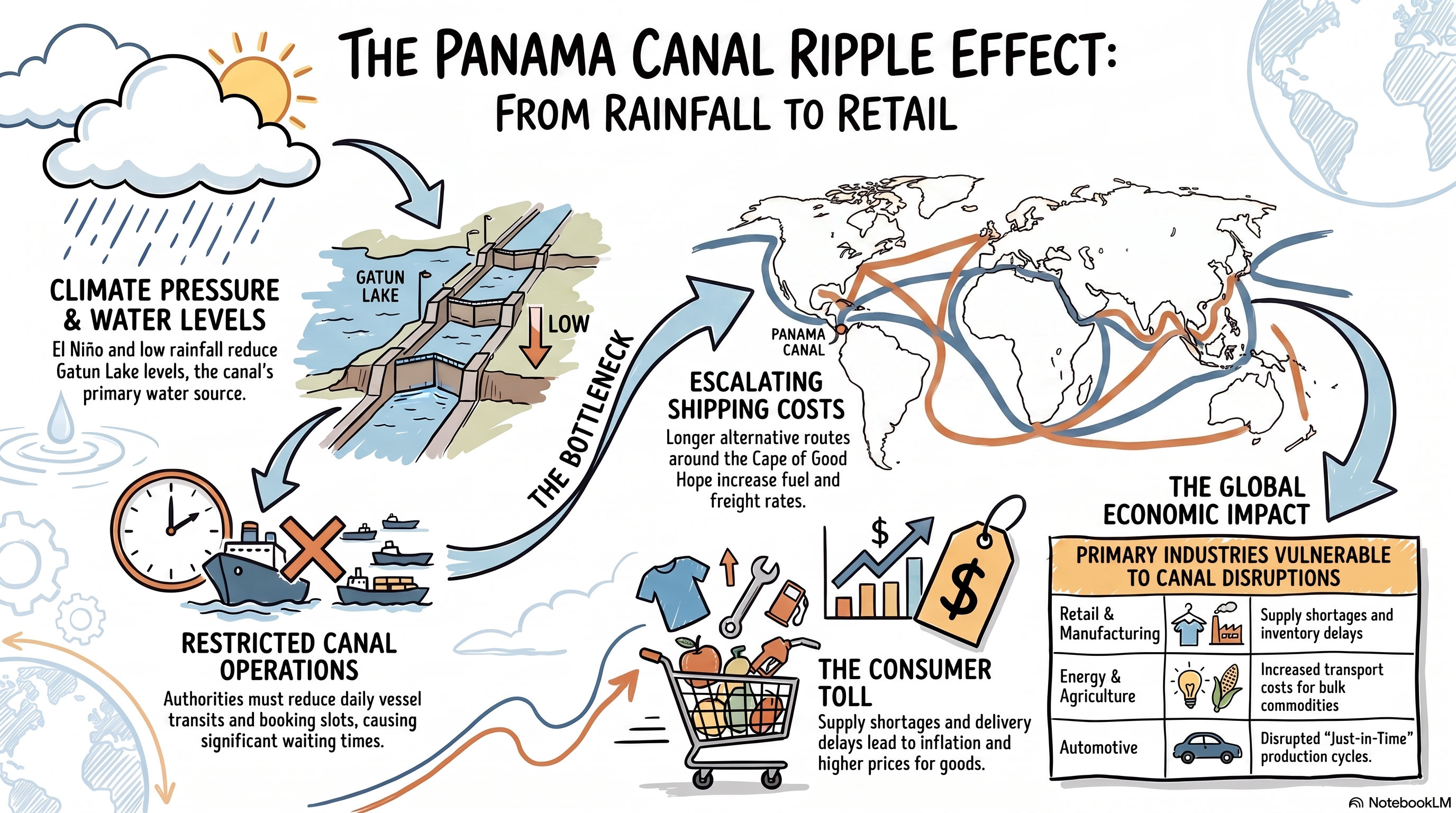
The Panama Canal Authority will temporarily suspend part of its vessel booking system from 25 July due to declining water levels and the risk of a strong El Niño reducing freshwater supply. The measure reduces daily booking capacity from 36 to 34 vessels, adding pressure to global shipping routes already disrupted by tensions in the Middle East.
🟨 2. Affected Channels (MECHANISM)
Trade / Logistics: Reduced canal capacity may increase transit delays and congestion.
Supply: Longer shipping times may disrupt the movement of raw materials and manufactured goods.
Cost: Freight rates, insurance and shipping costs may increase due to tighter vessel availability and rerouting.
Sentiment: Heightens concerns over the resilience of global supply chains amid multiple shipping disruptions.
Demand: Importers and exporters may adjust inventory planning and shipping schedules.
🟩 3. Malaysia Exposure (WHO)
Exposed sectors
Shipping and logistics
Ports
Manufacturing
Electrical and electronics
Commodities
Oil and gas
Export-oriented industries
Types of Malaysian companies
Shipping lines and freight forwarders.
Port operators.
Exporters serving North and South American markets.
Manufacturers relying on imported raw materials or global supply chains.
Commodity traders.
Logistics and warehousing providers.
Geographic relevance
Malaysia is indirectly exposed through global maritime trade, particularly shipments between Asia and the Americas that rely on the Panama Canal.
🟧 4. What to Watch (SIGNALS)
Further changes to Panama Canal transit limits or booking capacity.
Water levels at Gatun Lake and El Niño weather developments.
Global container and bulk freight rates.
Vessel congestion and transit waiting times at the Panama Canal.
Shipping route adjustments and increased use of alternative routes.
Malaysian exporters' logistics costs and delivery lead times.
Corporate disclosures regarding supply chain disruptions, freight costs or inventory management.
Panama Canal restrictions signal climate risk becoming a permanent feature of global trade infrastructure
2. Executive Summary
The Panama Canal's decision to reduce vessel booking capacity is more than a temporary operational adjustment—it demonstrates how climate change is becoming a structural constraint on global trade, alongside geopolitical disruptions.
Unlike disruptions caused by conflict in the Strait of Hormuz or the Red Sea, Panama's challenge is driven by freshwater scarcity, as the canal depends on rainfall-fed Gatun Lake to operate its lock system.
With the Middle East already disrupting east-west energy flows, a simultaneous reduction in Panama Canal capacity increases the probability that multiple global shipping chokepoints become constrained at the same time, raising freight costs and reducing supply-chain resilience.
Investors should increasingly treat climate resilience of logistics infrastructure as a strategic investment theme, rather than viewing weather-related disruptions as isolated events.
3. Key Insights
Insight 1: Climate is becoming a strategic supply-chain risk
Observation
The Panama Canal is reducing booking slots because lower rainfall threatens water levels required for lock operations.
Why it matters
Unlike geopolitical disruptions, climate-related constraints can persist for months or recur seasonally, making them increasingly predictable yet difficult to eliminate.
Second-order implication
Shipping companies and cargo owners will incorporate climate risk into route planning, inventory management, and freight contracts.
Third-order implication
Global supply chains become structurally more expensive as resilience replaces efficiency as the primary objective.
Insight 2: Multiple chokepoints are now under simultaneous pressure
Observation
Panama joins the Strait of Hormuz, Bab el-Mandeb, and other strategic maritime routes facing disruptions.
Why it matters
The diversification benefit among shipping routes is weakening because different chokepoints are being disrupted by different causes at the same time.
Second-order implication
Global freight markets become more volatile as rerouting options become increasingly constrained.
Insight 3: Water has become critical transport infrastructure
Observation
The canal's operating capacity depends directly on freshwater availability rather than engineering limitations.
Why it matters
Climate resilience is now inseparable from infrastructure resilience.
Third-order implication
Future investment in ports and canals will increasingly include water management, reservoirs, desalination, and climate adaptation projects.
Insight 4: Supply-chain resilience continues to outweigh efficiency
Observation
Reduced booking slots increase uncertainty even before severe restrictions are imposed.
Why it matters
Companies are likely to continue maintaining higher inventories and more diversified shipping networks despite higher costs.
Second-order implication
Working capital requirements rise while "just-in-time" logistics become less dominant.
Insight 5: Inflation risks increasingly originate from logistics
Observation
Reduced canal capacity raises freight costs and transit uncertainty.
Why it matters
Transportation costs feed into manufactured goods, agricultural products, and industrial supply chains.
Third-order implication
Central banks may increasingly face inflation driven by supply-side logistics disruptions rather than domestic demand alone.
Insight 6: Climate adaptation becomes a competitive advantage
Observation
The Panama Canal Authority is attempting to manage water resources proactively rather than reactively.
Why it matters
Infrastructure operators capable of adapting to climate variability will preserve throughput and market share more effectively than those relying solely on historical weather patterns.
4. Interpretation
What is really happening beneath the headlines?
This is not simply about two fewer daily vessel bookings.
It reflects a broader transformation in global trade where geopolitical risk and climate risk are increasingly interacting.
Traditionally, shipping disruptions were viewed as isolated events:
Wars
Labor strikes
Mechanical failures
Today, structural climate risks are joining geopolitical tensions as persistent constraints on global logistics.
The Panama Canal illustrates this evolution. Unlike the Strait of Hormuz, which depends on political stability, Panama's throughput depends on rainfall and freshwater availability.
As multiple chokepoints experience simultaneous pressure—from conflict in the Middle East to water shortages in Central America—companies can no longer rely on rerouting alone. Resilience increasingly requires diversified suppliers, larger inventories, and investment in alternative transport corridors.
5. What Changes Next?
Next 6 Months
Likely (80%)
Competition for Panama Canal transit slots intensifies.
Freight rates for affected routes remain elevated.
Shipping companies increase use of alternative routes where economically viable.
Possible (50%)
Additional transit restrictions if El Niño strengthens.
Increased congestion at alternative ports and canals.
Low Probability, High Impact (15%)
Simultaneous escalation of Middle East disruptions and severe Panama water shortages create a broad-based global shipping shock.
Next 12 Months
Likely (70%)
Greater investment in climate adaptation for canal operations.
More supply-chain diversification by multinational companies.
Higher use of predictive weather analytics in shipping.
Next 3 Years
Likely (75%)
Climate resilience becomes a standard criterion in logistics planning.
Infrastructure investment increasingly focuses on water security and operational flexibility.
Global trade networks become structurally more diversified but also more expensive.
6. Winners
Direct Winners
Industries
Shipping analytics
Freight forwarding
Logistics technology
Port operators outside constrained routes
Supply-chain software
Companies
Firms providing weather forecasting and maritime routing solutions.
Operators of alternative logistics corridors and intermodal transport networks.
Secondary Winners
Warehouse operators benefiting from higher inventory levels.
Rail freight providers on alternative trade routes.
Engineering firms specializing in water infrastructure and climate adaptation.
7. Losers / Pressure Points
Global shipping companies
Face higher operational complexity, scheduling uncertainty, and potentially higher costs.
Nature: Structural if climate variability intensifies.
Exporters dependent on predictable shipping schedules
May experience longer lead times and increased logistics costs.
Just-in-time manufacturers
Greater vulnerability to supply disruptions and inventory shortages.
8. Investment Implications
Equities
Opportunities
Logistics technology
Port operators
Warehousing
Engineering firms focused on water infrastructure
Supply-chain software providers
Risks
Shipping companies with concentrated exposure to constrained routes.
Manufacturers with limited supply-chain flexibility.
Private Equity
Potential investment themes:
Cold storage
Distribution centers
Climate-resilient infrastructure
Freight technology
Infrastructure
High-conviction themes:
Reservoirs
Water management systems
Ports
Rail intermodal facilities
Inland logistics hubs
Venture Capital
Opportunities in:
Climate analytics
Supply-chain visibility
AI-driven logistics optimization
Maritime software
Commodities
Watchlist
Container freight rates
Bunker fuel
Agricultural exports
LNG shipping costs
Fixed Income
Infrastructure issuers investing in climate resilience may benefit from stronger long-term credit profiles, while transport operators facing repeated disruptions could encounter higher capital expenditure needs.
Currencies
Commodity-exporting economies dependent on efficient maritime trade may experience greater volatility if transport bottlenecks significantly affect export flows.
Real Assets
Warehousing, inland logistics facilities, and strategically located ports become increasingly valuable as companies prioritize resilience and inventory buffers.
9. Malaysia / ASEAN Implications
Malaysia
Malaysia could benefit indirectly through its role as a regional manufacturing and logistics hub.
Positive
Increased demand for inventory storage and regional distribution.
Greater strategic importance of Port Klang and Tanjung Pelepas as companies diversify logistics networks.
Opportunities for Malaysian logistics, warehousing, and freight forwarding firms.
Risks
Export-oriented manufacturers relying on trans-Pacific routes may face higher shipping costs and longer delivery times.
Electronics, machinery, and palm oil exporters could experience increased logistics expenses if canal constraints persist.
Singapore
As a major global transshipment and maritime services hub, Singapore stands to benefit from stronger demand for shipping management, trade finance, maritime insurance, and logistics optimization services.
Indonesia
Resource exporters may face longer transit times to Atlantic markets, though diversified shipping routes help mitigate concentrated exposure.
Thailand
Manufacturers integrated into global supply chains may experience higher freight costs but could also benefit from increased regional inventory localization.
Vietnam
Export-oriented sectors such as electronics, furniture, and textiles remain exposed to higher logistics costs for shipments destined for the Americas.
10. Long-Term Structural Trend
Megatrend | Assessment | Why |
Supply-chain resilience | Strongly reinforces | Companies increasingly prioritize redundancy, inventory buffers, and diversified logistics. |
Climate adaptation | Strongly reinforces | Water availability becomes a strategic determinant of transport infrastructure performance. |
Re-industrialisation | Moderately reinforces | Manufacturers may localize production to reduce reliance on vulnerable global shipping routes. |
Financial fragmentation | Moderately reinforces | Persistent logistics disruptions increase regionalization of trade flows. |
Multipolar world | Moderately reinforces | Trade networks become more geographically diversified as firms reduce dependence on individual chokepoints. |
Industrial policy | Weakly reinforces | Governments may invest more heavily in strategic transport infrastructure. |
Energy transition | Neutral | Limited direct connection, though shipping emissions and efficiency remain long-term considerations. |
Resource nationalism | Neutral | No direct implication. |
AI infrastructure | Weakly reinforces | Predictive analytics and AI-driven logistics planning become increasingly valuable. |
Friend-shoring | Weakly reinforces | Companies may further diversify production toward trusted regional partners to reduce transport risk. |
11. Hidden Insights
Climate risk is becoming as important as geopolitical risk for global trade. Unlike conflicts, recurring droughts and extreme weather are likely to become more frequent, making logistics disruptions a structural feature rather than an occasional shock.
The interaction of multiple chokepoints is the real risk. Individually, Panama, Hormuz, or the Red Sea may be manageable. Simultaneous disruptions across several major routes can amplify freight costs, delay deliveries, and reduce global supply-chain flexibility far more than any single event.
Water infrastructure is now economic infrastructure. The Panama Canal's capacity is constrained not by engineering but by freshwater availability, highlighting how reservoirs, watershed management, and climate adaptation have become critical components of global trade competitiveness.
Supply-chain resilience increasingly requires investment rather than rerouting. Businesses are likely to allocate more capital to warehousing, inventory, digital logistics tools, and regional distribution hubs instead of relying solely on alternative shipping routes during disruptions.
ASEAN logistics hubs may gain strategic importance. As companies diversify production and inventory locations to cope with recurring global transport disruptions, Malaysia and Singapore could strengthen their roles as regional manufacturing, warehousing, and transshipment centers.
12. Signals to Monitor
Bullish Confirmation
Further reductions in Panama Canal transit slots.
El Niño intensifying and rainfall remaining well below historical norms.
Rising container freight rates on routes linked to the Americas.
Increased investment announcements in climate-resilient port and logistics infrastructure.
Growth in regional warehousing and inventory levels.
Bearish Confirmation
Rainfall recovering sufficiently to stabilize Gatun Lake water levels.
Panama Canal Authority restoring booking capacity.
Continued easing of disruptions in the Strait of Hormuz and the Red Sea, offsetting Panama-related constraints.
Invalidation Signals
Weather conditions improve materially, allowing the Panama Canal to maintain or expand transit capacity without prolonged restrictions.
Major investments in water management significantly reduce the canal's vulnerability to recurring El Niño events.
Freight markets remain stable despite reduced canal bookings, indicating that alternative routes and available shipping capacity are sufficient to absorb the disruption.
13. Bottom Line
The Panama Canal's booking restrictions highlight that climate resilience has become a core determinant of global trade efficiency, alongside geopolitics.
Water scarcity is emerging as a strategic constraint on one of the world's most important shipping corridors, reinforcing the need for climate adaptation in critical infrastructure.
The overlap of climate-related disruption in Panama with geopolitical tensions affecting other maritime chokepoints increases the likelihood of more frequent and persistent logistics bottlenecks.
Companies are likely to continue shifting from efficiency-first supply chains toward resilience-first strategies, supporting demand for warehousing, logistics technology, and diversified production networks.
Malaysia and Singapore are well positioned to benefit from stronger regional logistics, warehousing, and transshipment activity as global firms seek more resilient supply-chain configurations.
Investors should increasingly monitor climate indicators such as rainfall, reservoir levels, and seasonal weather forecasts alongside traditional geopolitical risks when assessing global trade and transportation sectors.
Over the coming decade, climate adaptation of transport infrastructure may prove as economically significant as expanding its physical capacity, reshaping investment priorities across shipping, logistics, and infrastructure markets.