🟦 1. The Event (FACT)
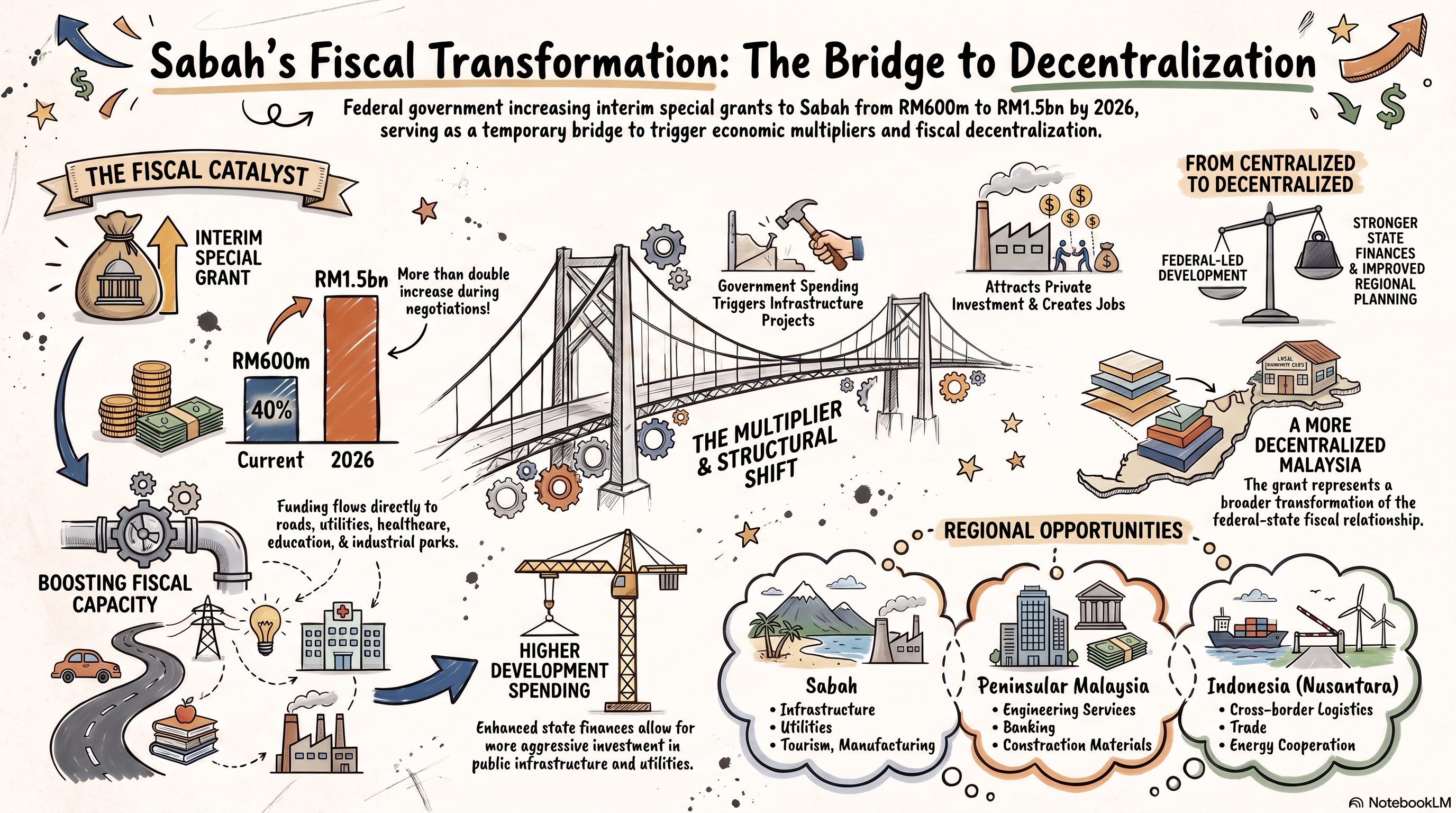
The Federal Government increased Sabah's interim special grant to RM1.5 billion for 2026, up from RM600 million, as a temporary arrangement while negotiations continue on Sabah's 40% revenue entitlement under the Malaysia Agreement 1963 (MA63).
🟨 2. Affected Channels (MECHANISM)
Fiscal Transfers: Higher federal transfers increase funding available to the Sabah government.
Government Spending: Greater capacity for state development and public infrastructure expenditure.
Policy: Ongoing negotiations on the MA63 revenue-sharing framework may affect future fiscal arrangements.
Financing: Increased public spending may support government-funded projects and related financing activities.
Sentiment: Signals continued federal commitment to resolving Sabah's fiscal entitlement discussions.
🟩 3. Malaysia Exposure (WHO)
Exposed sectors
Construction and infrastructure
Utilities
Public works
Banking
Engineering and project management
Government services
Types of Malaysian companies
Civil engineering and infrastructure contractors operating in Sabah.
State-linked government-linked companies (GLCs).
Utility providers involved in water, electricity and public infrastructure.
Banks financing government and infrastructure projects.
Consultants, engineering firms and service providers participating in public-sector development.
Geographic relevance
Primarily Sabah, with indirect implications for federal fiscal planning and nationwide government expenditure allocation.
🟧 4. What to Watch (SIGNALS)
Progress and final structure of the MA63 40% revenue entitlement negotiations.
Federal Budget allocations for Sabah in upcoming fiscal years.
Sabah state budget revisions and development expenditure plans.
New infrastructure project announcements, tenders and contract awards in Sabah.
Parliamentary or Cabinet decisions on fiscal devolution and revenue-sharing.
Corporate announcements relating to government contracts and infrastructure projects in Sabah.
Changes in federal-state fiscal transfer mechanisms or legislation.
Higher Sabah fiscal transfers signal accelerating fiscal decentralisation under MA63 rather than a one-off grant increase
2. Executive Summary
The increase in Sabah's interim special grant from RM600 million to RM1.5 billion is best viewed as a bridge mechanism while negotiations over Sabah's constitutional 40% revenue entitlement continue, rather than as the final settlement.
The move strengthens expectations that Malaysia is entering a new phase of fiscal devolution, where East Malaysia receives greater revenue autonomy and development spending.
For investors, the immediate beneficiaries are Sabah-focused infrastructure, utilities, engineering, and state-linked enterprises, but the longer-term implication is a structural redistribution of federal fiscal resources that could reshape capital allocation across Malaysia.
The unresolved 40% revenue formula remains the key catalyst. If a permanent framework is agreed, fiscal transfers could increase significantly beyond current interim levels, altering both Sabah's growth trajectory and federal budget dynamics.
3. Key Insights
Insight 1: This is a constitutional negotiation disguised as a fiscal transfer
Observation
The grant increase is explicitly described as an interim arrangement pending agreement on MA63's 40% revenue entitlement.
Why it matters
The real issue is not the additional RM900 million—it is the future revenue-sharing framework between the federal government and Sabah.
Second-order implication
Markets should focus on the eventual formula rather than the interim payment, as the permanent arrangement could involve substantially larger recurring transfers.
Insight 2: Fiscal decentralisation is becoming national policy
Observation
The federal government is increasing fiscal transfers while negotiations continue.
Why it matters
Malaysia appears to be gradually shifting from centralized fiscal allocation toward greater state-level financial autonomy.
Third-order implication
Other states—particularly Sarawak—may seek similar fiscal arrangements, increasing pressure for broader reforms to federal-state financial relations.
Insight 3: Sabah's investment profile improves
Observation
Higher guaranteed funding improves the state's fiscal capacity.
Why it matters
More predictable funding increases confidence in long-term infrastructure planning and project execution.
Second-order implication
Contractors, utilities, banks, and industrial developers may become more willing to invest in Sabah.
Insight 4: Federal fiscal flexibility narrows
Observation
Higher recurring transfers reduce fiscal room elsewhere unless offset by stronger revenue or spending restraint.
Why it matters
Every additional ringgit transferred to Sabah reduces fiscal flexibility for other priorities.
Third-order implication
Future federal budgets may face tougher trade-offs between subsidies, infrastructure, defence, healthcare, education, and regional transfers.
Insight 5: MA63 is increasingly becoming an economic issue rather than a political issue
Observation
Revenue-sharing negotiations directly affect state finances and investment.
Why it matters
MA63 is evolving into one of Malaysia's most important long-term fiscal policy questions.
Second-order implication
Institutional investors may increasingly incorporate MA63 outcomes into infrastructure, utilities, and state development assessments.
Insight 6: Sabah could become a higher-growth investment destination
Observation
Additional fiscal transfers support public investment.
Why it matters
Public infrastructure spending often crowds in private investment.
Third-order implication
Industrial parks, logistics, renewable energy, tourism, and manufacturing could benefit if fiscal certainty improves.
4. Interpretation
What is really happening beneath the headlines?
This represents a gradual rebalancing of Malaysia's fiscal architecture.
Rather than simply increasing spending, the federal government is attempting to manage competing objectives:
honour MA63 commitments,
preserve national fiscal stability,
avoid a sudden fiscal shock,
maintain political cohesion.
The interim grant functions as a transitional fiscal instrument, buying time while negotiations over the permanent 40% revenue formula continue.
The situation resembles fiscal decentralisation seen in countries where resource-rich regions negotiate greater revenue retention. The underlying question is not how much Sabah receives today, but how Malaysia allocates fiscal power over the next decade.
5. What Changes Next?
Next 6 Months
Likely (75%)
Continued MA63 negotiations.
Sabah accelerates planning for additional development projects.
Greater visibility on state infrastructure priorities.
Possible (45%)
Further interim adjustments before a permanent formula.
Increased borrowing or project financing linked to higher state spending.
Low Probability, High Impact (20%)
Comprehensive fiscal devolution package covering multiple aspects of MA63 beyond revenue sharing.
Next 12 Months
Likely (70%)
Greater federal budget allocation for Sabah.
More infrastructure tenders.
Expansion of utilities and public works spending.
Next 3 Years
Likely (75%)
Permanent MA63 revenue-sharing framework.
Larger state development expenditure.
Stronger private investment following improved infrastructure.
6. Winners
Direct Winners
Regions
Sabah
Industries
Construction
Civil engineering
Utilities
Water infrastructure
Roads
Public housing
Industrial parks
Companies
Potential beneficiaries include:
Sabah-focused construction contractors
State-linked GLCs
Utility operators
Engineering consultants
Local building material suppliers
Secondary Winners
Banks financing infrastructure
Property developers
Logistics operators
Telecommunications infrastructure
Renewable energy developers
Industrial estate operators
7. Losers / Pressure Points
Federal Budget
Higher recurring transfers increase fiscal pressure.
Nature: Structural if the permanent MA63 formula materially exceeds current transfers.
Other states
May face relatively slower growth in federal allocations if total spending remains constrained.
Federal contractors outside Sabah
Competition for budget resources may intensify.
8. Investment Implications
Equities
Opportunities
Construction
Utilities
Cement
Engineering
Banks with Sabah exposure
Risks
Delays in MA63 negotiations.
Federal fiscal consolidation reducing broader development spending.
Private Equity
Opportunities in:
Infrastructure
Logistics
Industrial parks
Renewable energy
Infrastructure
High-conviction themes:
Roads
Water treatment
Electricity transmission
Ports
Airports
Digital infrastructure
Venture Capital
Potential areas:
GovTech
Infrastructure technology
Digital public services
Smart city solutions
Commodities
Higher construction activity supports demand for:
Cement
Steel
Aggregates
Fixed Income
Potential increase in infrastructure financing and project-related debt issuance if development spending expands.
Currencies
No meaningful direct impact on the ringgit, although larger fiscal transfers may modestly influence federal fiscal metrics over time.
Real Assets
Industrial land, logistics hubs, commercial property near infrastructure corridors, and tourism-related assets in Sabah become more attractive if public investment accelerates.
9. Malaysia / ASEAN Implications
Malaysia
This is primarily a domestic fiscal decentralisation story.
Potential implications include:
Faster Sabah economic growth.
Greater East Malaysia infrastructure investment.
Improved regional connectivity.
Higher FDI attractiveness if infrastructure improves.
Singapore
Potential beneficiary through increased infrastructure financing, engineering services, and investment into Sabah-related projects.
Indonesia
The development of Indonesia's new capital (Nusantara) and stronger Sabah infrastructure could create cross-border economic synergies in logistics, tourism, trade, and energy across northern Borneo.
Thailand
Limited direct impact.
Vietnam
Limited direct impact.
10. Long-Term Structural Trend
Megatrend | Assessment | Why |
Industrial policy | Strongly reinforces | Public investment drives regional development. |
Re-industrialisation | Moderately reinforces | Better infrastructure improves manufacturing competitiveness. |
Supply-chain resilience | Moderately reinforces | Improved logistics strengthen East Malaysian connectivity. |
Multipolar governance (domestic) | Moderately reinforces | Fiscal authority becomes more decentralized within Malaysia. |
Financial fragmentation | Weakly reinforces | Fiscal resources become more regionally differentiated. |
Energy transition | Weakly reinforces | Greater funding may support renewable and grid investments. |
Resource nationalism | Weakly reinforces | MA63 reflects greater regional claims over resource-derived revenues. |
AI infrastructure | Neutral | No direct implication. |
Friend-shoring | Neutral | No material impact. |
Defence spending | Neutral | No direct connection. |
11. Hidden Insights (Most Analysts Miss)
The RM1.5 billion is less important than the precedent. The federal government's willingness to substantially increase the interim grant suggests openness to a higher long-term fiscal settlement under MA63.
Sabah's credit profile could improve indirectly. More predictable transfers may strengthen confidence in projects supported by state-linked entities, though this depends on the final revenue-sharing framework and project execution.
Federal-state fiscal negotiations may become a recurring policy theme. If Sabah secures a more favorable arrangement, other states could push for greater fiscal autonomy, increasing complexity in national budget planning.
Private investment may follow public spending. Infrastructure investment often catalyzes industrial parks, tourism, logistics, and manufacturing by reducing structural bottlenecks rather than simply increasing government expenditure.
North Borneo integration may accelerate. Improved infrastructure in Sabah could complement development around Indonesia's Nusantara capital, creating a stronger cross-border economic corridor over the medium term.
12. Signals to Monitor
Bullish Confirmation
Agreement on a permanent MA63 40% revenue-sharing formula.
Higher 2026–2027 Sabah development expenditure.
Increased infrastructure tender announcements.
Growth in private investment and FDI into Sabah.
Faster implementation of utilities, roads, ports, and industrial parks.
Bearish Confirmation
Prolonged MA63 negotiations without a permanent settlement.
Delays in project execution despite higher allocations.
Federal fiscal constraints limiting additional transfers.
Invalidation Signals
The interim grant remains a one-off measure with no meaningful progress toward a permanent revenue-sharing framework.
Material reductions in future federal development spending offset the higher grant, limiting Sabah's net fiscal benefit.
Significant implementation bottlenecks prevent the additional funding from translating into completed infrastructure and private investment.
13. Bottom Line
The grant increase is a bridge to a potentially much larger fiscal restructuring, not the end state.
The strategic issue is how MA63 reshapes Malaysia's federal-state fiscal relationship, not the RM900 million increase itself.
Sabah's medium-term outlook improves if higher public spending translates into better infrastructure and attracts private capital.
Construction, utilities, engineering, logistics, and banking sectors with Sabah exposure stand to benefit first.
The federal government faces a more complex balancing act between honoring MA63 commitments and maintaining overall fiscal discipline.
A permanent revenue-sharing formula would have greater long-term significance than any single annual allocation.
Investors should monitor the structure and implementation of the MA63 settlement rather than focusing solely on headline grant amounts.
If the current trajectory continues, this could mark the beginning of a more decentralized fiscal model for Malaysia, with lasting implications for regional development, capital allocation, and investment opportunities.