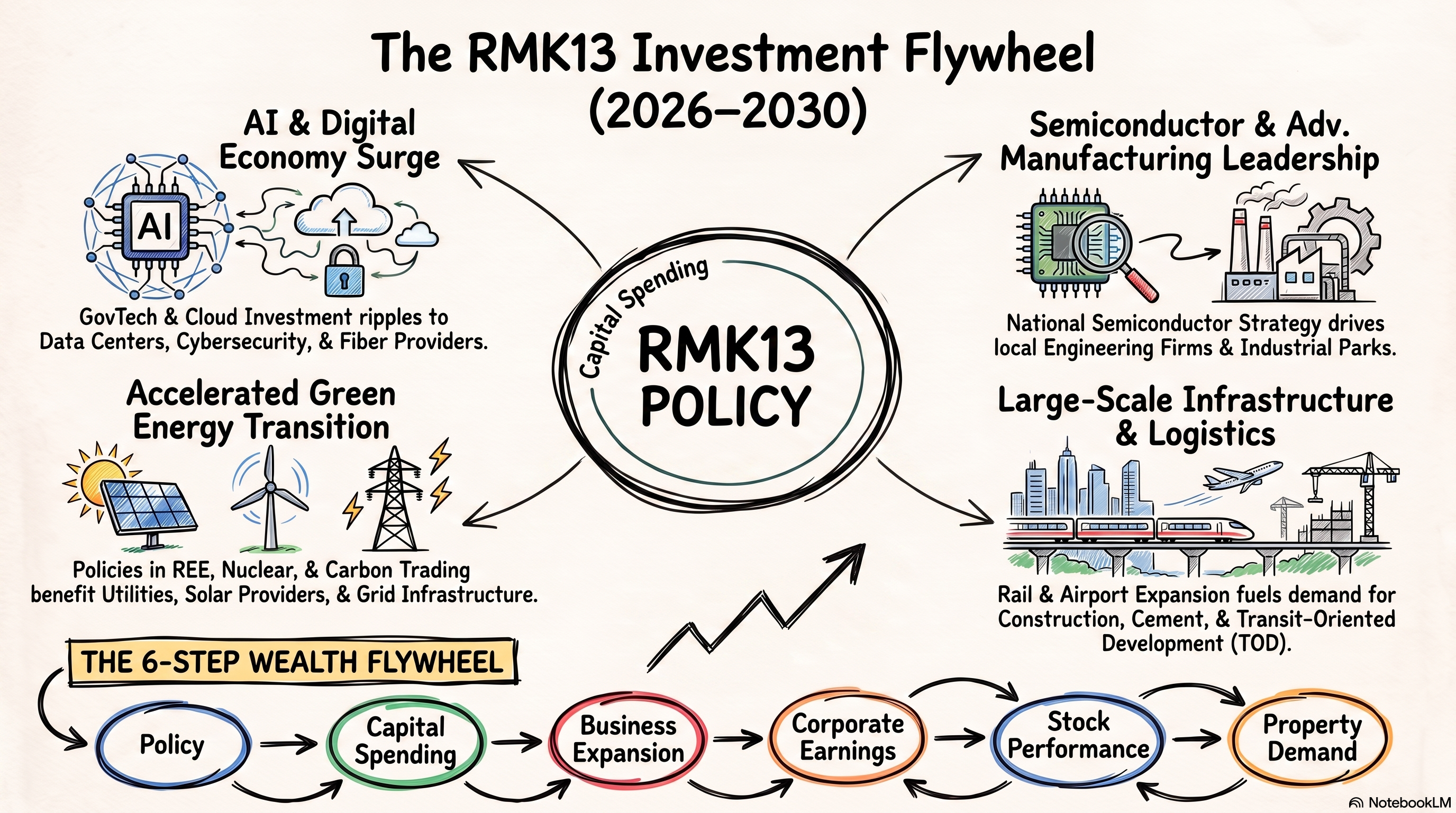
Thirteenth Malaysia Plan (RMK13) 2026–2030, is not simply a government spending plan. It is a capital allocation roadmap that tells investors where Malaysia intends to concentrate public money, policy support, regulatory reforms and private investment over the next five years.
RMK13 revolves around three major themes:
Raise the Ceiling
Transform Malaysia into a high-value economy.
AI, semiconductor, digital economy, renewable energy, logistics and advanced manufacturing become national priorities.
Raise the Floor
Increase household income.
Improve housing.
Improve education and TVET.
Reform labour market.
Raise wages.
Good Governance
Faster approvals.
Digital government.
Better fiscal discipline.
Stronger PPP participation.
Below explains what the government is actually trying to achieve, what actions they will take, and why investors should care.
Corporate Decision Maker
Signal 1: Malaysia is shifting from a labour-cost economy to a technology-driven economy
What the government will do
RMK13 places digitalisation and Artificial Intelligence (AI) at the centre of national development. Rather than competing with neighbouring countries through low wages, Malaysia intends to compete through innovation, automation, productivity and high-value manufacturing. The government will support businesses through AI adoption, digital transformation programmes, innovation incentives, research commercialisation and stronger science and technology capabilities.
Why this matters
This signals that labour-intensive industries will gradually lose competitiveness, while companies investing in automation, AI, software and proprietary technology will receive greater policy support and become more competitive globally.
Who benefits
AI software providers
Industrial automation companies
Robotics suppliers
Engineering firms
Industrial equipment manufacturers
Digital solution providers
Signal 2: Semiconductor becomes Malaysia's flagship industry
What the government will do
Rather than simply attracting more factories, RMK13 focuses on strengthening the entire semiconductor ecosystem. The government plans to reform the local semiconductor industry, strengthen domestic capabilities, develop higher value-added activities, improve local supplier participation and support the National Semiconductor Strategy.
Why this matters
Malaysia is positioning itself higher in the global semiconductor value chain. This means long-term investment into semiconductor parks, engineering talent, supplier development and supporting infrastructure.
Who benefits
Semiconductor manufacturers
Automation equipment
Precision engineering
Industrial property
Electrical engineering firms
Testing and packaging companies
Signal 3: Electricity becomes strategic national infrastructure
What the government will do
The government recognises that AI, semiconductor manufacturing and data centres require enormous electricity capacity. RMK13 therefore includes plans to:
strengthen natural gas supply
upgrade electricity infrastructure
expand renewable energy
introduce nuclear power as a future clean energy option
improve access to green electricity
develop the Rare Earth Elements (REE) value chain.
Why this matters
Electricity is no longer just a utility—it becomes a competitive advantage. Reliable and affordable power will be critical for attracting high-value investments.
Who benefits
Utilities
Renewable energy developers
Power infrastructure contractors
Battery manufacturers
Industrial parks
Data centres
Signal 4: AI becomes national infrastructure
What the government will do
RMK13 states that AI and digital transformation will underpin government services, economic planning and public administration. The government will digitalise public services, expand GovTech initiatives, improve data sharing and develop digital talent.
Why this matters
Government adoption usually accelerates private-sector adoption. Businesses will increasingly require AI solutions, cloud infrastructure, cybersecurity and enterprise software to remain competitive.
Who benefits
Cloud providers
Cybersecurity companies
Software developers
Data centre operators
Digital infrastructure companies
Signal 5: Labour costs will continue rising
What the government will do
The government plans to reduce dependence on foreign workers, strengthen TVET, expand the Progressive Wage Policy, improve workforce productivity and encourage greater participation of women and older workers.
Why this matters
Companies should expect higher wages over the next five years. Businesses that automate operations and improve productivity will be better positioned than those relying heavily on manual labour.
Who benefits
Automation companies
Industrial machinery suppliers
Workforce training providers
HR technology companies
Stock Investor
AI and Digital Economy
Government actions
The government wants Malaysia to become one of the leading AI nations in the region. AI will be integrated across industries while digital economy initiatives continue expanding. Research, innovation and digital infrastructure will receive continued support.
Investment implication
Demand should continue growing for software companies, cybersecurity providers, cloud infrastructure and digital service providers.
Semiconductor
Government actions
Malaysia will strengthen its semiconductor ecosystem through industrial upgrading, local supplier development, engineering talent and greater integration into global supply chains.
Investment implication
Long-term growth remains favourable for semiconductor manufacturers, industrial engineering firms and automation companies.
Renewable Energy and Green Economy
Government actions
RMK13 promotes:
carbon trading
green financing
renewable electricity
CCUS
REE development
clean energy investments.
Investment implication
The transition to a low-carbon economy should support renewable energy companies, utilities, engineering firms and green technology providers.
Utilities
Government actions
To support industrial expansion, AI and data centres, the government plans to expand electricity generation, strengthen transmission networks and improve power reliability.
Investment implication
Electricity demand is expected to rise structurally, supporting utilities and infrastructure companies.
Logistics
Government actions
RMK13 aims to improve logistics efficiency by expanding air transport, strengthening logistics infrastructure and improving supply chain connectivity.
Investment implication
Logistics operators, warehouse REITs, industrial parks and transport infrastructure companies stand to benefit.
Construction
Government actions
The government plans significant investments in:
flood mitigation
public transport
rail infrastructure
airports
utilities
regional infrastructure
Transit-Oriented Development (TOD).
Investment implication
Construction companies with exposure to infrastructure rather than purely residential projects should enjoy stronger order books.
Healthcare
Government actions
Malaysia is preparing for an ageing population through health financing reform, long-term care, digital health systems, healthcare service improvements and medical supply security.
Investment implication
Structural demand should increase for hospitals, pharmaceutical companies, medical device manufacturers and elderly care providers.
Housing
Government actions
Housing reform focuses on:
building more affordable homes
improving housing quality
increasing home ownership
strengthening housing regulations
improving housing management.
Investment implication
Developers with affordable housing, township projects and integrated communities are likely to benefit more than those focused solely on luxury developments.
Property Investor
Industrial property becomes the strongest long-term asset class
Government actions
Industrial policy is centred on semiconductors, advanced manufacturing, logistics, AI, renewable energy and high-value industries. These sectors require factories, logistics hubs, warehouses and industrial parks.
Investment implication
Demand for industrial land is expected to remain stronger than traditional residential property over the long term.
Transit-Oriented Development (TOD)
Government actions
The government will continue improving public transport while encouraging higher-density developments around rail stations and major transport hubs.
Investment implication
Properties near MRT, LRT and future rail corridors should experience stronger long-term demand and appreciation.
Data Centre Corridors
Government actions
By expanding electricity supply, digital infrastructure and AI capabilities, the government is laying the foundation for further data centre investment, particularly in established technology corridors.
Investment implication
Industrial land, commercial developments, worker housing and supporting retail in data centre corridors are likely to benefit from secondary demand.
Regional Development
Government actions
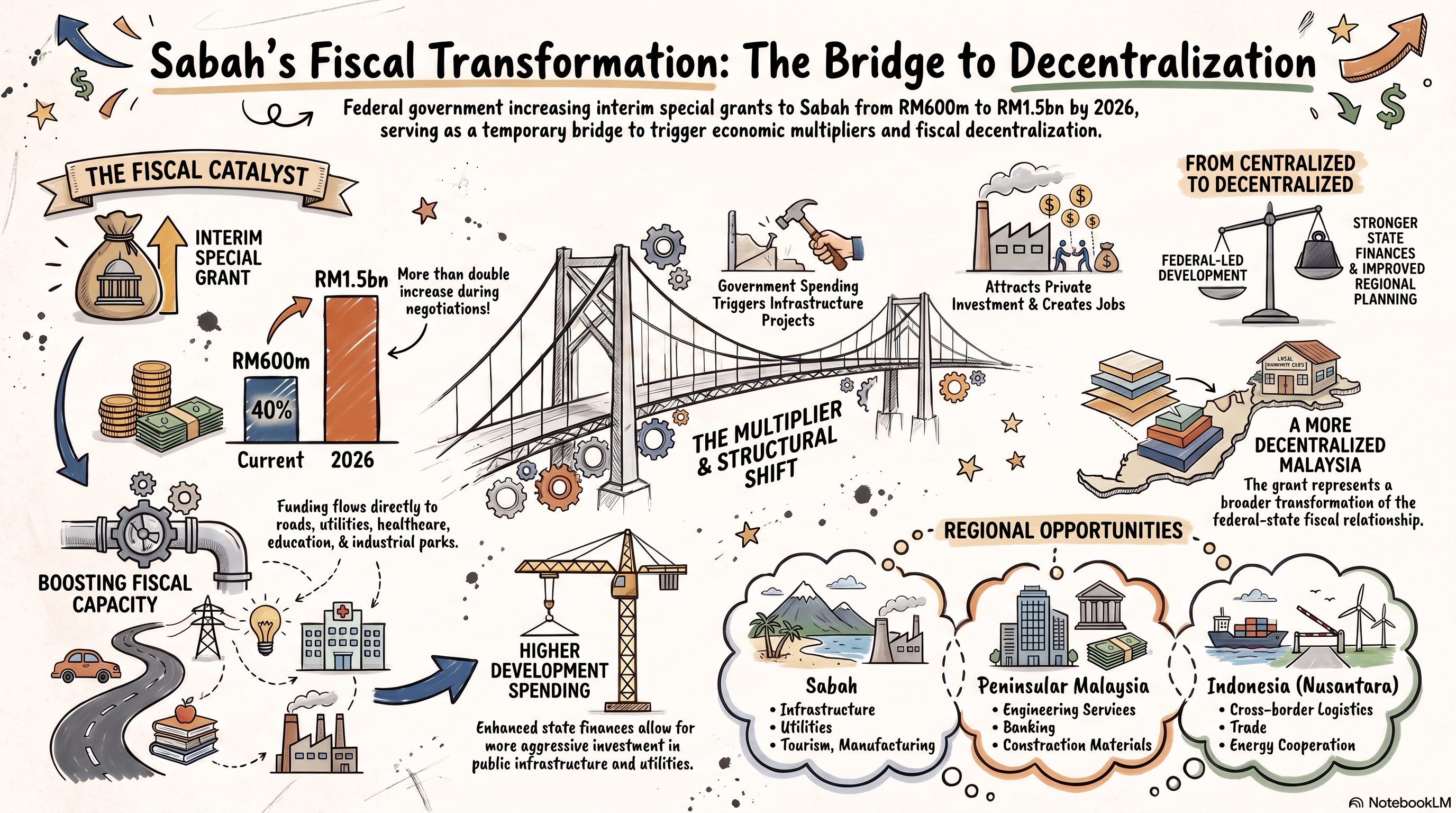
RMK13 aims to reduce development imbalances by investing in infrastructure, connectivity, utilities and economic opportunities outside the Klang Valley. Regional economic integration and rural development are key priorities.
Investment implication
Selected secondary cities, industrial growth corridors and regional economic hubs could experience faster appreciation than in previous development cycles.
Flood Resilience
Government actions
Flood mitigation is elevated to a national priority through accelerated infrastructure projects, improved drainage systems, innovative adaptation measures and stronger disaster governance.
Investment implication
Flood resilience is becoming an increasingly important investment criterion. Areas protected by new mitigation projects may enjoy lower insurance risk, improved confidence and stronger long-term property values.
Frequently Asked Questions (FAQ)
What is the Thirteenth Malaysia Plan (RMK13)?
The Thirteenth Malaysia Plan (RMK13) is Malaysia's five-year national development blueprint covering 2026 to 2030. It outlines the Government's economic priorities, infrastructure investments, policy reforms and development strategies to transform Malaysia into a high-income, technology-driven economy. RMK13 is built around three pillars: raising the economic ceiling, improving living standards and strengthening governance.
Why is RMK13 important for investors?
RMK13 provides one of the clearest indicators of where government spending, incentives and policy support will be concentrated over the next five years. Industries that align with these priorities are more likely to benefit from infrastructure projects, regulatory reforms, private investment and long-term economic growth.
Which sectors are expected to benefit the most from RMK13?
The sectors receiving the strongest policy support include:
Semiconductor and Electronics
Artificial Intelligence (AI)
Digital Economy
Renewable Energy
Utilities
Construction and Infrastructure
Logistics
Healthcare
Industrial Property
Affordable Housing
Research & Innovation
Food Security and Agrotechnology
These sectors are specifically highlighted under RMK13's economic restructuring agenda.
Which Bursa Malaysia sectors could benefit from RMK13?
Investors may want to monitor listed companies in:
Construction
Technology
Electrical & Electronics
Utilities
Renewable Energy
Industrial REITs
Logistics
Healthcare
Engineering Services
Building Materials
While RMK13 does not guarantee higher earnings for every company, businesses operating in government priority sectors may enjoy stronger long-term growth opportunities.
How does RMK13 affect corporate decision makers?
For businesses, RMK13 signals that future competitiveness will increasingly depend on:
Digital transformation
AI adoption
Automation
Workforce productivity
Energy efficiency
Innovation
High-value manufacturing
Companies that modernise operations and align with these national priorities are likely to be better positioned over the next decade.
How will RMK13 affect property investors?
RMK13 places greater emphasis on:
Industrial parks
Logistics hubs
Transit-Oriented Developments (TOD)
Regional economic corridors
Public transport
Flood mitigation infrastructure
As a result, industrial and infrastructure-linked properties may benefit more than traditional residential developments in selected locations.
Will RMK13 create more infrastructure projects?
Yes. RMK13 continues to prioritise investment in:
Public transportation
Rail infrastructure
Airports
Electricity transmission
Renewable energy
Flood mitigation
Water infrastructure
Regional connectivity
Digital infrastructure
These projects aim to improve Malaysia's long-term economic competitiveness while supporting regional development.
Why does RMK13 place so much emphasis on AI and semiconductors?
The Government views AI and semiconductors as strategic industries that can increase productivity, attract foreign investment, create high-income jobs and move Malaysia further up the global value chain. RMK13 therefore supports investment in digital infrastructure, semiconductor capabilities, research, innovation and talent development.
How does RMK13 support renewable energy?
RMK13 outlines plans to strengthen Malaysia's energy transition through:
Green electricity
Carbon trading
Carbon Capture, Utilisation and Storage (CCUS)
Green financing
Renewable energy expansion
Nuclear energy exploration
Rare Earth Elements (REE) development
These initiatives aim to improve energy security while supporting Malaysia's climate commitments.
Does RMK13 mean labour costs will increase?
Yes. RMK13 supports higher wages through labour market reforms, the Progressive Wage Policy, stronger TVET programmes and reduced dependence on low-cost foreign labour. Businesses should therefore expect increasing labour costs and focus on improving productivity through automation and technology adoption.
What are the biggest long-term investment themes from RMK13?
The strongest structural themes include:
Artificial Intelligence
Semiconductor manufacturing
Digital transformation
Renewable energy
Energy infrastructure
Logistics
Industrial property
Healthcare
Advanced manufacturing
Regional development
Research and innovation
These themes are expected to shape Malaysia's investment landscape throughout the 2026–2030 period.
What are the biggest risks investors should monitor?
While RMK13 creates significant opportunities, investors should also monitor:
Global economic slowdowns
Geopolitical tensions and trade restrictions
Delays in project implementation
Fiscal constraints affecting government spending
Rising labour costs
Execution risks for large infrastructure and technology projects
The success of RMK13 will ultimately depend on the pace of implementation, private sector participation and global economic conditions.