🟦 1. The Event (FACT)
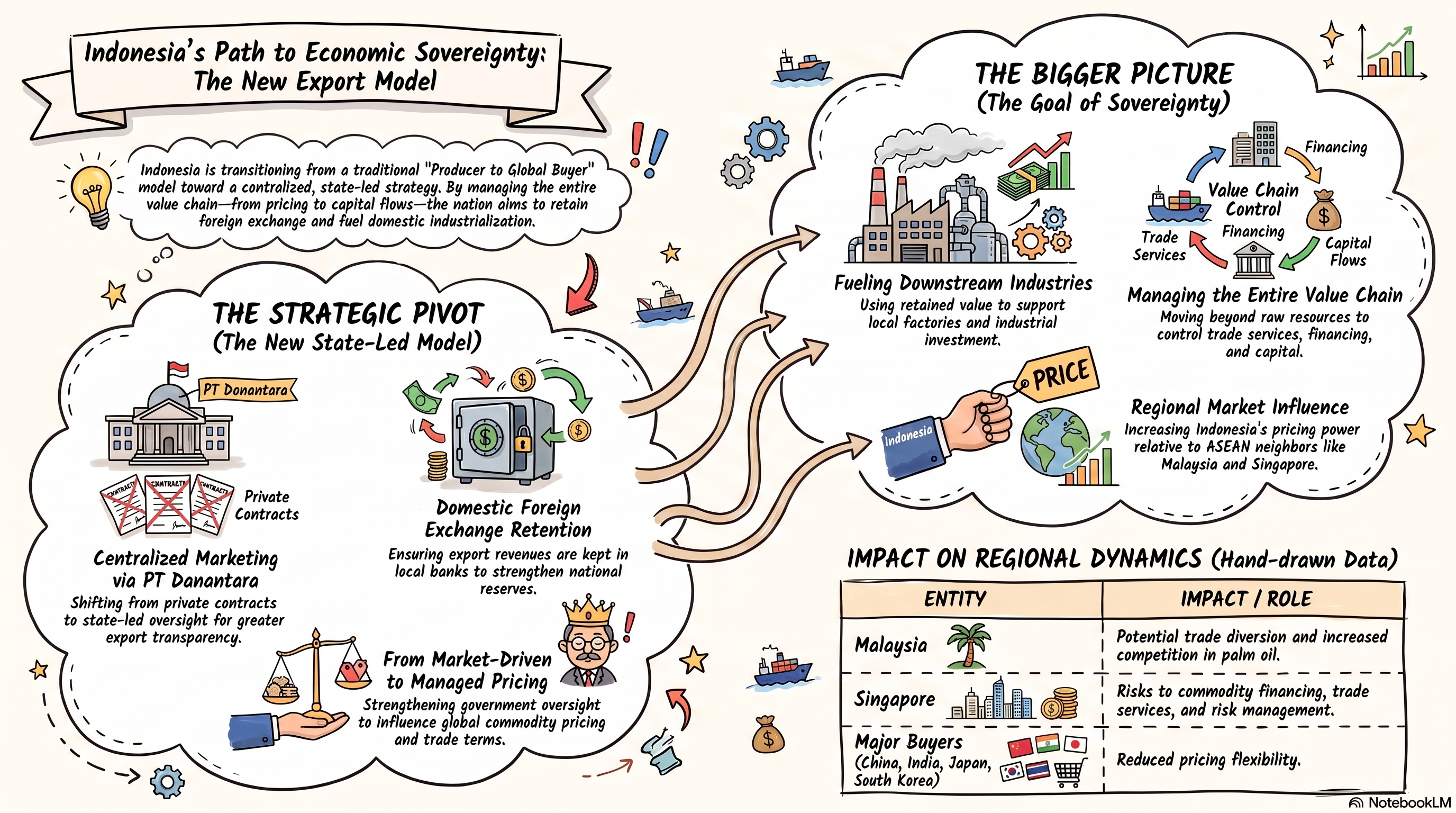
Indonesia announced that exports of palm oil, thermal coal and ferroalloys will progressively be conducted through state-owned PT Danantara Sumber Daya, following a transition period of at least three months. The policy aims to improve export transparency, reduce under-invoicing, increase government revenue, and strengthen Indonesia's foreign exchange reserves, with additional commodities to be reviewed for inclusion every three months.
🟨 2. Affected Channels (MECHANISM)
Trade / Logistics: Export transactions will shift from direct company-to-buyer sales to a state-managed export model.
Regulation: New government controls over export sales and foreign exchange earnings.
Supply: Export administration may affect the timing and execution of commodity shipments during implementation.
Financing: Export proceeds must be retained in Indonesian state banks, affecting exporters' cash management.
Sentiment: Greater state involvement changes the operating environment for commodity exporters.
🟩 3. Malaysia Exposure (WHO)
Exposed sectors
Palm oil
Coal and power generation
Commodity trading
Shipping and logistics
Industrial metals
Types of Malaysian companies
Palm oil producers and exporters competing in international markets.
Commodity trading companies handling Indonesian exports.
Utilities and industrial users importing Indonesian thermal coal.
Shipping and port service providers involved in regional commodity trade.
Manufacturers using ferroalloys as industrial inputs.
Geographic relevance
Malaysia is affected through regional commodity trade, particularly in palm oil markets where Malaysia and Indonesia are the world's two largest exporters, and through reliance on Indonesian coal imports.
🟧 4. What to Watch (SIGNALS)
Implementation details and timeline for the state-managed export system.
Export volumes of Indonesian palm oil, coal and ferroalloys during the transition period.
Changes in benchmark pricing or export contract structures.
Trade flow adjustments by international commodity buyers.
Malaysian corporate disclosures regarding sourcing, export competitiveness or procurement strategies.
Expansion of the policy to additional commodities following the government's three-month reviews.
Foreign exchange and export earnings regulations affecting Indonesian commodity exporters.
Indonesia moves toward state-controlled commodity exports, reshaping global resource trade and capital flows
2. Executive Summary
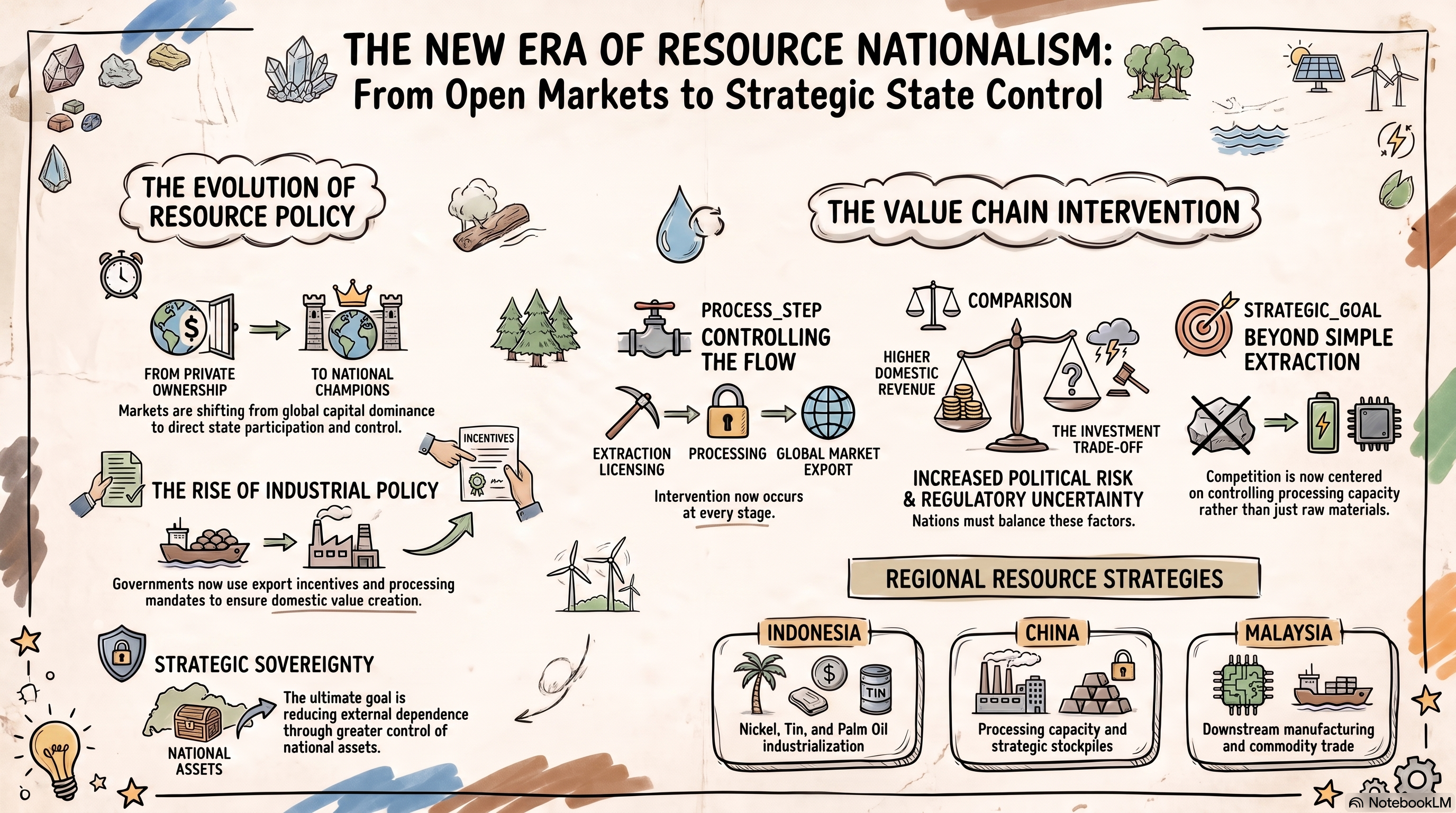
Indonesia is taking a major step from resource nationalism to state-led commodity marketing, requiring key exports (initially palm oil, coal, and ferroalloys) to be routed through a state agency. This is not merely an administrative reform—it changes who controls pricing, settlement, and foreign exchange.
By combining centralized export marketing with a rule requiring 100% of export earnings to remain in domestic banks, Jakarta is attempting to capture more value from its natural resources, strengthen the rupiah, and expand foreign exchange reserves.
The policy mirrors historical state commodity marketing systems (e.g., OPEC coordination, state oil companies, and agricultural marketing boards), increasing Indonesia's ability to influence trade flows and negotiate with major buyers such as China and India.
Investors should see this as part of a broader trend of resource nationalism, industrial policy, and financial sovereignty, with implications extending beyond Indonesia to other commodity-exporting economies.
3. Key Insights
Insight 1: Indonesia is centralizing control over commodity exports
Observation
Rather than allowing producers to sell directly to overseas buyers, a state agency will become the intermediary.
Why it matters
Control over exports provides the government with greater visibility over prices, volumes, tax collection, and foreign exchange.
Second-order implication
Indonesia gains bargaining power with major importing nations while reducing opportunities for under-invoicing and profit shifting.
Insight 2: Commodities are becoming instruments of macroeconomic policy
Observation
The policy explicitly aims to strengthen the rupiah and increase foreign currency reserves.
Why it matters
Natural resource exports are being integrated into monetary and financial stability objectives.
Third-order implication
Commodity policy increasingly overlaps with central banking and exchange-rate management, reducing reliance on interest rate policy alone.
Insight 3: Indonesia is following the downstream industrialization playbook
Observation
The first commodities include coal, palm oil, and ferroalloys, with additional products to be added over time.
Why it matters
This suggests a long-term strategy of extending state influence across a broader range of strategic commodities.
Second-order implication
The government could use centralized marketing to encourage downstream processing, domestic investment, and value-added manufacturing.
Insight 4: Sovereign wealth funds are becoming industrial policy vehicles
Observation
PT Danantara Sumber Daya, under Danantara Indonesia, will manage export transactions.
Why it matters
Sovereign wealth funds are evolving beyond passive investors into active participants in national industrial and trade policy.
Third-order implication
Danantara could become a strategic institution similar to national commodity trading entities or state-owned energy companies, coordinating investment, financing, and export strategy.
Insight 5: Global buyers may face reduced negotiating leverage
Observation
Foreign buyers will increasingly transact with a centralized state entity rather than numerous private exporters.
Why it matters
Centralized marketing can improve price discipline and reduce competitive discounting among domestic producers.
Second-order implication
Importers may experience higher procurement costs and reduced flexibility in contract negotiations.
Insight 6: Financial sovereignty is becoming as important as resource sovereignty
Observation
Export proceeds must be retained within Indonesia's banking system.
Why it matters
The government seeks not only to control physical commodities but also the associated financial flows.
Third-order implication
Domestic liquidity, banking sector funding, and foreign exchange reserves could strengthen, supporting broader financial stability and investment capacity.
4. Interpretation
What is really happening beneath the headlines?
Indonesia is moving beyond simply owning natural resources—it is seeking to control the entire value chain of resource monetization, from production and pricing to export settlement and foreign exchange management.
This strategy echoes several historical precedents:
OPEC demonstrated how coordinated marketing can enhance producer bargaining power.
State oil companies such as Saudi Aramco and national commodity agencies have shown that governments can capture greater economic rents by controlling exports.
Indonesia's own nickel export restrictions were designed to force downstream investment; the new policy extends similar thinking into commodity marketing and finance.
The broader objective is to transform Indonesia from a price taker into a price influencer while retaining more value within the domestic economy.
5. What Changes Next?
Next 6 Months
Likely (75%)
Transition to centralized oversight of exports.
Increased compliance requirements for exporters.
Initial operational challenges as Danantara builds trading capabilities.
Possible (45%)
Expansion of covered commodities beyond the initial three.
Bilateral discussions with major importers regarding new contracting arrangements.
Low Probability, High Impact (20%)
Coordinated commodity marketing among multiple resource-rich countries, increasing producer influence over global pricing.
Next 12 Months
Likely (70%)
Improved visibility over export revenues and tax collection.
Growth in domestic foreign currency deposits.
Further integration of commodity policy with industrial development objectives.
Next 3 Years
Likely (80%)
Expansion of state-led marketing to additional strategic commodities.
Increased downstream investment linked to centralized export policy.
Greater role for Danantara in financing and coordinating industrial development.
6. Winners
Direct Winners
Countries
Indonesia
Industries
Commodity trading (state-led)
Downstream processing
State-owned financial institutions
Industrial logistics
Companies / Institutions
Danantara Indonesia
PT Danantara Sumber Daya
Indonesian state-owned banks
Domestic processing industries
Secondary Winners
Industrial park developers
Infrastructure providers
Ports
Logistics companies
Domestic engineering firms
Currency management and treasury service providers
7. Losers / Pressure Points
Commodity exporters
Private exporters lose direct access to international buyers and may experience reduced commercial flexibility.
Nature: Structural.
International commodity traders
Traditional intermediaries may see reduced roles if the state assumes marketing functions.
Import-dependent countries
Major buyers such as China, India, Vietnam, and the Philippines may face reduced negotiating flexibility and potentially higher procurement costs.
Foreign banks
Reduced offshore retention of export earnings may limit related transaction volumes and deposits.
8. Investment Implications
Equities
Opportunities
Indonesian infrastructure
Domestic banks
Downstream processors
Logistics and ports
Risks
Export-oriented firms facing operational adjustments
Companies dependent on flexible international marketing arrangements
Private Equity
Potential investment areas:
Downstream commodity processing
Industrial parks
Supply-chain infrastructure
Export logistics
Infrastructure
High-conviction themes:
Ports
Storage facilities
Processing plants
Rail and logistics corridors
Venture Capital
Emerging opportunities:
Commodity trading technology
Supply-chain transparency
Trade finance platforms
Digital compliance solutions
Commodities
Watchlist
Palm oil
Thermal coal
Ferroalloys
Nickel (potential future inclusion)
Bauxite and copper if added to the regime
Fixed Income
Potential increase in domestic issuance linked to infrastructure and industrial expansion as foreign exchange reserves strengthen.
Currencies
The policy is explicitly designed to support the Indonesian rupiah through greater onshore retention of export proceeds. Effectiveness will depend on implementation and broader capital flows.
Real Assets
Industrial parks, export terminals, storage facilities, and processing hubs become increasingly valuable as downstream industrialization accelerates.
9. Malaysia / ASEAN Implications
Malaysia
Malaysia may benefit if some commodity buyers diversify sourcing to avoid new Indonesian trading arrangements, particularly in palm oil.
Malaysian commodity traders could capture opportunities if trade flows become more fragmented.
However, if Indonesia succeeds in strengthening pricing discipline, Malaysian exporters may face pressure to adapt to a more state-influenced regional market.
Singapore
As Asia's commodity trading and financial hub, Singapore could experience mixed effects. Some trading activity may migrate to Indonesia, while demand for financing, hedging, and risk management services could remain strong if contracts become more standardized.
Indonesia
Strengthens control over export revenues, foreign exchange, and commodity pricing.
Supports broader downstream industrialization and financial sovereignty objectives.
Thailand
Manufacturing sectors dependent on Indonesian coal or ferroalloys may face greater procurement complexity.
Opportunities may arise for logistics and alternative sourcing.
Vietnam
Heavy reliance on Indonesian thermal coal means procurement strategies may need to diversify if centralized marketing changes pricing or contract terms.
10. Long-Term Structural Trend
Megatrend | Assessment | Why |
Resource nationalism | Strongly reinforces | The state is expanding control over commodity exports and associated revenues. |
Industrial policy | Strongly reinforces | Export policy is being used to support downstream development and macroeconomic objectives. |
Financial fragmentation | Strongly reinforces | Export earnings are increasingly retained within domestic financial systems. |
Multipolar world | Strongly reinforces | Resource-rich countries seek greater influence over trade and pricing. |
Re-industrialisation | Moderately reinforces | Greater domestic value capture encourages local processing. |
Supply-chain resilience | Moderately reinforces | Importers may diversify suppliers to reduce dependence. |
Friend-shoring | Weakly reinforces | Buyers may seek politically aligned alternatives where feasible. |
Energy transition | Neutral | Coal inclusion reflects strategic resource management rather than decarbonization. |
AI infrastructure | Neutral | No direct implication. |
Defence spending | Weakly reinforces | Stronger financial sovereignty can indirectly support broader strategic resilience. |
11. Hidden Insights
Indonesia is nationalizing the commercial interface rather than the assets. Producers remain private, but the state increasingly controls how value is realized in international markets.
Foreign exchange policy is becoming a core component of industrial strategy. Retaining export earnings domestically strengthens banking liquidity and may lower funding costs for domestic investment.
Commodity trading itself is becoming a strategic capability. Governments are recognizing that controlling contracts, pricing, and settlement can be as valuable as controlling production.
Other resource-rich countries may study this model. If Indonesia demonstrates improved fiscal revenues and currency stability, similar export-marketing mechanisms could emerge elsewhere.
Global commodity markets may become less competitive and more state-mediated. Greater government involvement could reduce pricing transparency and increase the importance of political relationships in securing supply.
12. Signals to Monitor
Bullish Confirmation
Smooth implementation of Danantara's export role.
Growth in Indonesia's foreign exchange reserves.
Increased domestic bank deposits from export earnings.
Expansion of the policy to additional commodities.
New downstream investment announcements linked to state-led marketing.
Bearish Confirmation
Significant resistance from exporters or buyers.
Operational bottlenecks delaying shipments.
Reduced export competitiveness due to administrative complexity.
Invalidation Signals
Major exemptions that allow producers to continue selling directly at scale.
Reversal or suspension of the policy following industry opposition.
No measurable improvement in tax collection, foreign exchange reserves, or rupiah stability after implementation.
13. Bottom Line
Indonesia is evolving from a resource producer into a resource manager, extending state influence over pricing, exports, and financial flows.
Commodity policy is increasingly serving macroeconomic goals, including currency stability and reserve accumulation.
Sovereign wealth funds are becoming operational tools of industrial and trade policy rather than passive investment vehicles.
The policy strengthens the global trend toward resource nationalism and greater state participation in commodity markets.
Importers should prepare for a future in which access to strategic resources depends increasingly on government-to-government relationships as well as commercial contracts.
ASEAN commodity trade may become more fragmented, creating opportunities for alternative suppliers while increasing the strategic value of logistics and trade finance.
Investors should watch implementation quality closely; effective execution could become a model for other commodity-exporting economies, while operational difficulties could limit its impact.
Over the next decade, control over how commodities are marketed and monetized may prove as strategically important as control over the resources themselves.