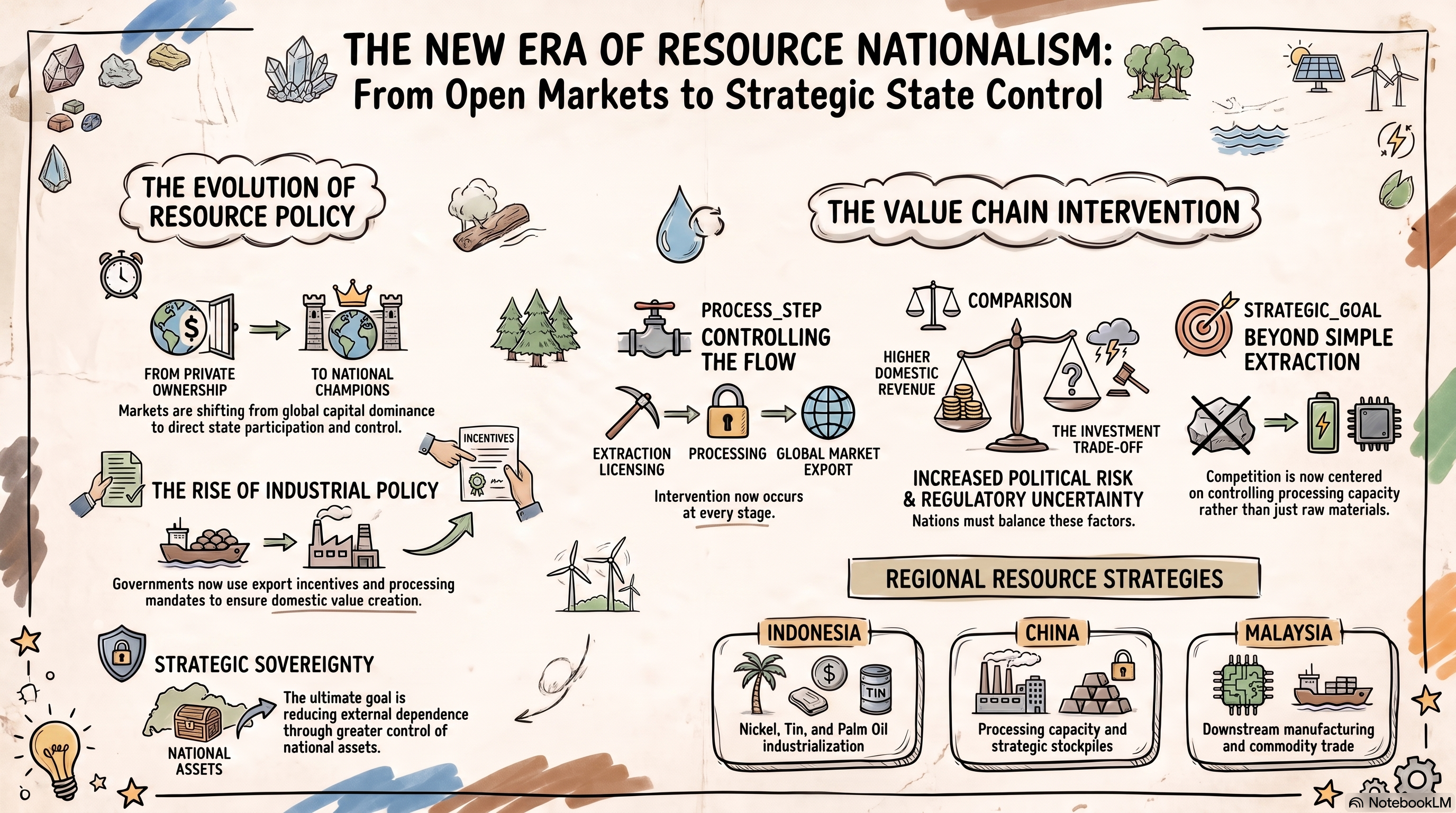
🟦 1. The Event (FACT)
Since March 2025, the Indonesian government under President Prabowo Subianto has seized over 4 million hectares of plantations, mining concessions, and processing facilities, transferring much of the land to state-owned Agrinas Palma Nusantara.
The campaign targets palm oil, nickel, tin, and other commodities, citing governance, permit violations, and alleged illegal gains.
🟨 2. Affected Channels (MECHANISM)
Supply: Immediate state control of plantation and mining assets may disrupt production planning
Cost: Penalties and joint-operation revenue-sharing reduce profitability for affected operators
Demand: Potential impacts on commodity flows if operations slow or replanting is delayed
Regulation: Enforcement of land reclamation, fines, and permit reviews
Sentiment: Heightened investor caution and perception of increased resource nationalism
🟩 3. Malaysia Exposure (WHO)
Exposed sectors: Palm oil, nickel, tin, mining services, commodity trading
Company types: Malaysian plantation operators with Indonesian holdings (e.g., IOI Corp, First Resources, SD Guthrie), commodity traders, mining investors
Geographic relevance: Indonesia (Sumatra, Kalimantan, Halmahera), with downstream exposure in Malaysia for trade and investment
🟧 4. What to Watch (SIGNALS)
Updates on fines, penalties, or joint-operation agreements for seized land
Changes in production output, plantation replanting schedules, or mining activity
Announcements from Malaysian firms assessing or altering Indonesian investments
Commodity trade flows from Indonesia (palm oil, nickel, tin) to regional buyers
Government communications on land seizure policy or further resource nationalisation
1. Key Insights
1.1 This is not just governance — it’s resource nationalism with teeth
Indonesia has always talked about resource sovereignty. What’s different now is scale, speed, and coercive enforcement:
4+ million hectares seized in <1 year
Military-led task force
Assets transferred directly to a state operator (Agrinas)
This moves Indonesia from regulatory nationalism to operational state control.
1.2 Prabowo is building a command-style economic pillar
This resembles:
Early Suharto-era consolidation
Latin American-style strategic sector control
Less rule-based, more discretionary enforcement
The phrase “defending the people” is politically powerful, but investors should read this as executive power concentration, not just reform.
1.3 Agrinas is being positioned as a national champion — but it’s underprepared
Facts that matter:
<50% of seized land is productive
Fragmented plots, poor agronomy
Led largely by retired military officers
Heavy capex needs (replanting, restoration, logistics)
This is administrative expansion faster than operational capacity, a classic inefficiency risk.
1.4 Legal ambiguity is intentional, not accidental
Overlapping forest vs cultivation permits are real — but:
These overlaps existed for decades
Central government approved many of them implicitly
Enforcement now is selective and retroactive
This creates policy optionality for the state but legal uncertainty for investors.
1.5 Smallholders are collateral damage, not beneficiaries
Despite populist rhetoric:
Farmers lose independence
Revenue share drops to ~55–60%
Cash flow delays
Replanting halted
This weakens long-term productivity, not strengthens it.
2. Impact Assessment (Short-, Medium-, Long-Term)
2.1 Short-term impact (0–12 months)
Palm oil
Minimal immediate supply shock
Prices remain muted
Operational confusion, delayed harvesting & replanting
Nickel & metals
Higher volatility risk
Even small seizures already moved prices
Financing costs rise for marginal miners
Capital markets
Indonesia risk premium increases quietly
FDI slows, not collapses
More “wait and see” behavior
2.2 Medium-term impact (1–3 years)
This is where pain shows up.
Production risk
Delayed replanting → yield drop
Farmer disengagement
Inefficient state management
Cost inflation
Compliance, fines, renegotiation costs
Higher political risk insurance
Banks tighten lending terms
Investment diversion
Capital flows to:
Malaysia (palm)
Philippines / PNG (nickel alternatives)
Africa & LatAm for new agri exposure
2.3 Long-term impact (3–7 years)
Two diverging paths:
Scenario A (Optimistic, low probability)
State improves land governance, productivity recovers, Agrinas professionalises.
Scenario B (More realistic)
Structural underinvestment
Politicised land allocation
Lower national output growth
Indonesia trades efficiency for control
History suggests Scenario B is more likely unless governance reforms follow — which are not visible yet.
3. Interpretation of the Action (Strategic Reading)
3.1 This is about funding the state
Prabowo has:
Expensive social programmes
Defence spending ambitions
Food and energy security goals
Seized land + fines = off-balance-sheet fiscal lever.
3.2 This is a political signal to elites
The message is clear:
Old networks are expendable
Licenses ≠ permanent rights
Loyalty matters as much as legality
This will discipline domestic conglomerates, not just foreigners.
3.3 This is leverage over foreign capital
Indonesia isn’t anti-investment — it’s anti-unconditional investment.
Future deals will increasingly require:
Local value-add
State participation
Political alignment
4. What Should Investors Do?
4.1 Public equity investors
Reduce naïve “Indonesia growth premium” assumptions
Apply higher discount rates
Stress-test land tenure risk
Assume higher regulatory intervention probability
Prefer companies with:
Shorter permit chains
Strong Jakarta-level relationships
Downstream integration (less land exposure)
4.2 Private equity & direct investors
If you’re entering Indonesia now:
Assume land tenure is revocable
Structure deals with:
Convertible concessions
Exit-trigger clauses
International arbitration (even if imperfect)
Avoid greenfield plantation risk
Brownfield + joint ventures are safer — but still political.
4.3 Commodity traders
Short-term: volatility trading opportunities
Medium-term: hedge Indonesian supply risk more aggressively
Long-term: diversify origination geography
This especially applies to:
Palm oil
Nickel intermediates
Tin concentrates
4.4 Lenders & project finance
Tighten covenants
Reprice political risk
Shorten tenor
Require stronger cash sweep mechanisms
Some projects that looked bankable in 2023 are not bankable anymore without sovereign comfort.
5. What Should Corporates & Operators Do?
5.1 Existing operators in Indonesia
Audit all land permits immediately
Model retroactive penalties
Prepare for forced JV scenarios
Budget for fines > land value (this is real)
5.2 Smallholders & local operators
Realistically:
Collective bargaining > individual resistance
Legal wins are unlikely
Cash flow survival > land ownership ideology
Emotionally understandable resistance ≠ economically optimal outcome.
6. Bottom Line
This is not a temporary crackdown and not just about environmental cleanup.
It is a structural shift toward state-dominant control of strategic resources.
Indonesia remains investable — but:
Not cheap
Not predictable
Not hands-off anymore
Anyone pricing Indonesia like Vietnam or Thailand is misreading the political economy.