🟦 1. The Event (FACT)
China announced a consumption tax on lithium-ion batteries and solar cells to be introduced in phases, with lithium-ion batteries taxed from September 2026 and solar cells from April 2027. The move ends tax exemptions introduced in 2015 and forms part of Beijing's efforts to address excess production capacity in the clean energy manufacturing sector.
🟨 2. Affected Channels (MECHANISM)
Regulation: New consumption taxes increase policy oversight of the solar and battery industries.
Cost: Manufacturers may face higher production costs or reduced margins.
Supply: Measures may discourage excess capacity expansion and support industry consolidation.
Demand: Higher product costs could influence purchasing decisions, depending on tax pass-through.
Sentiment: Signals continued government intervention to improve industry sustainability.
🟩 3. Malaysia Exposure (WHO)
Exposed sectors
Solar manufacturing
Battery manufacturing
Renewable energy
Electrical and electronics
Industrial manufacturing
Types of Malaysian companies
Solar module and component manufacturers.
Battery manufacturers and battery supply chain participants.
Renewable energy developers.
Electrical equipment manufacturers.
Companies supplying materials or components to China's clean energy industry.
Geographic relevance
Malaysia is exposed through its role in regional solar manufacturing supply chains and clean energy exports, particularly to global markets served by Chinese producers.
🟧 4. What to Watch (SIGNALS)
Implementation of the consumption tax according to the announced timeline.
Capacity reduction, plant closures or consolidation within China's solar and battery industries.
Corporate announcements on production, pricing and capital expenditure.
Export volumes of Chinese solar products and lithium-ion batteries.
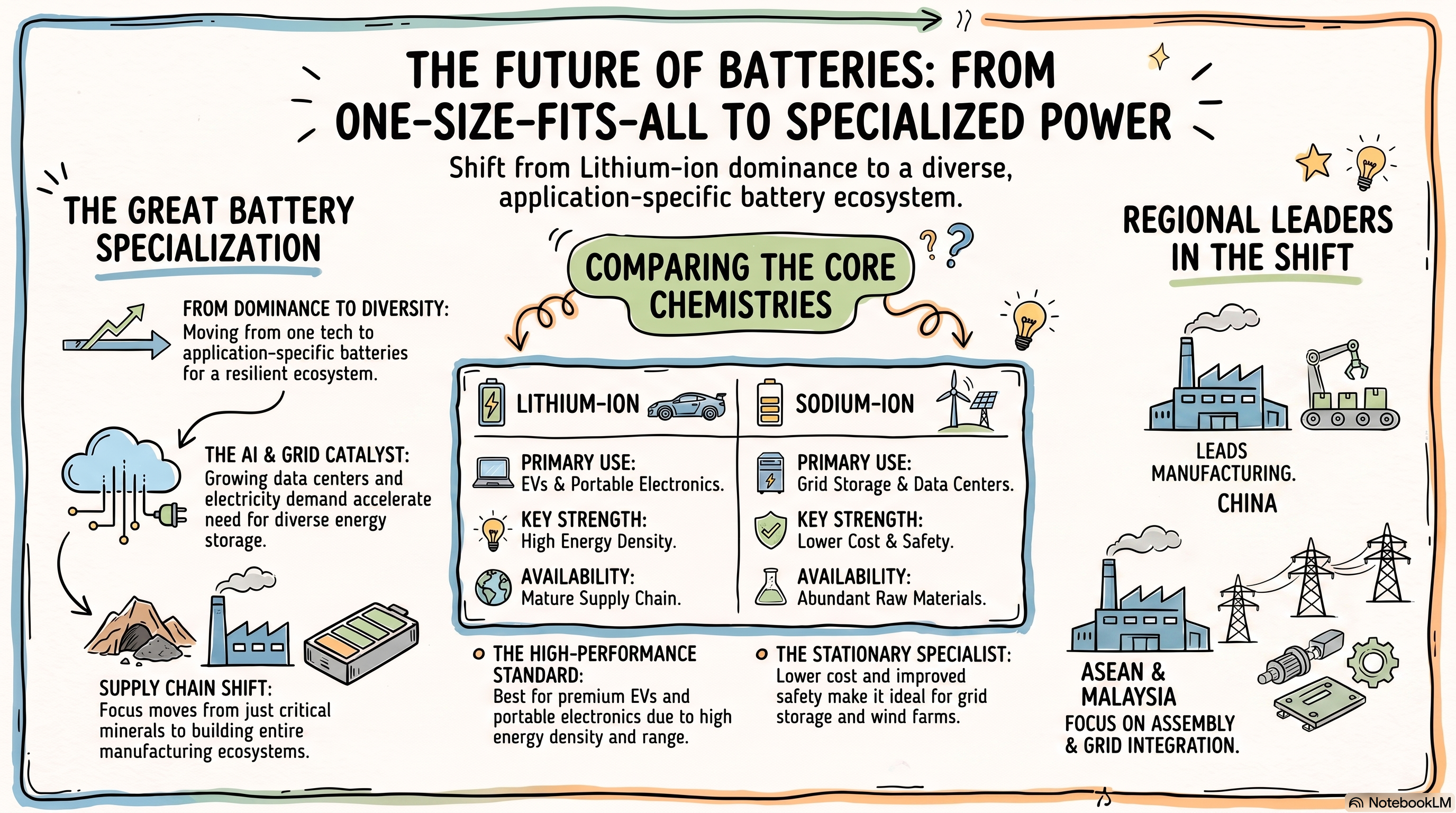
Investment trends in exempt technologies such as sodium-ion, perovskite solar cells and solid-state batteries.
Manufacturing expansion or relocation by clean energy companies within Asia.
Malaysian corporate disclosures relating to solar exports, battery supply chains or production capacity adjustments.
China's new clean-energy tax marks the shift from capacity expansion to industrial consolidation
2. Executive Summary
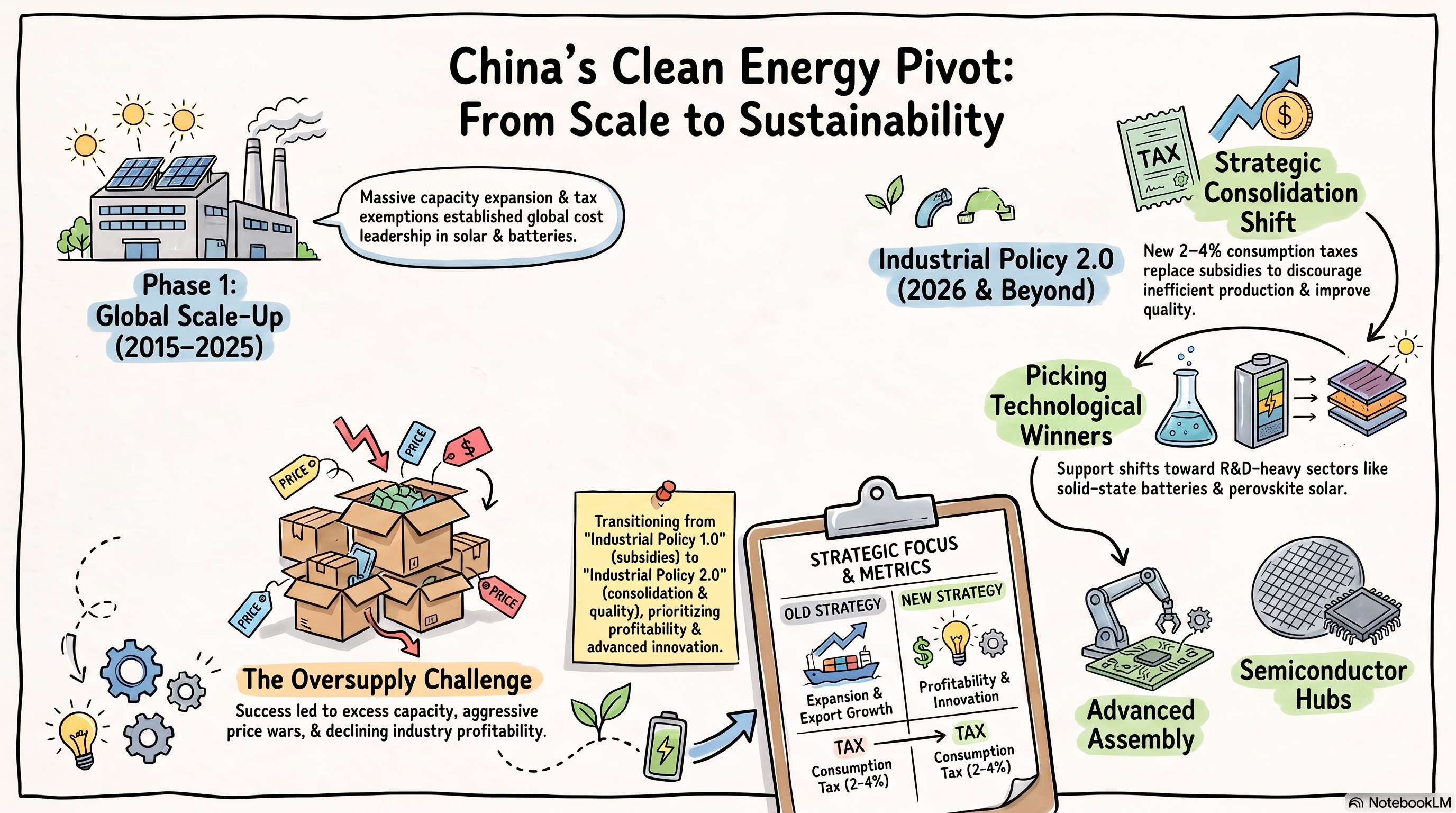
China's decision to impose a consumption tax on lithium-ion batteries and solar cells represents a significant change in industrial policy. After a decade of subsidizing rapid expansion, Beijing is now using taxation to eliminate excess capacity and improve industry profitability.
The tax is relatively modest (2%, rising to 4%), but its strategic objective is much larger: accelerate consolidation by raising costs for weaker manufacturers while allowing market leaders to strengthen their competitive position.
The exemption for perovskite solar cells, sodium-ion batteries, and solid-state batteries demonstrates that China is simultaneously discouraging mature technologies while incentivizing next-generation innovation.
Investors should view this as Industrial Policy 2.0—China is moving from creating national champions to improving industry quality, profitability, and technological leadership.
3. Key Insights
Insight 1: China has shifted from industrial expansion to industrial optimisation
Observation
China is ending a decade-long tax exemption that helped build its global leadership in batteries and solar manufacturing.
Why it matters
The government's priority has changed. Previously, the objective was maximum production capacity; now it is sustainable profitability and technological competitiveness.
Second-order implication
Future policy will likely focus on improving returns on capital rather than maximizing output.
Third-order implication
China's clean-energy industries become more disciplined, with healthier pricing and stronger market structures.
Insight 2: Consolidation—not tax revenue—is the primary objective
Observation
The tax rates are relatively small but will disproportionately affect lower-margin manufacturers.
Why it matters
The policy is designed to accelerate consolidation by increasing financial pressure on weaker firms.
Second-order implication
Large manufacturers such as Contemporary Amperex Technology Co., Longi Green Energy Technology Co., and Jinko Solar Co. are better positioned to absorb costs or pass them on.
Third-order implication
Market concentration increases, giving industry leaders greater pricing power over time.
Insight 3: Beijing is encouraging technological leapfrogging
Observation
Perovskite solar cells, sodium-ion batteries, and solid-state batteries remain exempt until at least the end of 2028.
Why it matters
China is using tax policy to steer investment toward next-generation technologies rather than simply protecting existing industries.
Second-order implication
Capital expenditure increasingly shifts toward advanced manufacturing and R&D.
Third-order implication
China seeks to maintain technological leadership rather than merely manufacturing scale.
Insight 4: The solar industry enters a new phase
Observation
Solar manufacturers have endured more than two years of severe overcapacity and price wars.
Why it matters
Higher costs may accelerate factory closures and capacity rationalisation.
Second-order implication
Industry profitability could recover even if shipment volumes moderate.
Insight 5: The battery industry is being regulated before severe oversupply develops
Observation
Unlike solar, batteries continue benefiting from EV and energy storage demand.
Why it matters
China is acting pre-emptively to avoid repeating the solar industry's prolonged price collapse.
Third-order implication
Industrial policy becomes increasingly preventative rather than reactive.
Insight 6: Fiscal policy is becoming an industrial policy tool
Observation
The government expects to raise approximately 45 billion yuan in additional revenue.
Why it matters
The revenue is secondary to shaping market behaviour.
Second-order implication
Future industrial policy may increasingly rely on taxes and incentives instead of direct subsidies.
4. Interpretation
What is really happening beneath the headlines?
China has reached a new stage of industrial development.
Between 2015 and 2025, policy focused on building global manufacturing dominance through tax exemptions, subsidies, and scale expansion.
That strategy succeeded:
China dominates global solar manufacturing.
China dominates EV battery production.
Chinese firms became global cost leaders.
The challenge now is too much success.
Excess capacity has led to destructive price wars, weak profitability, and poor returns on investment. Rather than continuing to subsidize production, Beijing is introducing measured taxation to encourage weaker producers to exit while preserving incentives for technological advancement.
This reflects a broader evolution in Chinese industrial policy—from "grow at all costs" to "optimize industry structure."
5. What Changes Next?
Next 6 Months
Likely (80%)
Share prices of leading manufacturers outperform smaller competitors.
Consolidation discussions accelerate.
Manufacturers begin adjusting pricing and production plans.
Possible (50%)
Additional industrial standards targeting inefficient production.
Increased mergers or acquisitions among Tier 2 producers.
Low Probability, High Impact (15%)
More aggressive capacity reduction measures if oversupply persists despite the tax.
Next 12 Months
Likely (75%)
Solar margins begin stabilizing.
Battery manufacturers pass through part of the tax to customers.
Investment shifts toward exempt technologies.
Next 3 Years
Likely (80%)
Industry concentration increases.
Next-generation battery and solar technologies gain market share.
China's clean-energy manufacturing becomes more profitable and technologically advanced.
6. Winners
Direct Winners
Companies
Contemporary Amperex Technology Co.
Longi Green Energy Technology Co.
Jinko Solar Co.
Leading integrated manufacturers with strong balance sheets
Industries
Solid-state batteries
Sodium-ion batteries
Perovskite solar
Advanced materials
Industrial automation
Secondary Winners
Equipment manufacturers serving next-generation production.
R&D-intensive technology firms.
High-efficiency component suppliers.
7. Losers / Pressure Points
Tier 2 and Tier 3 manufacturers
Face higher costs with limited pricing power.
Nature: Structural, as consolidation is a core policy objective.
Commodity suppliers serving inefficient producers
Demand may weaken if factory closures accelerate.
Smaller exporters
Reduced competitiveness if unable to absorb higher costs.
8. Investment Implications
Equities
Opportunities
Large battery manufacturers
Leading solar manufacturers
Semiconductor equipment
Industrial automation
Advanced materials
Risks
Smaller battery companies
Highly leveraged solar firms
Low-margin manufacturers
Private Equity
Opportunities in:
Battery technology
Advanced materials
Industrial automation
Clean-energy software
Infrastructure
Continued investment in:
Energy storage
Grid modernization
Renewable integration
Venture Capital
High-conviction themes:
Perovskite solar
Sodium-ion batteries
Solid-state batteries
Battery recycling
Manufacturing AI
Commodities
Watchlist
Lithium
Nickel
Copper
Polysilicon
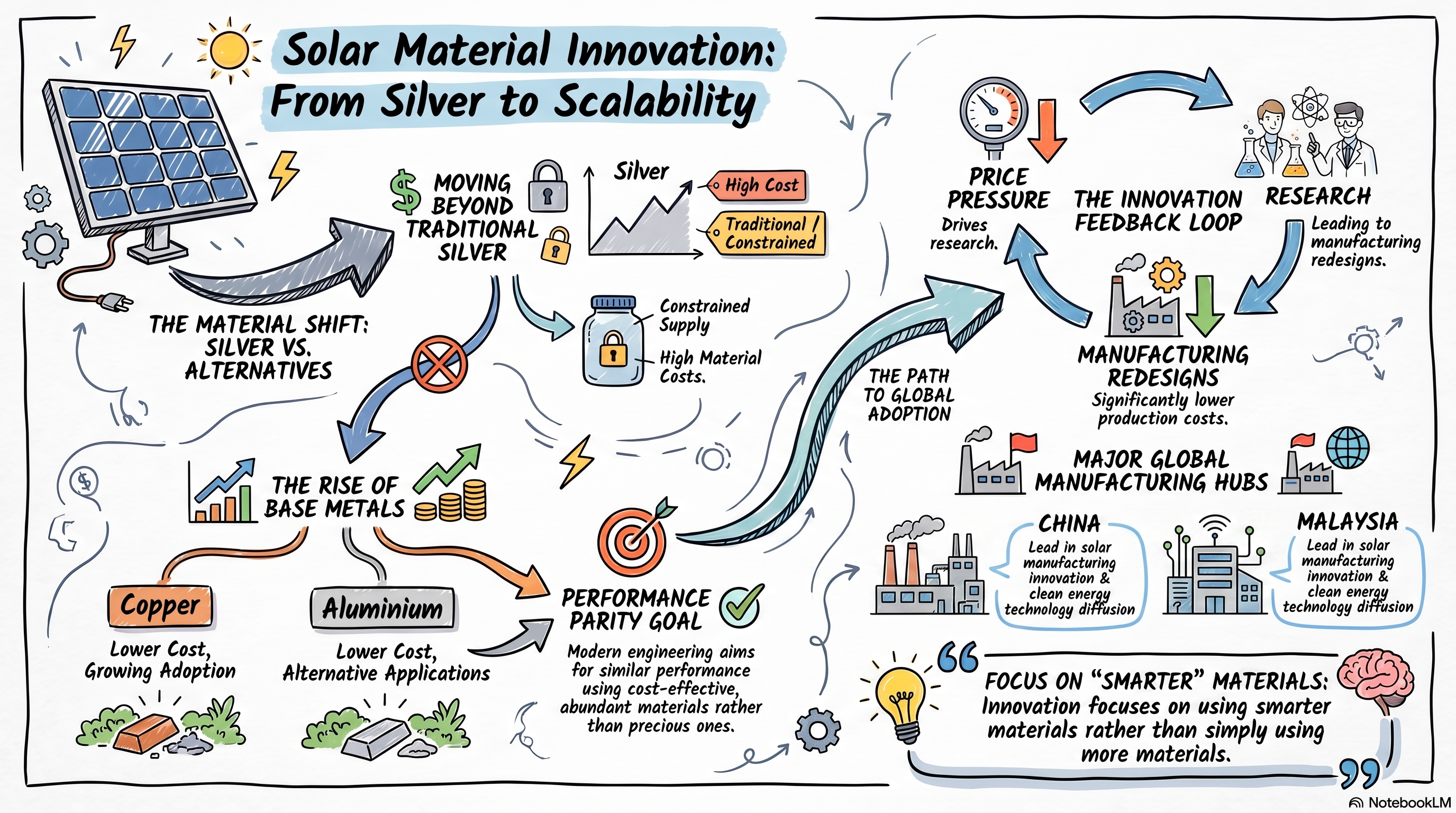
Silver
Rare earths
Fixed Income
Credit quality of market leaders may improve as industry profitability strengthens, while weaker manufacturers could face refinancing pressure.
Currencies
Limited direct impact on the renminbi, though stronger export competitiveness among industry leaders may support China's clean-energy trade surplus over time.
Real Assets
Advanced manufacturing facilities focused on exempt technologies become increasingly valuable.
9. Malaysia / ASEAN Implications
Malaysia
Malaysia could be one of the largest indirect beneficiaries.
Positive
Increased Chinese investment into Malaysian battery and solar manufacturing as firms optimize regional supply chains.
Higher demand for Malaysian semiconductor packaging, industrial automation, precision engineering, and electrical components.
Stronger opportunities in battery assembly, renewable energy, and data centre energy storage.
Risks
Malaysian firms competing directly with Chinese exports may continue facing pricing pressure from dominant industry leaders after consolidation.
Singapore
Benefits from increased financing, regional headquarters activity, commodity trading, and supply-chain management for advanced clean-energy technologies.
Indonesia
Major beneficiary
Indonesia's nickel industry and battery ecosystem become increasingly strategic as larger Chinese battery manufacturers consolidate and continue investing in integrated EV supply chains.
Thailand
EV manufacturing ecosystem may benefit from stronger, more stable battery suppliers and continued Chinese investment.
Vietnam
Electronics and renewable manufacturing supply chains could attract additional investment as Chinese firms diversify production while maintaining technological leadership.
10. Long-Term Structural Trend
Megatrend | Assessment | Why |
Industrial policy | Strongly reinforces | Tax policy is being used to shape industrial structure rather than simply raise revenue. |
Re-industrialisation | Strongly reinforces | Focus shifts toward higher-value, technologically advanced manufacturing. |
Energy transition | Strongly reinforces | Cleaner technologies continue receiving policy support despite taxation of mature products. |
Supply-chain resilience | Moderately reinforces | Industry consolidation creates stronger, financially healthier suppliers. |
Technological competition | Strongly reinforces | Tax exemptions explicitly favour next-generation technologies. |
Multipolar world | Moderately reinforces | China strengthens strategic leadership in clean-energy manufacturing. |
Resource nationalism | Weakly reinforces | Demand remains concentrated around strategic battery minerals. |
AI infrastructure | Weakly reinforces | Advanced manufacturing increasingly integrates AI-driven production and quality control. |
Friend-shoring | Neutral | China's policy is focused on domestic industrial optimization rather than geopolitical supply-chain realignment. |
Financial fragmentation | Neutral | Limited direct impact. |
11. Hidden Insights
This marks the end of China's subsidy era for mature clean-energy industries. The government believes these sectors are now globally competitive enough to operate with less direct support, shifting policy toward improving industry economics rather than expanding capacity.
The tax is effectively a profitability filter. A 2–4% levy is manageable for industry leaders but can materially erode margins for weaker firms already operating at or below breakeven, accelerating consolidation without imposing explicit production quotas.
Innovation is being rewarded selectively. By exempting perovskite solar cells, sodium-ion batteries, and solid-state batteries through 2028, Beijing is using tax policy to direct capital toward technologies that could define the next decade of clean-energy competition.
The policy complements—not replaces—earlier industrial measures. Recent efficiency standards for solar and polysilicon, together with this tax, form a coordinated strategy to reduce excess capacity while improving product quality and returns on capital.
Malaysia and ASEAN may benefit through supply-chain upgrading rather than production migration. Rather than relocating large volumes of manufacturing out of China, leading Chinese firms may deepen regional partnerships in components, engineering, battery materials, and advanced manufacturing as they move up the technology curve.
12. Signals to Monitor
Bullish Confirmation
Increased mergers, acquisitions, or capacity closures among Tier 2 solar and battery manufacturers.
Recovery in gross margins for leading producers such as CATL and major integrated solar companies.
Rising investment announcements in perovskite, sodium-ion, and solid-state technologies.
Continued tightening of industrial standards targeting inefficient production.
Bearish Confirmation
Persistent price wars despite the new tax.
Weak EV or energy storage demand reducing manufacturers' ability to absorb higher costs.
Significant declines in exports due to reduced global demand rather than healthier industry structure.
Invalidation Signals
Beijing delays or reverses the implementation of the consumption tax.
Authorities introduce broad new subsidies that offset the tax and encourage renewed capacity expansion.
Industry overcapacity continues worsening despite consolidation measures, indicating the policy has limited structural impact.
13. Bottom Line
China's new consumption tax represents a strategic evolution in industrial policy, shifting from building manufacturing scale to improving industry quality and profitability.
The objective is consolidation, not fiscal revenue, with stronger firms expected to emerge while weaker manufacturers face greater pressure.
Exemptions for next-generation technologies signal that Beijing is encouraging innovation even as it withdraws preferential treatment from mature industries.
Market leaders are likely to strengthen their competitive positions, while smaller producers may face increasing consolidation or exit pressures.
Malaysia and ASEAN stand to benefit indirectly through higher-value supply-chain integration, engineering services, battery materials, and advanced manufacturing partnerships.
Investors should focus less on the modest headline tax rate and more on the broader policy direction: China is entering a phase where industrial discipline, technological leadership, and sustainable profitability matter more than sheer production volume.
Over the next three to five years, this transition could create a healthier clean-energy sector with fewer participants, stronger pricing power, and greater emphasis on next-generation technologies.