🟦 1. The Event (FACT)
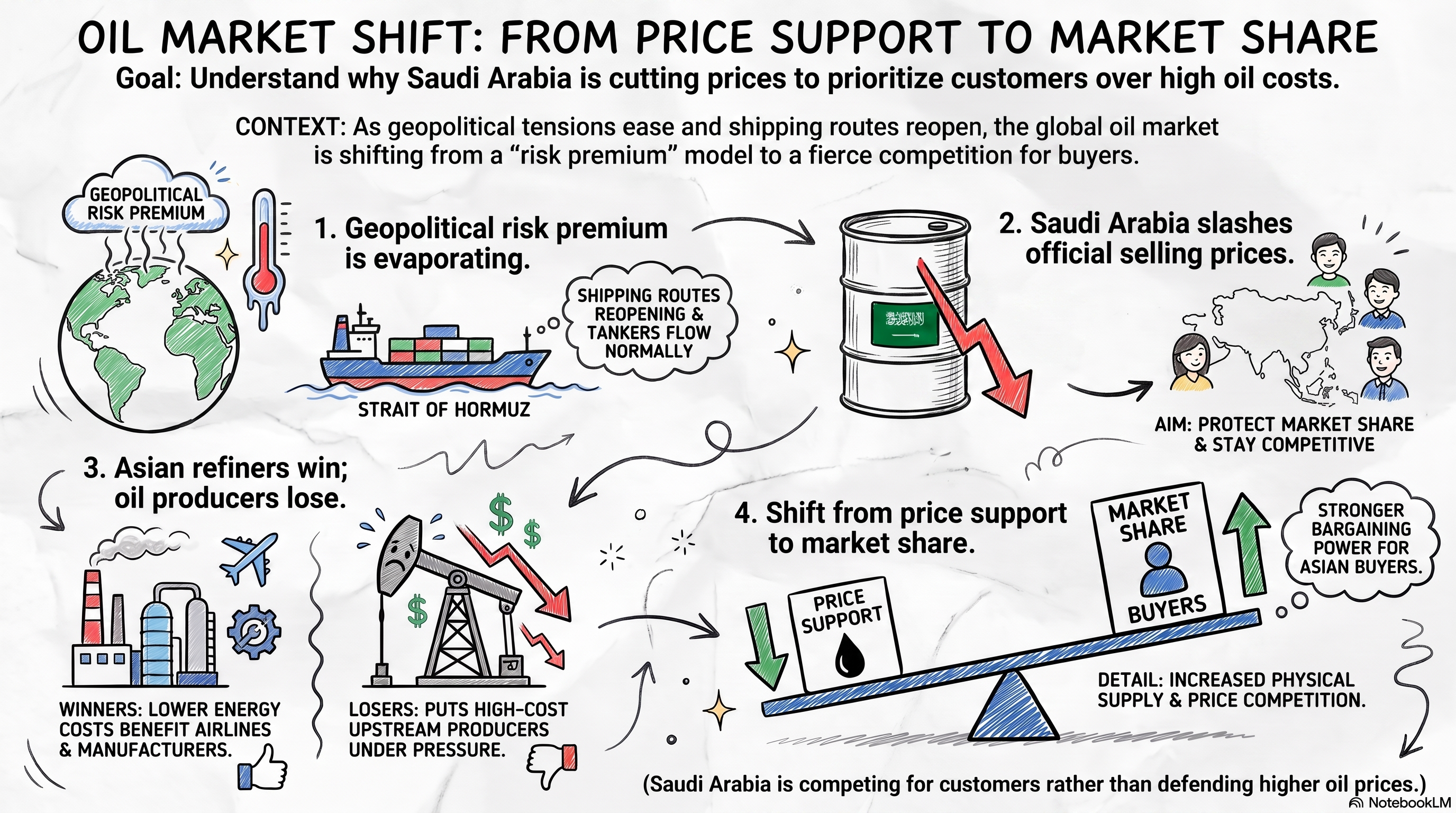
Saudi Aramco reduced the official selling price (OSP) of its Arab Light crude for Asian buyers by US$11 per barrel, placing it at a US$1.50 discount to the regional benchmark. The price cut follows a recovery in oil exports through the Strait of Hormuz after an interim US-Iran agreement, increasing global crude supply and intensifying competition among Middle Eastern producers.
🟨 2. Affected Channels (MECHANISM)
Supply: Higher Middle Eastern crude exports increase global oil availability.
Cost: Lower official selling prices reduce crude procurement costs for refiners.
Trade / Logistics: Normalisation of Hormuz shipping restores regional crude trade flows.
Sentiment: Reflects increased competition among oil exporters amid abundant supply.
Demand: Producers are adjusting prices to remain competitive, particularly in Asian markets.
🟩 3. Malaysia Exposure (WHO)
Exposed sectors
Oil and gas
Refining and petrochemicals
Aviation
Shipping and logistics
Manufacturing
Utilities
Types of Malaysian companies
Crude oil producers.
Oil refiners and petrochemical manufacturers.
Fuel distributors.
Airlines and shipping operators with significant fuel consumption.
Industrial manufacturers using petroleum-based feedstocks.
Geographic relevance
Malaysia is affected through regional crude oil pricing, refining economics and fuel costs, as Asia is a key destination for Middle Eastern crude exports.
🟧 4. What to Watch (SIGNALS)
Official selling prices announced by other Middle Eastern crude exporters.
Crude oil import patterns by Asian refiners.
Brent and regional crude benchmark price movements.
Refinery utilisation rates and crude procurement activity in Asia.
Oil export volumes through the Strait of Hormuz.
Malaysian refiners' procurement and margin updates.
OPEC+ production quota decisions and export levels.
Saudi Arabia's deep oil price cuts signal the transition from geopolitical premium to market-share competition
2. Executive Summary
Saudi Arabia's decision to price Arab Light below the regional benchmark is not simply a commercial discount—it marks a strategic shift from defending oil prices to defending market share as post-conflict supply returns.
The catalyst is the rapid normalization of exports through the Strait of Hormuz following the interim US-Iran agreement. The collapse of the geopolitical risk premium has exposed an oversupplied physical oil market, particularly in Asia.
The move suggests OPEC+ is entering a more difficult phase where quota increases, weak Chinese demand, and returning Gulf exports are colliding. Pricing—not production quotas—may become the primary competitive tool.
Investors should watch for a potential transition from supply management to price competition, which would have broad implications for inflation, energy equities, petrochemicals, and commodity-exporting economies.
3. Key Insights
Insight 1: Saudi Arabia is prioritizing market share over price support
Observation
Saudi Aramco cut official selling prices (OSPs) by the largest amount in decades, moving Arab Light into a discount relative to the regional benchmark.
Why it matters
Saudi Arabia typically uses OSPs to signal market conditions without changing production. A discount indicates that preserving customer relationships—especially in Asia—has become more important than maximizing price per barrel.
Second-order implication
Other Middle Eastern producers may be forced to reduce their own OSPs, intensifying competition across the region.
Third-order implication
If sustained, pricing power shifts from producers back toward refiners and large importing nations.
Insight 2: The oil market has moved from geopolitical scarcity to physical oversupply
Observation
The reopening of the Strait of Hormuz has released previously trapped barrels into a market already experiencing soft demand.
Why it matters
Oil prices are increasingly being driven by logistics normalization rather than geopolitical fears.
Second-order implication
Freight rates, storage utilization, and refinery margins become more important indicators than conflict headlines.
Insight 3: China's demand weakness is amplifying competitive pressures
Observation
Saudi pricing is explicitly aimed at stimulating Asian—and particularly Chinese—buying.
Why it matters
China remains the marginal buyer of global crude. Weak import demand limits producers' ability to maintain premium pricing.
Third-order implication
Oil-exporting countries become increasingly sensitive to China's industrial cycle rather than only Western economic growth.
Insight 4: OPEC+ cohesion faces a more difficult test
Observation
Supply quotas are rising while producers simultaneously compete on price.
Why it matters
Quota discipline becomes harder to maintain when individual members seek to protect export volumes.
Second-order implication
Future OPEC+ negotiations may become more contentious as members balance revenue needs against market stability.
Insight 5: Energy inflation may moderate more quickly than expected
Observation
Lower crude prices feed directly into transportation fuels and industrial energy costs.
Why it matters
Energy has been one of the most volatile components of inflation.
Third-order implication
Central banks could face less pressure from energy-driven inflation, though broader inflation outcomes will still depend on wages and services.
Insight 6: Pricing flexibility is becoming Saudi Arabia's preferred policy instrument
Observation
Saudi Arabia adjusted OSPs sharply without abandoning OPEC+ production coordination.
Why it matters
The kingdom can influence regional competitiveness while preserving the appearance of quota discipline.
Second-order implication
Future market management may rely more on pricing strategy than abrupt production changes.
4. Interpretation
What is really happening beneath the headlines?
Saudi Arabia is adapting to a post-conflict oil market where the problem is no longer constrained supply but excess availability.
The interim US-Iran agreement has reopened one of the world's most important energy corridors. As exports normalize, the geopolitical premium embedded in crude prices has evaporated.
Rather than launching a classic price war, Saudi Arabia appears to be repricing oil to reflect a new physical reality while protecting long-term relationships with Asian refiners.
The episode resembles:
2015–16, when Saudi Arabia defended market share against rising US shale production.
2020, when a breakdown in producer coordination triggered aggressive price discounts.
Unlike those episodes, today's adjustment follows a positive supply shock—the restoration of disrupted trade routes—rather than a collapse in producer cooperation.
If oversupply persists, pricing strategy may become the principal battlefield among Gulf exporters.
5. What Changes Next?
Next 6 Months
Likely (75%)
Other Gulf producers reduce official selling prices to remain competitive.
Asian refiners increase purchases opportunistically.
Brent prices remain under pressure if inventories continue to build.
Possible (45%)
OPEC+ slows or pauses planned production quota increases.
China increases strategic petroleum reserve purchases while prices remain attractive.
Low Probability, High Impact (20%)
A renewed geopolitical disruption in the Gulf rapidly restores the risk premium and reverses price declines.
Next 12 Months
Likely (70%)
Competition intensifies in Asian crude markets.
Refining margins improve as feedstock costs fall.
Oil-importing economies benefit from lower energy costs.
Next 3 Years
Likely (65%)
OSP adjustments become a more active policy tool alongside production quotas.
Greater volatility emerges as producers respond to shifting demand rather than structural shortages.
Lower average oil prices encourage consuming countries to replenish strategic reserves.
6. Winners
Direct Winners
Countries
China
India
Japan
South Korea
Other net oil importers
Industries
Airlines
Shipping
Petrochemicals
Refining
Logistics
Chemicals
Companies
Asian refiners
Transportation companies
Industrial manufacturers with high energy intensity
Secondary Winners
Consumer discretionary sectors benefiting from lower fuel costs
Fertilizer producers using energy as an input
Governments of oil-importing nations through reduced import bills
7. Losers / Pressure Points
Oil-exporting economies
Lower realized prices reduce fiscal revenues if discounts persist.
Nature: Cyclical, though prolonged oversupply could create structural budget pressures.
High-cost oil producers
Projects with elevated breakeven costs become less attractive.
US shale producers
Profitability may decline if benchmark prices remain subdued for an extended period.
Oilfield service companies
Capital expenditure by upstream producers may moderate if lower prices persist.
8. Investment Implications
Equities
Opportunities
Airlines
Refiners
Petrochemical producers
Logistics companies
Consumer sectors benefiting from lower fuel costs
Risks
Integrated oil majors
Exploration and production companies
Oilfield services
Private Equity
Potential investment themes:
Energy efficiency
Midstream logistics
Refining infrastructure
Industrial manufacturing
Infrastructure
High-conviction themes:
Refineries
Storage terminals
Pipelines
Export terminals
Venture Capital
Emerging opportunities:
Energy optimization software
Commodity trading analytics
Refinery automation
Logistics technology
Commodities
Watchlist
Brent crude
Dubai crude
Refining margins
Diesel cracks
LNG (for indirect sentiment effects)
Fixed Income
Lower energy prices may support credit quality in energy-consuming industries while weighing on fiscal positions of oil-dependent sovereigns.
Currencies
Oil-importing currencies may benefit from improved trade balances, while currencies of major oil exporters could face downward pressure if lower prices become sustained.
Real Assets
Refining assets, storage facilities, and petrochemical complexes may gain relative attractiveness if feedstock costs remain low.
9. Malaysia / ASEAN Implications
Malaysia
Malaysia faces mixed effects:
Positive
Lower domestic fuel import costs where applicable.
Improved margins for petrochemical and manufacturing sectors.
Reduced inflationary pressure supports consumers and businesses.
Negative
Lower crude prices could reduce revenues linked to upstream oil production and government-related energy income.
Energy sector earnings may come under pressure if discounts persist.
Overall, downstream industries are likely to benefit more than upstream producers.
Singapore
Strong beneficiary through refining, oil trading, storage, and maritime services.
Lower feedstock costs improve refinery economics and trading opportunities.
Indonesia
Lower oil prices reduce import costs but may affect fiscal revenues from hydrocarbon exports.
Coal markets are largely influenced by separate demand dynamics.
Thailand
Manufacturing, aviation, and tourism sectors benefit from lower fuel costs.
Reduced energy inflation supports domestic consumption.
Vietnam
Energy-intensive exporters gain from lower input costs.
Improved trade balance through reduced oil import expenses.
10. Long-Term Structural Trend
Megatrend | Assessment | Why |
Multipolar world | Moderately reinforces | Asian demand increasingly shapes producer strategy. |
Financial fragmentation | Weakly reinforces | Regional pricing dynamics become more differentiated. |
Supply-chain resilience | Weakly reinforces | Restored shipping routes reduce logistical bottlenecks. |
Energy transition | Neutral | Lower oil prices could modestly slow some substitution in the near term, but structural decarbonization drivers remain intact. |
Resource nationalism | Neutral | This reflects commercial competition rather than tighter state control. |
Industrial policy | Neutral | Limited direct policy implication. |
AI infrastructure | Neutral | No direct connection. |
Re-industrialisation | Weakly reinforces | Lower energy costs support manufacturing competitiveness. |
Friend-shoring | Neutral | No meaningful change. |
Defence spending | Weakly weakens | Reduced geopolitical tension temporarily lowers energy security concerns, though this could reverse quickly. |
11. Hidden Insights
Saudi Arabia is competing on pricing without abandoning OPEC+. Official selling prices provide a flexible way to defend market share while avoiding the political costs of breaking production agreements.
China's demand has become the swing factor in global oil pricing. Saudi discounts are aimed at stimulating Chinese buying, highlighting China's central role in determining global crude balances.
Physical market indicators now matter more than futures prices. Discounts on prompt cargoes suggest that real-world supply conditions are driving strategy more than financial market sentiment.
The normalization of logistics can be as market-moving as geopolitical conflict. Reopening the Strait of Hormuz created a positive supply shock comparable in importance to earlier disruptions.
Oil-importing Asian economies may enjoy a temporary macroeconomic tailwind. Lower energy costs can improve trade balances, ease inflation, and support manufacturing competitiveness, even if producers face revenue pressure.
12. Signals to Monitor
Bullish Confirmation (for the thesis of sustained market-share competition)
Additional OSP cuts by Iraq, Kuwait, the UAE, or other Gulf exporters.
Continued high export volumes through the Strait of Hormuz.
Weak Chinese crude import data.
Rising global commercial crude inventories.
Narrowing or negative spot crude premiums in Asia.
Bearish Confirmation
OPEC+ pauses or reverses production increases.
Strong rebound in Chinese industrial activity and refinery demand.
Faster-than-expected inventory draws.
Invalidation Signals
Renewed disruption to the Strait of Hormuz restoring supply constraints.
Major coordinated production cuts by OPEC+ that tighten physical markets.
Sustained increase in Asian crude demand sufficient to absorb additional supply without further price concessions.
13. Bottom Line
Saudi Arabia's pricing decision reflects a shift from protecting prices to protecting customers in an increasingly competitive physical oil market.
The restoration of Gulf exports has transformed oil market dynamics from geopolitical scarcity to commercial oversupply.
Official selling prices are becoming a more important strategic tool than production quotas in managing market share.
China's demand trajectory is once again the key determinant of pricing power in global crude markets.
Lower energy costs provide a near-term macroeconomic benefit for oil-importing economies, particularly across Asia.
Upstream producers face greater earnings pressure, while refiners, petrochemical companies, airlines, and manufacturers stand to benefit.
Malaysia experiences mixed effects, with downstream industries gaining while upstream energy revenues may soften.
Investors should monitor physical market indicators—OSPs, inventories, refinery margins, and Asian import demand—rather than relying solely on Brent futures, as they are likely to provide earlier signals of the next phase in global oil market competition.