🟦 1. The Event (FACT)
Contemporary Amperex Technology Co Ltd (CATL) introduced a new sodium-ion battery energy storage system for commercial delivery in China from September 2026, with global deliveries starting in June 2027. The company also announced plans to expand sodium battery production to over 100GWh annually within three to five years, targeting growing energy storage demand, particularly from data centres.
🟨 2. Affected Channels (MECHANISM)
Demand: Growing demand for grid-scale energy storage and data centre power infrastructure.
Supply: Expansion of sodium-ion battery manufacturing capacity increases alternative battery supply.
Cost: Sodium batteries may improve cost competitiveness as lithium prices rise and sodium is more abundant.
Technology: Broader commercialization of sodium-ion batteries diversifies battery technology options.
Sentiment: Strengthens industry focus on alternative battery chemistries beyond lithium-ion.
🟩 3. Malaysia Exposure (WHO)
Exposed sectors
Battery manufacturing
Renewable energy
Energy storage
Data centre infrastructure
Electrical equipment
Industrial manufacturing
Types of Malaysian companies
Battery component and materials manufacturers
Energy storage system integrators
Renewable energy developers
Data centre developers and operators
Electrical equipment manufacturers
Industrial engineering and EPC companies involved in energy infrastructure
Geographic relevance
Malaysia is exposed through expanding investments in renewable energy, battery storage deployment and rapidly growing data centre infrastructure.
🟧 4. What to Watch (SIGNALS)
Commercial deployment of sodium-ion battery projects in China and other markets.
New energy storage procurement and project announcements using sodium-ion technology.
Expansion of battery manufacturing capacity and supply chain investments.
Data centre developers' adoption of alternative energy storage technologies.
Corporate announcements relating to battery technology partnerships or localisation.
Changes in lithium and sodium battery cost competitiveness.
Government policies or incentives supporting energy storage deployment and battery manufacturing.
CATL's sodium battery scale-up signals the emergence of a second global battery ecosystem
2. Executive Summary
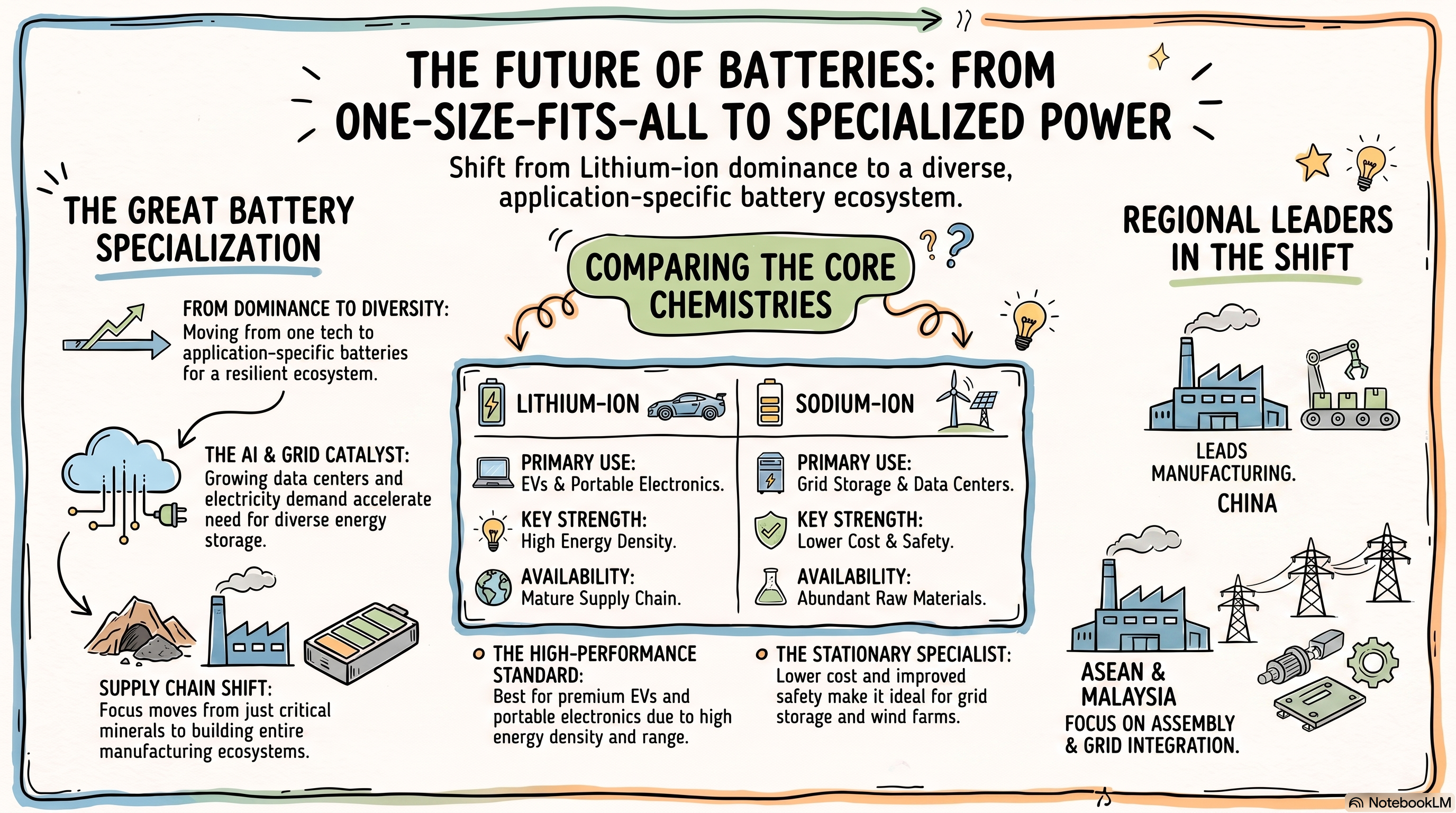
CATL's commercialization of sodium-ion energy storage marks the beginning of a dual-chemistry battery era, where lithium is no longer the only viable technology for large-scale storage.
The initial market is strategically significant: data centres and stationary energy storage, sectors where cost, safety, longevity, and supply security matter more than maximum energy density.
If CATL achieves its >100GWh annual sodium battery target within 3–5 years, the battery industry could undergo its biggest structural shift since the rise of lithium iron phosphate (LFP), reducing dependence on lithium while reshaping raw material demand and industrial investment.
Investors should interpret this not as a replacement for lithium, but as the beginning of battery specialization, where different chemistries dominate different applications.
3. Key Insights
Insight 1: Battery technology is moving from "one chemistry fits all" to specialization
Observation
CATL is simultaneously expanding lithium and sodium battery production rather than replacing one with the other.
Why it matters
The industry is transitioning toward application-specific chemistries:
Lithium for EVs requiring high energy density.
Sodium for stationary storage, backup power, and lower-cost applications.
Second-order implication
Battery manufacturers with multiple chemistry platforms gain a competitive advantage over firms dependent on a single technology.
Insight 2: AI infrastructure is creating a new battery market
Observation
CATL explicitly links sodium battery expansion to growing energy storage demand from data centres.
Why it matters
The AI boom is increasing demand not only for semiconductors but also for reliable, low-cost energy storage.
Third-order implication
Battery demand becomes increasingly driven by AI infrastructure alongside electric vehicles, broadening the industry's growth base.
Insight 3: Sodium reduces critical mineral concentration risk
Observation
Sodium is abundant globally, unlike lithium, which is concentrated in a limited number of producing countries.
Why it matters
Sodium batteries enhance supply-chain resilience by reducing exposure to lithium price volatility and geopolitical risks.
Second-order implication
Governments may support sodium battery development as part of broader critical mineral and energy security strategies.
Insight 4: Cost competitiveness becomes the primary battleground
Observation
Rising lithium carbonate prices have improved the economics of sodium batteries.
Why it matters
For stationary storage, cost per cycle and total lifetime cost often matter more than maximum energy density.
Third-order implication
Utilities and data centre operators may increasingly adopt sodium batteries if they offer lower lifecycle costs and adequate performance.
Insight 5: CATL is shaping industry standards before competitors scale
Observation
The company has already secured a large supply agreement with Beijing HyperStrong Technology and is targeting rapid production expansion.
Why it matters
Early commercialization allows CATL to build manufacturing scale, customer relationships, and ecosystem advantages.
Second-order implication
Competitors may accelerate investment in sodium-ion technologies to avoid technological dependence on CATL.
Insight 6: Battery competition is shifting from raw materials to manufacturing ecosystems
Observation
Success depends not only on chemistry but also on manufacturing scale, system integration, and downstream partnerships.
Why it matters
Industrial ecosystems become more valuable than individual technological breakthroughs.
Third-order implication
Countries with integrated battery manufacturing, power electronics, and storage deployment capabilities will strengthen their competitive position.
4. Interpretation
What is really happening beneath the headlines?
CATL is not simply launching another battery product—it is attempting to establish a second global battery ecosystem.
The lithium-ion industry has been built around concentrated supply chains for lithium, nickel, cobalt, and graphite. Sodium-ion technology offers an alternative ecosystem based on a more abundant raw material, potentially reducing exposure to geopolitical bottlenecks and commodity price volatility.
The strategy mirrors earlier industrial transitions:
Lithium iron phosphate (LFP) gained market share by sacrificing some energy density in exchange for lower cost and greater safety.
The CHIPS and Science Act highlighted the strategic importance of diversifying critical technology supply chains.
CATL's sodium push similarly seeks to diversify battery inputs while maintaining China's leadership in downstream manufacturing.
Rather than replacing lithium, sodium is likely to complement it, creating a more segmented battery market where chemistry is matched to application.
5. What Changes Next?
Next 6 Months
Likely (75%)
Initial deliveries of CATL's sodium energy storage systems in China.
Additional pilot projects involving data centres and utilities.
Increased attention from global utilities and storage developers.
Possible (45%)
Announcements of further sodium battery supply agreements.
Early responses from competing battery manufacturers.
Low Probability, High Impact (20%)
Major hyperscale cloud providers adopt sodium batteries at scale sooner than expected, accelerating global commercialization.
Next 12 Months
Likely (70%)
Global deliveries begin as planned.
Expansion of manufacturing capacity.
Greater investment in sodium battery research and supply chains.
Next 3 Years
Likely (80%)
Sodium batteries establish a meaningful position in stationary energy storage.
Multiple battery chemistries coexist across different applications.
Utilities and AI infrastructure become major drivers of battery demand alongside EVs.
6. Winners
Direct Winners
Countries
China (through manufacturing leadership)
Countries with abundant sodium resources and strong battery industries
Industries
Stationary energy storage
Data centres
Grid infrastructure
Battery manufacturing
Power electronics
Companies
Contemporary Amperex Technology Co., Limited
Energy storage system integrators
Power management software providers
Battery equipment manufacturers
Secondary Winners
Utilities deploying large-scale storage
Renewable energy developers
Engineering and EPC firms
Industrial automation providers
Battery recycling companies (through broader storage deployment)
7. Losers / Pressure Points
Lithium producers
Could face slower long-term demand growth in stationary storage if sodium gains share.
Nature: Structural for some applications, though EV demand remains supportive.
Single-chemistry battery manufacturers
Risk losing competitiveness if they cannot diversify product offerings.
High-cost lithium refining projects
May become less attractive if stationary storage shifts toward sodium.
Countries dependent on lithium exports
Need to diversify downstream industries as battery technologies evolve.
8. Investment Implications
Equities
Opportunities
Battery manufacturers with diversified chemistry portfolios
Energy storage system providers
Grid equipment manufacturers
Power electronics companies
Risks
Pure-play lithium producers heavily exposed to stationary storage demand
Companies slow to adapt to chemistry diversification
Private Equity
Potential investment themes:
Sodium battery manufacturing
Grid storage developers
Energy management software
Battery system integration
Infrastructure
High-conviction opportunities:
Utility-scale storage
Data centre backup systems
Renewable energy integration
Smart grids
Venture Capital
Emerging opportunities:
Sodium battery materials
Battery management systems
AI-enabled energy optimization
Recycling technologies
Commodities
Watchlist
Sodium compounds
Lithium carbonate
Graphite
Copper (through grid expansion)
Fixed Income
Growing issuance of green bonds and infrastructure financing for storage projects.
Currencies
Countries with diversified battery manufacturing ecosystems may attract long-term capital inflows, while lithium-exporting economies may experience greater sensitivity to shifts in battery chemistry demand.
Real Assets
Industrial parks supporting battery manufacturing, logistics hubs, and energy storage deployment become increasingly valuable.
9. Malaysia / ASEAN Implications
Malaysia
Opportunity to attract investment in battery assembly, energy storage systems, and power electronics.
Data centre expansion increases demand for stationary storage solutions.
Existing electronics manufacturing ecosystem positions Malaysia to participate in the sodium battery value chain, particularly in module assembly and system integration.
Singapore
Benefits from increased demand for energy storage in data centres and as a regional financing and technology hub for clean energy.
Indonesia
While lithium demand for EVs remains, sodium batteries could diversify regional battery manufacturing and reduce dependence on imported lithium for stationary applications.
Nickel remains strategically important for high-energy-density batteries.
Thailand
Automotive sector may continue focusing on lithium-based EV batteries while exploring sodium for industrial and grid storage.
Vietnam
Electronics manufacturing and renewable energy expansion create demand for affordable stationary storage solutions.
10. Long-Term Structural Trend
Megatrend | Assessment | Why |
AI infrastructure | Strongly reinforces | Data centres require reliable, scalable energy storage. |
Energy transition | Strongly reinforces | Lower-cost storage supports renewable integration. |
Supply-chain resilience | Strongly reinforces | Sodium diversifies battery inputs away from concentrated lithium supply chains. |
Industrial policy | Moderately reinforces | Governments may support alternative battery technologies. |
Re-industrialisation | Moderately reinforces | New manufacturing ecosystems emerge around sodium batteries. |
Friend-shoring | Moderately reinforces | Countries seek resilient battery supply chains. |
Multipolar world | Moderately reinforces | Competition extends to battery chemistry leadership. |
Resource nationalism | Weakly reinforces | Reduced reliance on scarce minerals may ease some geopolitical pressures. |
Financial fragmentation | Neutral | No immediate implication. |
Defence spending | Weakly reinforces | Stationary energy storage supports resilient infrastructure. |
11. Hidden Insights
The first major disruption from sodium batteries is likely to occur in energy storage, not electric vehicles. This allows commercialization without directly competing against lithium in its strongest market.
AI infrastructure could become as important as EVs in shaping future battery demand. Data centres increasingly require storage to improve reliability, integrate renewable energy, and manage peak loads.
Battery competition is evolving into ecosystem competition. Manufacturing scale, software integration, and customer relationships may prove more decisive than chemistry alone.
Lithium demand is unlikely to collapse but may become more segmented. High-energy applications remain lithium-dominated, while sodium gains share where cost, safety, and longevity matter more.
Countries investing early in sodium battery manufacturing could build new industrial capabilities without relying on large domestic lithium resources. This broadens the geographic distribution of future battery production.
12. Signals to Monitor
Bullish Confirmation
Successful September deployment of CATL's sodium storage systems.
Additional multi-GWh supply agreements with utilities, data centre operators, or storage developers.
Government incentives supporting sodium battery manufacturing.
Falling levelized cost of storage (LCOS) for sodium systems relative to lithium.
Bearish Confirmation
Lithium prices decline significantly, narrowing sodium's cost advantage.
Technical challenges reduce adoption or delay commercialization.
Competing battery chemistries (such as advanced LFP or solid-state) improve faster than expected.
Invalidation Signals
Sodium batteries fail to achieve projected manufacturing scale.
Utilities continue overwhelmingly favoring lithium despite comparable economics.
CATL materially reduces its sodium capacity expansion plans.
13. Bottom Line
CATL is positioning sodium-ion batteries as the foundation of a second battery ecosystem, not as a universal replacement for lithium.
AI infrastructure and data centres are emerging as major drivers of battery demand alongside electric vehicles.
Battery markets are becoming application-specific, with different chemistries optimized for different use cases.
Supply-chain resilience and raw material diversification are becoming strategic priorities equal to performance improvements.
Stationary energy storage is likely to be the earliest large-scale commercial market for sodium batteries.
Countries with strong manufacturing ecosystems, rather than only critical mineral resources, may capture the greatest long-term value.
ASEAN economies have opportunities in battery assembly, power electronics, and energy storage deployment as the industry broadens beyond lithium.
Investors should monitor commercial deployment, manufacturing scale, and customer adoption rather than focusing solely on laboratory performance, as execution will determine whether sodium batteries become a lasting pillar of the global energy storage industry.