🟦 1. The Event (FACT)
Banking industry representatives called on Bank Negara Malaysia (BNM) to raise the single-customer lending exposure limit, arguing that current rules may constrain financing needed for Malaysia's energy transition. The request was made on 9 April 2026, citing higher funding requirements driven by rapid data centre expansion and increased electricity demand.
🟨 2. Affected Channels (MECHANISM)
Financing: Existing lending concentration limits may restrict banks' ability to finance large energy and grid projects.
Demand: Rising data centre electricity consumption increases demand for renewable energy, grid upgrades and energy infrastructure.
Regulation: Potential revision of BNM's large exposure framework could alter banks' lending capacity.
Supply: Greater financing capacity could support development of power generation, transmission and energy storage projects.
Sentiment: Signals continued policy and industry focus on ensuring sufficient capital for Malaysia's energy transition.
🟩 3. Malaysia Exposure (WHO)
Exposed sectors
Banking
Renewable energy
Power generation
Electricity transmission and distribution
Energy storage
Data centre infrastructure
Types of Malaysian companies
Commercial banks
Renewable energy developers
Grid infrastructure contractors
Power utilities
Engineering, procurement and construction (EPC) firms involved in energy infrastructure
Data centre developers and operators
Geographic relevance
Malaysia nationwide, particularly regions experiencing rapid data centre development.
🟧 4. What to Watch (SIGNALS)
Final BNM policy on single-customer exposure limits.
Growth in syndicated or large-ticket financing for energy projects.
New renewable energy, battery storage and grid upgrade project announcements.
Corporate announcements on financing for energy transition projects.
Continued expansion announcements from data centre developers.
Changes in electricity demand forecasts linked to data centre growth.
Government policy updates relating to the National Energy Transition Roadmap (NETR).
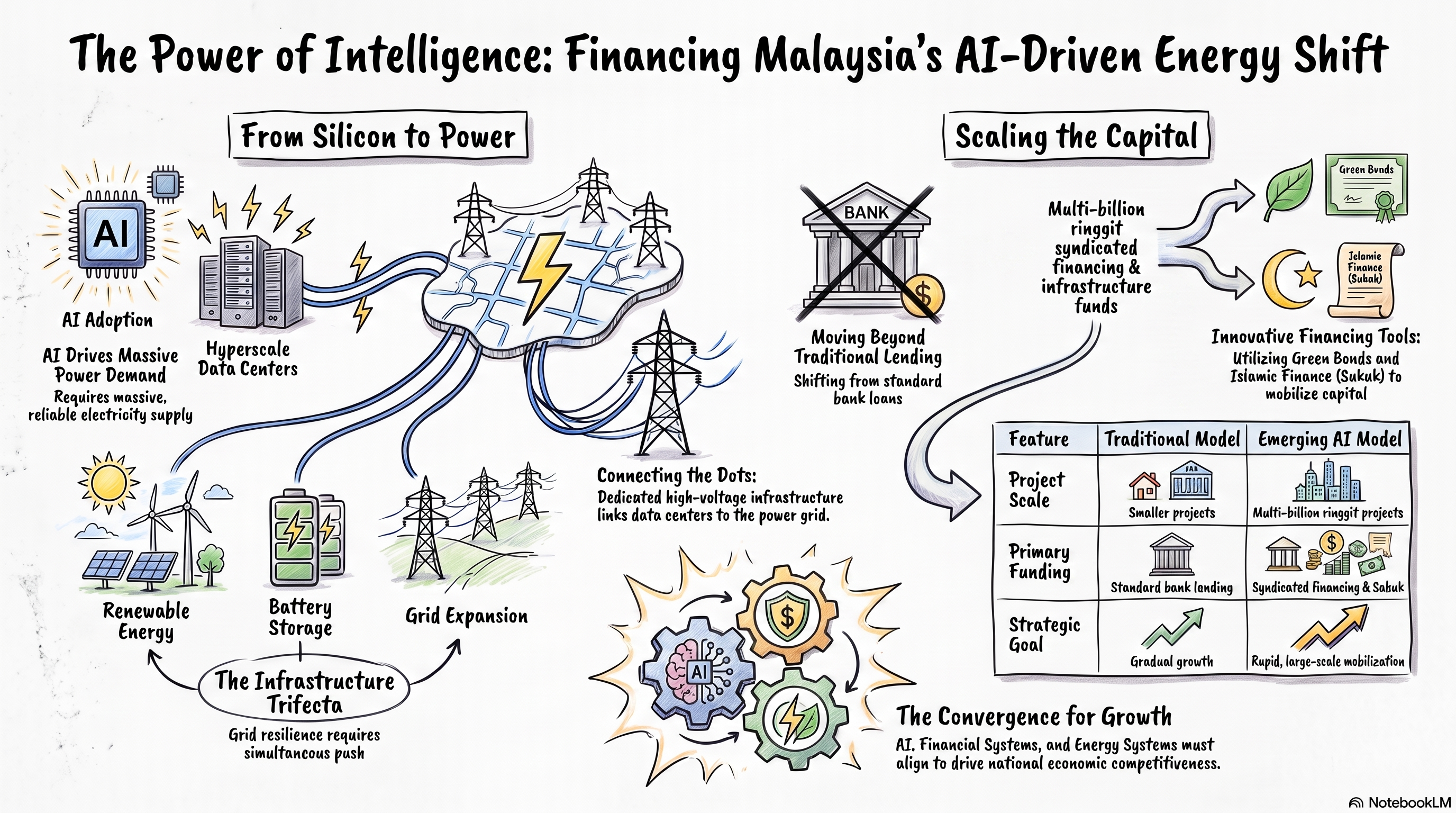
Malaysia's energy transition financing model faces structural redesign as AI-driven power demand outgrows banking limits
2. Executive Summary
Malaysia's AI and data centre boom is no longer just a technology story—it is becoming a financial system capacity problem, where bank lending regulations may constrain strategic infrastructure investment.
The existing 25% single-customer exposure limit, designed before the surge in hyperscale data centres, may become a bottleneck for financing utilities and national energy infrastructure rather than a prudential safeguard.
If Bank Negara Malaysia (BNM) relaxes concentration limits or creates targeted exemptions, it would represent a shift toward industrial policy through financial regulation, similar to how many countries have adapted banking and fiscal frameworks to support strategic industries.
Investors should view this as an early signal that Malaysia's power grid, renewable generation, storage, and transmission sectors may enter a multi-year investment supercycle supported by policy changes.
3. Key Insights
Insight 1: Banking regulation is becoming part of industrial policy
Observation
The debate is no longer about whether enough renewable projects exist—it is whether banks are legally allowed to finance them at the required scale.
Why it matters
Capital availability, rather than project economics, could become the primary constraint on Malaysia's energy transition.
Second-order implication
BNM may increasingly use prudential regulation to facilitate strategic national investment while balancing financial stability.
Insight 2: AI infrastructure is reshaping electricity economics
Observation
The National Energy Transition Roadmap (NETR) underestimated electricity demand because it preceded Malaysia's data centre boom.
Why it matters
AI demand is accelerating electricity consumption faster than traditional industrial planning anticipated.
Second-order implication
Malaysia's renewable deployment targets, transmission expansion, and battery storage requirements are likely to require upward revisions.
Insight 3: Utilities become strategic national assets
Observation
Companies like Tenaga Nasional Berhad move beyond being regulated utilities to becoming enablers of digital economic growth.
Why it matters
Electricity capacity increasingly determines a country's ability to attract AI investment and digital manufacturing.
Second-order implication
Utilities may receive stronger policy support, accelerated approvals, and preferential financing access.
Insight 4: Energy transition funding is shifting from ESG to economic competitiveness
Observation
Renewable investment is increasingly justified by economic growth rather than climate commitments alone.
Why it matters
AI infrastructure creates a commercial rationale for accelerating renewable deployment.
Third-order implication
Future renewable investment becomes less dependent on ESG sentiment and more closely tied to national competitiveness.
Insight 5: Grid infrastructure becomes the hidden bottleneck
Observation
Renewable generation alone cannot support data centres without transmission upgrades and energy storage.
Why it matters
Transmission networks and grid flexibility become equally important as power generation.
Second-order implication
Investment opportunities extend beyond solar farms into substations, transmission lines, batteries, smart grids, and grid software.
Insight 6: Financing models may evolve beyond traditional bank lending
Observation
If single-bank exposure limits remain binding, alternative funding structures become more attractive.
Why it matters
Malaysia may increasingly rely on syndicated loans, infrastructure funds, green bonds, project finance, and institutional investors.
Third-order implication
Domestic capital markets could deepen as infrastructure financing diversifies away from bank balance sheets.
4. Interpretation
What is really happening beneath the headlines?
The discussion is less about a regulatory technicality than about whether Malaysia's financial architecture is keeping pace with a structural shift in its economy.
The emergence of AI and hyperscale data centres has transformed electricity from a utility service into a strategic production input. This mirrors how semiconductors became strategic assets following the CHIPS and Science Act and how clean energy investment accelerated under the Inflation Reduction Act.
Malaysia now faces a similar challenge:
Existing financial regulations were designed for a different demand profile.
Digital infrastructure is pulling forward decades of electricity investment.
Policymakers must decide whether prudential rules should adapt to strategic national priorities.
The hidden incentive is to ensure Malaysia remains competitive in attracting AI investment while maintaining financial stability.
5. What Changes Next?
Next 6 Months
Likely (70%)
Continued industry lobbying for higher exposure limits or targeted exemptions.
Faster approval of grid and renewable projects.
Greater emphasis on syndicated financing.
Possible (40%)
BNM introduces sector-specific flexibility for nationally strategic infrastructure.
Government expands guarantees or blended finance mechanisms.
Low Probability, High Impact (15%)
Creation of a dedicated national infrastructure financing vehicle for AI-energy projects.
Next 12 Months
Likely (65%)
Revised NETR investment estimates reflecting AI-driven electricity demand.
More renewable PPAs linked directly to data centres.
Increased issuance of green or sustainability-linked financing.
Possible (45%)
New incentives for battery storage and grid modernisation.
Next 3 Years
Likely (75%)
Electricity infrastructure becomes one of Malaysia's largest capital expenditure sectors.
Domestic institutional investors play a larger role in infrastructure finance.
Malaysia strengthens its position as a regional AI and data centre hub.
6. Winners
Direct Winners
Countries
Malaysia
Singapore (through regional digital ecosystem integration)
Industries
Electricity utilities
Renewable energy
Battery storage
Transmission engineering
Grid technology
Project finance
Companies
Tenaga Nasional Berhad
Petroliam Nasional Berhad (through gas-fired generation and transition investments)
Renewable IPPs
EPC contractors
Grid equipment suppliers
Secondary Winners
Infrastructure funds
Pension funds
Islamic finance providers
Green bond issuers
Industrial park developers
Engineering consultancies
Electrical equipment manufacturers
Battery integrators
7. Losers / Pressure Points
Banks
Pressure increases if exposure rules remain unchanged.
Temporary if regulation adapts.
Energy-intensive manufacturers
May face higher electricity costs as demand tightens.
Smaller renewable developers
Could struggle to compete for financing if capital concentrates on larger strategic projects.
Data centre developers
Risk project delays if grid expansion lags demand.
8. Investment Implications
Equities
Opportunities
Utilities
Grid equipment
Renewable developers
Industrial engineering
Risks
Regulatory delays
Cost inflation
Execution risk
Private Equity
Growing opportunities in:
Battery storage
Grid services
Energy software
Distributed energy
Infrastructure
One of the strongest long-term beneficiaries through transmission, substations, storage, and renewable assets.
Venture Capital
Opportunities in:
Energy management software
AI power optimisation
Grid analytics
Virtual power plants
Commodities
Higher structural demand for:
Copper
Aluminium
Silver
Lithium
Rare earth elements
Fixed Income
Expansion of:
Green bonds
Infrastructure sukuk
Sustainability-linked financing
Currencies
A successful investment cycle could support medium-term capital inflows into Malaysia, though effects will depend on broader macroeconomic conditions.
Real Assets
Industrial land with grid connectivity, substations, logistics corridors, and renewable resource sites become increasingly valuable.
9. Malaysia / ASEAN Implications
Malaysia
The country strengthens its positioning as an AI infrastructure hub but must expand generation, transmission, and financing capacity in parallel.
Singapore
Benefits indirectly by extending its digital ecosystem into Malaysia while leveraging cross-border infrastructure.
Indonesia
May compete for future data centre and renewable investment but also benefits from supplying critical minerals for batteries and electrification.
Thailand
Likely to accelerate its own energy and grid investments to remain regionally competitive.
Vietnam
Could intensify efforts to expand renewable energy and transmission to attract similar digital infrastructure investment.
10. Long-Term Structural Trends
Megatrend | Assessment | Why |
Re-industrialisation | Strongly reinforces | Electricity infrastructure becomes a strategic industrial asset. |
AI infrastructure | Strongly reinforces | AI demand drives power investment. |
Industrial policy | Strongly reinforces | Financial regulation adapts to national development priorities. |
Energy transition | Strongly reinforces | Renewable deployment accelerates for economic reasons. |
Supply-chain resilience | Moderately reinforces | Reliable power becomes a competitive advantage. |
Friend-shoring | Moderately reinforces | AI investors seek politically stable power markets. |
Multipolar world | Moderately reinforces | Regional competition for AI investment intensifies. |
Financial fragmentation | Neutral | Financing remains largely domestic but could diversify over time. |
Resource nationalism | Weakly reinforces | Greater demand may increase the strategic value of energy resources. |
Defence spending | Neutral | No direct implication. |
11. Hidden Insights
Electricity is becoming a competitive differentiator for AI investment. Countries with abundant, reliable, and financeable power infrastructure will increasingly attract hyperscale data centres.
Prudential regulation is emerging as a tool of industrial policy. Adjusting bank exposure limits would illustrate how financial rules can be adapted to support strategic national priorities without direct fiscal spending.
The value chain is broader than renewable generation. Transmission networks, substations, battery storage, and grid management software may see sustained investment alongside solar and wind assets.
Capital markets could become more important than bank balance sheets. If lending limits remain restrictive, greater use of infrastructure funds, sukuk, and green bonds could reshape Malaysia's long-term financing mix.
AI demand could repeatedly outpace infrastructure planning. This episode suggests that future national energy plans may need more dynamic assumptions about digital economy growth rather than relying on static long-term forecasts.
12. Signals to Monitor
Bullish Confirmation
BNM revises or relaxes single-customer exposure limits.
Updated NETR targets reflecting higher electricity demand.
Large syndicated financings for grid and renewable projects.
Increased issuance of infrastructure sukuk and green bonds.
Accelerated renewable and transmission project approvals.
Bearish Confirmation
Banks continue approaching exposure limits without regulatory changes.
Delays in grid expansion or transmission upgrades.
Rising project financing costs.
Data centre developments postponed due to insufficient power availability.
Invalidation Signals
Data centre investment slows materially, reducing projected electricity demand.
Alternative financing structures fully offset bank lending constraints, making exposure limits largely irrelevant.
Significant improvements in energy efficiency reduce AI-related power growth beyond current expectations.
13. Bottom Line
AI infrastructure is transforming electricity from a utility issue into a strategic economic asset.
Malaysia's energy transition is increasingly constrained by financing capacity rather than project availability.
Bank regulation may evolve into an instrument of industrial policy if strategic infrastructure funding becomes a national priority.
Utilities, grid operators, and transmission assets are becoming core enablers of digital economic competitiveness.
The investment opportunity extends well beyond renewable generation to storage, transmission, and financing platforms.
Domestic capital markets are likely to play a larger role as infrastructure funding needs expand.
ASEAN competition for AI investment will increasingly depend on the ability to deliver reliable, scalable, low-carbon electricity.
Investors should watch regulatory changes at BNM as closely as power-sector developments, because financing rules may become a key determinant of Malaysia's long-term AI and energy investment trajectory.