Executive Summary
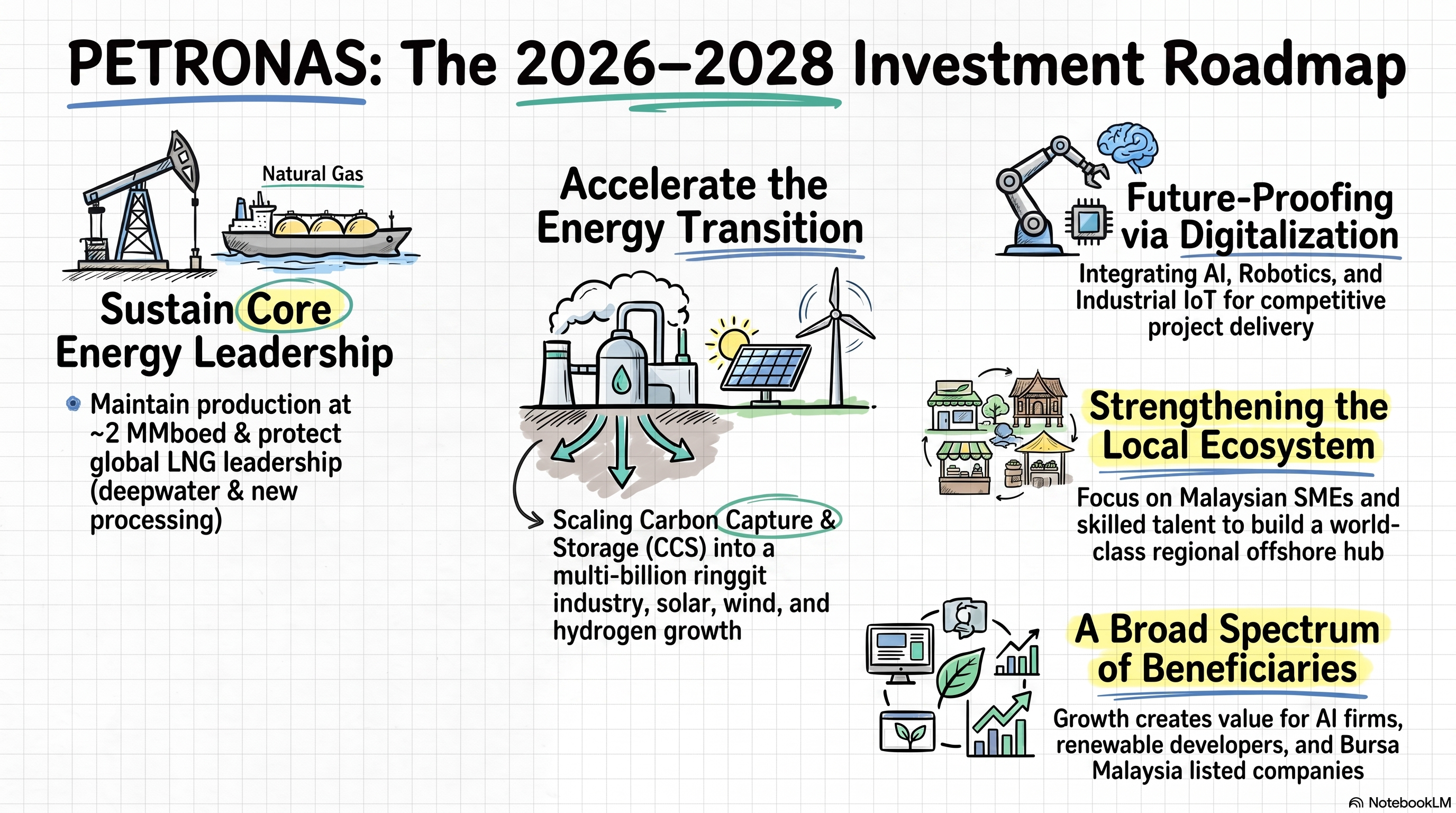
The PETRONAS Activity Outlook 2026–2028 is much more than a procurement forecast. It is effectively PETRONAS' strategic roadmap for where capital expenditure, technology adoption, supply chain transformation, and Malaysia's energy industry will head over the next three years.
The biggest takeaway is:
PETRONAS is not reducing investment because of the energy transition—it is redirecting investment into lower-cost, lower-carbon, more technology-intensive projects while keeping Malaysia's oil and gas production near 2 million barrels of oil equivalent per day (MMboed).
Executive Signals
Theme | Signal | Impact |
|---|---|---|
Upstream | Production maintained around 2 MMboed | Long pipeline of offshore projects |
OGSE | Massive productivity upgrade | Winners are efficient contractors |
Digital | AI, robotics and automation become mandatory | Digital companies gain |
CCS | Carbon Capture becoming mainstream | New billion-ringgit industry |
LNG | Malaysia protects LNG leadership | Maritime and gas investments continue |
Renewable | Gentari expansion continues | Hydrogen, solar and EV ecosystem grows |
Procurement | More localisation + capability building | Local companies preferred if competitive |
Capital | Projects continue despite lower oil prices | Stable capex outlook |
1. Biggest Strategic Signal
PETRONAS is transforming—not shrinking
Instead of moving away from oil & gas, PETRONAS wants to become an integrated energy company by 2035 operating across:
Oil & Gas
LNG
Renewable Energy
Hydrogen
Carbon Capture & Storage (CCS)
Green Mobility
Biofuels
This means conventional oil & gas remains important while clean energy becomes an additional growth engine.
Investment Signal
The energy transition creates more engineering work, not less.
2. Upstream Investment Signal
PETRONAS aims to sustain production at approximately:
2 million barrels of oil equivalent per day (MMboed)
through:
new exploration
deepwater developments
Enhanced Oil Recovery (EOR)
Malaysia Bid Round projects
new Production Sharing Contracts
instead of allowing production to decline.
Investors should expect demand for
drilling
offshore fabrication
FPSO
subsea
well services
maintenance
engineering
to remain healthy through 2028.
3. OGSE is entering a new phase
This is perhaps the biggest hidden message.
PETRONAS repeatedly states the future OGSE industry must become:
more digital
lower cost
automated
AI-enabled
robotics-driven
rather than simply increasing manpower.
Winners
Companies investing in:
robotics
AI inspection
predictive maintenance
digital twins
automation
drones
industrial software
Losers
Companies competing only on cheap labour.
4. Productivity is becoming a procurement requirement
PETRONAS introduced several transformation programmes including:
CAPE Masterplan 2030
MYPT
Engineering Excellence Roadmap
HUC-MCM Excellence
Targets include:
30% productivity improvement
shorter project delivery
digital planning
integrated resource management
engineering standardisation
This means future tenders will increasingly reward companies with measurable efficiency gains.
5. Malaysia becoming an Energy Technology Hub
PETRONAS wants Malaysia to become:
regional engineering hub
fabrication hub
offshore logistics hub
LNG hub
CCS hub
hydrogen hub
rather than simply an oil producer.
This is a major industrial policy signal.
6. Digitalisation is no longer optional
The report repeatedly mentions:
Artificial Intelligence
Robotics
Data Analytics
Automation
Digital Platforms
Predictive Planning
These technologies are expected to improve:
project scheduling
engineering
procurement
maintenance
logistics
fabrication
Corporate Signal
Software vendors serving industrial customers have a growing opportunity.
7. Carbon Capture & Storage (CCS)
Although oil production continues, PETRONAS positions CCS as one of its core future businesses.
Future demand will include:
CO₂ pipelines
compression systems
injection wells
monitoring equipment
geological services
This creates a new engineering market over the coming decade.
8. LNG remains a national priority
PETRONAS emphasises maintaining its position as a reliable global LNG supplier while improving efficiency and lowering emissions.
Beneficiaries
LNG terminals
cryogenic equipment
gas processing
offshore support vessels
LNG shipping
maintenance contractors
9. Gentari becomes increasingly important
Gentari is identified as PETRONAS' vehicle for:
renewable energy
hydrogen
green mobility
with the aspiration to become Asia-Pacific's leading clean energy solutions partner by 2030.
This indicates sustained investment beyond traditional hydrocarbons.
10. Localisation remains important
PETRONAS emphasises:
local vendor development
capability building
technology transfer
talent development
partnerships with Malaysian SMEs
However, localisation is tied to competitiveness rather than protection alone.
Bursa Malaysia Winners
Strong Positive
Energy Services
Potential beneficiaries include companies involved in:
offshore engineering
fabrication
hook-up & commissioning
maintenance
drilling
subsea services
Marine
offshore vessels
logistics
installation support
Industrial Automation
industrial software
robotics
AI inspection
sensors
predictive maintenance
Engineering Consultants
Demand should increase for:
FEED
engineering design
digital engineering
project management
Electrical & Instrumentation
Growth is supported by:
decarbonisation
automation
digitalisation
offshore upgrades
Corporate Strategy Lessons
If I were running an engineering company, I would prioritise:
AI-assisted engineering.
Robotics to reduce labour dependency.
Digital twins and predictive maintenance.
Expansion into CCS.
Hydrogen capability development.
Carbon accounting services.
Integrated EPC solutions rather than standalone services.
Regional expansion beyond Malaysia.
These align closely with PETRONAS' stated direction.
What Investors Should Monitor (2026–2028)
Indicator | Why it matters |
|---|---|
New offshore project awards | Revenue visibility for contractors |
Malaysia Bid Rounds | Future drilling pipeline |
CCS final investment decisions | Emergence of a new industry |
Gentari renewable projects | Growth in clean energy |
Engineering digitalisation contracts | Spending on AI and automation |
Fabrication yard upgrades | Productivity improvements |
LNG expansion projects | Continued maritime and gas demand |
Deepwater developments | High-value EPC opportunities |
Overall Investment Assessment
Perspective | Assessment |
|---|---|
Stock Investors | Bullish for Malaysian energy services, offshore engineering, marine support, industrial automation and digital engineering firms. |
Industry Players | Invest in automation, AI, robotics and CCS capabilities to stay competitive. |
Corporates | Diversify beyond traditional EPC into integrated energy solutions and digital services. |
Government & Policymakers | The roadmap reinforces Malaysia's ambition to remain a leading regional energy hub while accelerating lower-carbon industries. |
Bottom line: The report signals that the next growth cycle is not about drilling more wells alone. It is about building a smarter, lower-carbon, digitally enabled energy ecosystem. Companies that improve productivity, adopt advanced technologies, and expand into CCS, hydrogen, renewable energy, and digital engineering are likely to be best positioned to capture PETRONAS' investment over the coming decade.
Malaysia's energy industry is entering one of its biggest transformation periods in decades. The PETRONAS Activity Outlook 2026–2028 is more than a procurement forecast—it is a strategic blueprint revealing where billions of ringgit in investment, technology adoption, infrastructure development, and corporate spending will be directed over the next three years.
For investors, this document offers early insight into sectors likely to experience rising demand before contracts are awarded. For business owners, it highlights where future procurement opportunities will emerge. For corporate leaders, it outlines the capabilities companies must build to remain competitive in an industry increasingly defined by automation, digitalisation, and lower-carbon energy solutions.
One message is consistent throughout the report: Malaysia is not moving away from oil and gas. It is building a more diversified, technology-driven energy economy where conventional hydrocarbons and cleaner energy will grow together.
Malaysia's Energy Industry Is Entering a New Investment Cycle
Despite global uncertainty, geopolitical tensions, slower economic growth, and increasing pressure to reduce emissions, PETRONAS remains committed to maintaining Malaysia's position as a major energy producer while accelerating investments into future energy technologies.
Rather than replacing oil and gas, the company is expanding into an integrated energy portfolio that combines:
Conventional oil and gas
Liquefied Natural Gas (LNG)
Renewable energy
Hydrogen
Carbon Capture and Storage (CCS)
Green mobility
Biofuels
PETRONAS has set an ambition to become a fully integrated energy company by 2035 while continuing to safeguard Malaysia's energy security. This approach means the coming decade is expected to generate substantial investment across both traditional engineering industries and emerging clean energy sectors.
For investors, this changes the narrative surrounding the energy transition. Instead of reducing capital expenditure, PETRONAS is redirecting capital into projects that deliver lower emissions, greater operational efficiency, and stronger long-term returns.
The report also reinforces Malaysia's strategic importance as a regional energy hub, positioning the country to attract new investment into engineering, fabrication, offshore services, digital technologies, logistics, and industrial infrastructure.
Where the Biggest Investment Opportunities Will Come From Between 2026 and 2028
One of the strongest signals throughout the report is PETRONAS' commitment to sustaining production at approximately 2 million barrels of oil equivalent per day (MMboed) through continued exploration, deepwater developments, enhanced oil recovery programmes, and new Production Sharing Contracts awarded under recent Malaysia Bid Rounds.
Maintaining this production level creates long-term demand across virtually every segment of the oil and gas supply chain.
Engineering firms can expect continued demand for Front-End Engineering Design (FEED), detailed engineering, and project management services. Offshore contractors will continue benefiting from drilling campaigns, subsea developments, offshore fabrication, installation work, and production facilities.
Marine companies supporting offshore logistics, transportation and installation activities should continue to experience healthy project pipelines as offshore developments expand.
Meanwhile, LNG remains one of PETRONAS' strategic priorities. Malaysia intends to strengthen its position as one of the world's most reliable LNG suppliers while improving efficiency and lowering emissions across the entire gas value chain. This supports continued investment in LNG infrastructure, gas processing, cryogenic equipment, specialised vessels, and maintenance services.
Unlike previous industry cycles driven primarily by higher oil prices, this investment cycle is increasingly driven by operational excellence, technology adoption, and productivity improvements.
Digitalisation, Artificial Intelligence and Carbon Capture Are Becoming the New Competitive Advantage
Perhaps the most important structural change within the report is that future competitiveness will no longer depend primarily on labour costs or equipment ownership.
PETRONAS repeatedly identifies automation, robotics, artificial intelligence, predictive analytics, digital platforms, advanced engineering software, and data-driven planning as essential capabilities for future contractors. Companies unable to improve productivity through technology may struggle to remain competitive regardless of their experience.
At the same time, Carbon Capture and Storage (CCS) has moved from being an experimental concept to becoming one of PETRONAS' strategic growth pillars.
As Malaysia develops CCS infrastructure, new opportunities are expected to emerge across carbon transportation, injection wells, geological assessment, compression systems, environmental monitoring, engineering consulting, and specialised industrial equipment.
Hydrogen and renewable energy also continue gaining momentum through Gentari, PETRONAS' clean energy subsidiary, which is building businesses across renewable generation, hydrogen solutions, and green mobility throughout Asia-Pacific.
For technology providers, software companies, automation specialists, industrial sensor manufacturers, robotics developers, engineering consultants, and AI solution providers, this represents one of the strongest long-term structural growth themes within Malaysia's industrial economy.
Why PETRONAS Is Reshaping the Entire Malaysian OGSE Ecosystem
Beyond individual projects, PETRONAS is attempting to fundamentally transform Malaysia's Oil & Gas Services and Equipment (OGSE) industry.
Several major initiatives are highlighted throughout the report, including the CAPE Masterplan 2030, Malaysia Yard Productivity Target (MYPT), Engineering Excellence Roadmap, and HUC-MCM Excellence Programme. Collectively, these initiatives aim to improve productivity by approximately 30% while significantly shortening project delivery timelines through digital transformation, standardisation, automation, integrated resource planning, and engineering excellence.
PETRONAS also intends to reduce project development timelines from discovery to monetisation while encouraging Malaysian contractors to adopt robotics, automation, lean construction methods, predictive planning, and digital engineering.
Rather than competing solely on price, contractors will increasingly compete on measurable productivity improvements, quality performance, safety records, digital capabilities, and engineering innovation.
This shift benefits companies willing to invest early in advanced technologies while creating significant barriers for businesses relying exclusively on traditional labour-intensive operating models.
The report also highlights PETRONAS' continued commitment to strengthening local suppliers through capability development, technology transfer, financing programmes, strategic partnerships, and talent development. However, localisation is increasingly linked to competitiveness and technical capability rather than simply domestic ownership.
What Investors, Corporate Leaders and Industry Players Should Learn From the PETRONAS Activity Outlook
The PETRONAS Activity Outlook provides one of the clearest long-term roadmaps available for Malaysia's energy economy.
For investors, the report suggests continued opportunities across Bursa Malaysia-listed engineering contractors, offshore service providers, fabrication companies, marine logistics operators, industrial automation firms, electrical and instrumentation specialists, engineering consultants, and businesses positioned to participate in CCS, hydrogen, LNG, and renewable energy infrastructure.
Corporate leaders should recognise that future procurement decisions will increasingly reward companies capable of delivering higher productivity through automation, AI, digital engineering, predictive maintenance, and integrated project execution rather than simply offering lower pricing.
Business owners serving industrial customers should consider expanding into emerging areas such as industrial software, robotics integration, digital twins, environmental monitoring, carbon management, engineering simulation, and advanced maintenance technologies.
Perhaps the most valuable lesson is that Malaysia's next industrial growth cycle will not be driven solely by higher commodity prices. Instead, it will be powered by companies capable of combining engineering excellence with technology, sustainability, and operational efficiency.
For anyone seeking to identify long-term investment trends before they become widely recognised, the PETRONAS Activity Outlook 2026–2028 serves as one of the most comprehensive strategic roadmaps available. It demonstrates that the future of Malaysia's energy sector lies not only in producing hydrocarbons, but in building a globally competitive, digitally enabled, lower-carbon industrial ecosystem that supports energy security, economic growth, and technological leadership for decades to come.