🟦 1. The Event (FACT)
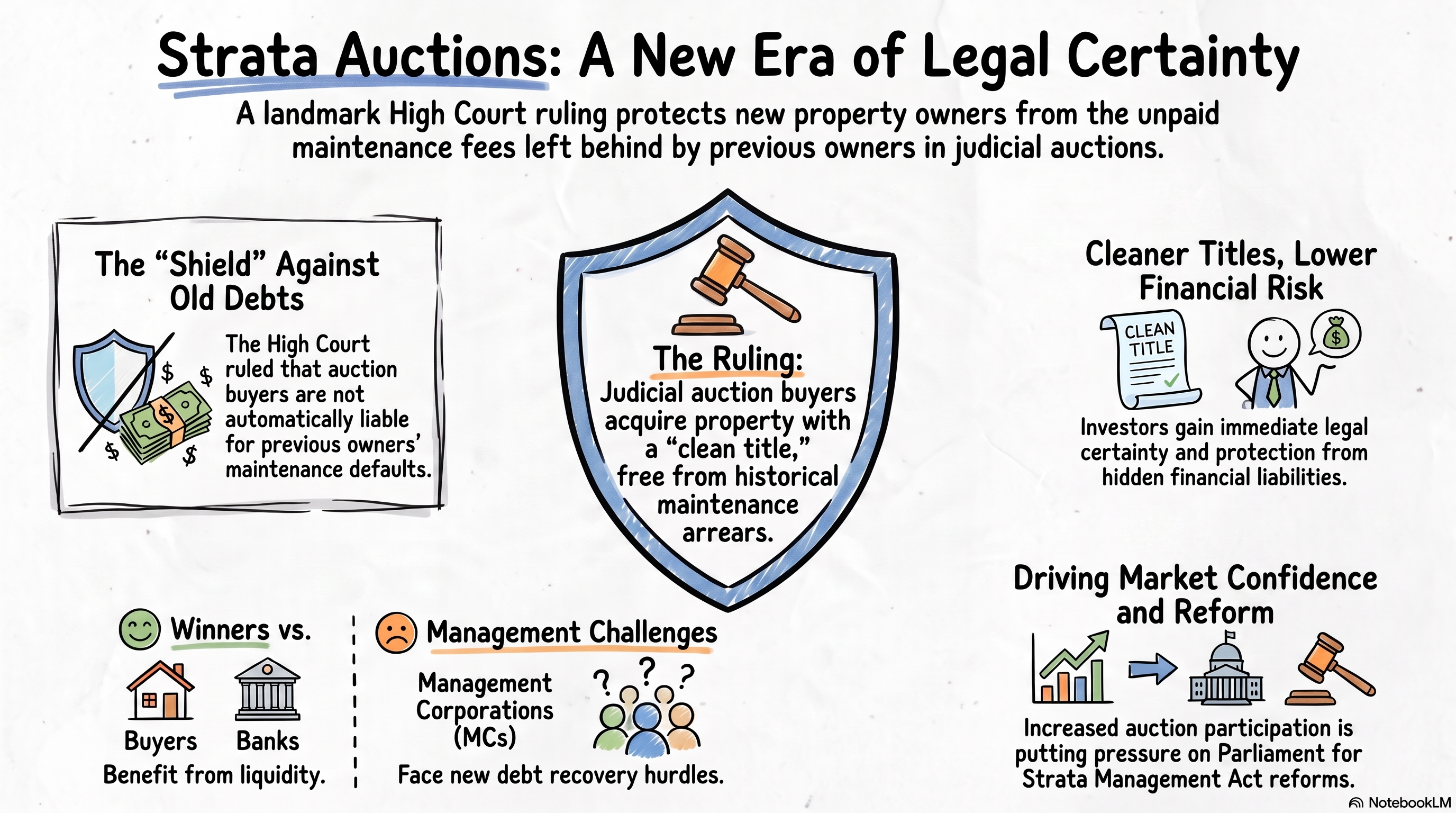
The High Court ruled that purchasers of strata properties acquired through court-ordered auctions are not automatically liable for unpaid maintenance charges and sinking fund arrears owed by previous owners. The decision arose from a dispute involving the Management Corporation (MC) of Megan Avenue 1 and an auction purchaser, with the court finding that such buyers are not "successors-in-title" under the Strata Management Act 2013.
🟨 2. Affected Channels (MECHANISM)
Regulation: Clarifies the legal interpretation of liability under the Strata Management Act.
Property Transactions: Reduces uncertainty surrounding financial obligations in judicial property auctions.
Financing: May influence banks' recovery processes in foreclosure and auction sales.
Sentiment: Improves legal certainty for participants in court-supervised property auctions.
🟩 3. Malaysia Exposure (WHO)
Exposed sectors
Property
Real estate services
Banking
Property management
Legal services
Types of Malaysian companies
Property management corporations (MCs) and joint management bodies (JMBs).
Banks involved in mortgage foreclosure.
Auctioneers and property auction service providers.
Property investors participating in judicial auctions.
Developers managing stratified properties.
Geographic relevance
Malaysia, particularly the strata property market and judicial auction ecosystem.
🟧 4. What to Watch (SIGNALS)
Whether the judgment is appealed or affirmed by higher courts.
Changes in management corporations' debt recovery practices.
Revisions to auction terms and legal documentation by banks and auctioneers.
Legislative or regulatory amendments to the Strata Management Act.
Trends in participation and transaction volume in court-ordered property auctions.
Corporate disclosures from property management firms regarding bad debt provisions or recovery rates.
Malaysian High Court strengthens auction property certainty by limiting successor liability for strata arrears
2. Executive Summary
The ruling fundamentally reallocates financial risk in Malaysia's strata property market by confirming that buyers of court-ordered auction properties are generally not automatically liable for unpaid maintenance and sinking fund arrears incurred by previous owners.
This enhances legal certainty for judicial auctions, likely increasing investor confidence and participation in Malaysia's distressed property market, while shifting loss recovery pressure back onto management corporations (MCs), lenders, and policymakers.
The judgment exposes a structural weakness in strata finance: insolvency losses cannot always be recovered, potentially leading to reforms in reserve funding, disclosure requirements, insurance mechanisms, or statutory recovery powers.
Investors should view this less as a property case and more as a capital markets and credit risk decision affecting auction pricing, mortgage recoveries, distressed asset investing, and strata governance.
3. Key Insights
Insight 1: The court has redefined who bears insolvency risk
Observation
The High Court held that an auction purchaser through a judicial foreclosure sale is not automatically a "successor-in-title" responsible for historical strata arrears.
Why it matters
The decision allocates insolvency losses to parties already exposed to the failed owner—rather than transferring them to a new purchaser with no contractual relationship.
Second-order implication
Auction buyers face lower legal uncertainty, while management corporations may experience higher unrecoverable debts when owners become insolvent.
Third-order implication
Future legislative reforms may seek to rebalance this allocation of risk without undermining judicial sale certainty.
Insight 2: Judicial auctions become more investable
Observation
The court emphasized that judicial sales must provide certainty and finality.
Why it matters
Investors assign lower risk premiums when legal liabilities are predictable.
Second-order implication
Participation in court auctions may increase, improving liquidity in the distressed property market.
Third-order implication
Banks could achieve higher recovery values on foreclosed assets if stronger bidder participation narrows auction discounts.
Insight 3: Management corporations face a new financial challenge
Observation
The court acknowledged that MCs may ultimately absorb losses caused by insolvent owners.
Why it matters
MCs depend on maintenance collections to fund building operations and capital expenditure.
Second-order implication
Buildings with high foreclosure or default rates could face weaker cash flows and deferred maintenance.
Third-order implication
Credit quality and governance standards of strata developments may become increasingly important to purchasers and lenders.
Insight 4: The ruling strengthens the principle of clean judicial title
Observation
The judgment protects buyers from undisclosed historical liabilities.
Why it matters
Property rights become more secure when judicial sales extinguish uncertain legacy obligations.
Second-order implication
Malaysia's foreclosure framework becomes more attractive to institutional distressed-asset investors.
Insight 5: The pressure shifts toward earlier debt enforcement
Observation
If arrears cannot be recovered from auction buyers, recovery efforts must focus on the original owner before insolvency.
Why it matters
MCs have stronger incentives to pursue early legal action and improve arrears management.
Third-order implication
Technology-driven collections, stricter enforcement, and better debtor monitoring may become more common.
Insight 6: The case highlights a policy gap rather than simply resolving a legal dispute
Observation
The court interpreted existing legislation but acknowledged the practical burden on MCs.
Why it matters
The judgment leaves unresolved how communal property schemes should absorb losses arising from insolvent owners.
Second-order implication
Legislative review of the Strata Management Act 2013 becomes more likely if policymakers view the current balance as unsustainable.
4. Interpretation
What is really happening beneath the headlines?
This judgment is fundamentally about risk allocation.
The court prioritized certainty of title over collective debt recovery.
In economic terms, it prevents "hidden liabilities" from attaching to judicial sales, thereby preserving confidence in foreclosure markets. Without this protection, rational investors would discount auction bids to account for unknown arrears, reducing recovery values for lenders and slowing the resolution of distressed assets.
The decision resembles principles seen in many insolvency regimes, where judicial processes aim to provide purchasers with a clean transfer of assets so markets can function efficiently.
However, the ruling also exposes an institutional weakness: strata management relies on ongoing fee collection, and when owners become insolvent, losses may be socialized across remaining owners unless alternative recovery mechanisms exist.
5. What Changes Next?
Next 6 Months
Likely (75%)
Increased interest from investors in judicial property auctions.
Greater scrutiny of strata arrears before lending or investment decisions.
MCs review collection policies and legal strategies.
Possible (45%)
Industry calls for legislative clarification of "successor-in-title."
Developers and property managers strengthen reserve fund policies.
Low Probability, High Impact (20%)
Appeals or conflicting judgments create temporary legal uncertainty until appellate courts provide definitive guidance.
Next 12 Months
Likely (65%)
Banks market foreclosed strata properties more confidently.
Conveyancing lawyers revise due diligence practices.
MCs adopt more aggressive early recovery measures.
Next 3 Years
Likely (70%)
Potential amendments to strata legislation.
Greater emphasis on financial resilience of MCs.
Institutional investors increase participation in Malaysia's distressed property market if legal certainty is maintained.
6. Winners
Direct Winners
Groups
Judicial auction buyers
Banks disposing of foreclosed properties
Distressed asset investors
Real estate investment funds
Industries
Property auction services
Legal services
Mortgage recovery
Distressed asset management
Secondary Winners
Banks through potentially higher auction proceeds.
Conveyancing firms benefiting from clearer legal interpretation.
Institutional investors seeking distressed property opportunities.
7. Losers / Pressure Points
Management corporations
Face greater risk of unrecoverable maintenance and sinking fund arrears.
Nature: Structural unless legislation changes or alternative recovery mechanisms are introduced.
Existing parcel owners
May indirectly bear higher maintenance costs if arrears cannot be recovered.
Developers managing high-default projects
Cash flow pressures may increase in developments with elevated owner insolvency rates.
8. Investment Implications
Equities
Opportunities
Banks with significant mortgage portfolios may benefit from improved foreclosure recoveries.
Property services firms involved in auctions.
Risks
Companies heavily exposed to strata management operations could face higher bad debt risk.
Private Equity
Potential investment themes:
Distressed real estate
Loan portfolios
Special situations
Asset recovery platforms
Infrastructure
No material direct implication.
Venture Capital
Opportunities in:
Property due diligence technology
Digital strata management
Collections software
Legal technology
Commodities
No direct implication.
Fixed Income
Potentially positive for mortgage-backed recoveries if auction outcomes improve, though the impact is likely to be modest.
Currencies
No meaningful direct impact.
Real Assets
Judicial auction properties become relatively more attractive due to improved legal certainty regarding historical strata liabilities.
9. Malaysia / ASEAN Implications
Malaysia
This is the primary jurisdiction affected.
Potential implications include:
Stronger participation in judicial auctions.
Improved confidence in foreclosure processes.
Increased pressure for reforms to strata governance and debt recovery.
Singapore
Limited direct impact, but the case may be studied comparatively because Singapore also has an extensive strata property regime.
Indonesia
Minimal direct implication, though regional investors may compare legal protections across ASEAN property markets.
Thailand
Limited direct effect.
Vietnam
Limited direct effect.
10. Long-Term Structural Trend
Megatrend | Assessment | Why |
Financial fragmentation | Neutral | No significant impact. |
Industrial policy | Neutral | Primarily a judicial interpretation. |
Supply-chain resilience | Neutral | Not applicable. |
Resource nationalism | Neutral | Not applicable. |
Re-industrialisation | Neutral | Not applicable. |
Multipolar world | Neutral | Not applicable. |
AI infrastructure | Neutral | Not applicable. |
Energy transition | Neutral | Not applicable. |
Friend-shoring | Neutral | Not applicable. |
Institutional quality (emerging governance theme) | Strongly reinforces | Clear property rights and judicial certainty improve market confidence and capital allocation efficiency. |
11. Hidden Insights
This ruling may increase auction prices. Reduced legal uncertainty lowers the risk premium demanded by bidders, potentially improving recoveries for banks.
The burden shifts from purchasers to governance. MCs may need stronger reserve policies, insurance solutions, or faster enforcement because historical arrears cannot simply be transferred to new owners.
Distressed property could become a more institutional asset class. Greater legal certainty makes foreclosure markets more accessible to professional investors and real estate funds.
The decision exposes a financing gap in strata management. Legislators may eventually explore mechanisms such as guarantee funds, enhanced recovery powers, or mandatory financial safeguards for MCs.
Banks indirectly benefit even though they were not parties to the case. Higher confidence in foreclosure outcomes can improve collateral values and reduce expected credit losses over time.
12. Signals to Monitor
Bullish Confirmation
No successful appeal overturning the ruling.
Increased bidder participation and stronger prices at judicial property auctions.
Banks reporting improved recovery rates on foreclosed strata properties.
Professional investors increasing exposure to auction assets.
Bearish Confirmation
Legislative amendments imposing some form of successor liability.
Growing financial stress among MCs due to unrecoverable arrears.
Higher maintenance fees imposed on remaining owners to offset bad debts.
Invalidation Signals
An appellate court reverses or substantially narrows the High Court's interpretation.
Parliament amends the Strata Management Act to explicitly make judicial auction purchasers liable for historical arrears.
13. Bottom Line
The ruling strengthens the principle that judicial sales should deliver clean and predictable title, reducing hidden liabilities for auction purchasers.
Distressed property investments become more attractive because legal uncertainty—and therefore required risk premiums—may decline.
Banks could benefit indirectly through stronger foreclosure recoveries and more competitive auction outcomes.
Management corporations face increased pressure to improve collections and financial resilience, as historical arrears may become harder to recover after insolvency.
The decision highlights a policy trade-off between protecting innocent buyers and safeguarding the financial sustainability of strata communities.
Legislative clarification of the Strata Management Act is a realistic medium-term possibility if policymakers seek to rebalance these competing interests.
For investors, the key takeaway is not the specific dispute but the broader improvement in property rights certainty, which supports more efficient capital allocation in Malaysia's distressed real estate market.
One year from now, the most important indicator will be whether this judgment leads to higher auction participation, stronger recovery values, or legislative reform that reshapes strata finance.