🟦 1. The Event (FACT)
At the Rehda CEO Series 2026 conference on Thursday, Rehda Institute chairman Datuk Jeffrey Ng highlighted that homeownership among Malaysia’s M40 group has fallen to 75.9%, below the B40 rate of 76.3%, citing cross-subsidisation in development models as a key factor. He also addressed concerns over the proposed increase in stamp duty for foreign home purchases from 4% to 8%.
🟨 2. Affected Channels (MECHANISM)
Demand: Affordability pressures may constrain M40 homebuying
Cost: Increased stamp duty for foreign buyers raises transaction costs
Financing: Need for flexible homebuyer financing and risk-sharing mechanisms
Regulation: Policy decisions on stamp duty, approvals, and housing ecosystem support
🟩 3. Malaysia Exposure (WHO)
Exposed sectors: Residential property developers, real estate financing institutions, utilities providing infrastructure to new developments
Company types: Developers of affordable and mid-market housing, banks offering mortgages, state utility providers
Geographic relevance: Nationwide, with heightened relevance in urban and suburban housing markets
🟧 4. What to Watch (SIGNALS)
Official decisions on the foreign home purchase stamp duty rate
M40 homeownership statistics and mortgage uptake trends
Announcements of preferential financing schemes for first-time buyers
Updates on affordable housing project deliveries and completion rates
Developer statements on cross-subsidisation models and pricing adjustments
1. Key Insights
M40 homeownership has dropped below B40: Middle-income households (M40) now have a 75.9% homeownership rate versus 76.3% for low-income B40 households.
Cross-subsidisation is a core issue: Developers fund affordable units by charging higher prices for open-market units, inflating overall market prices and reducing affordability.
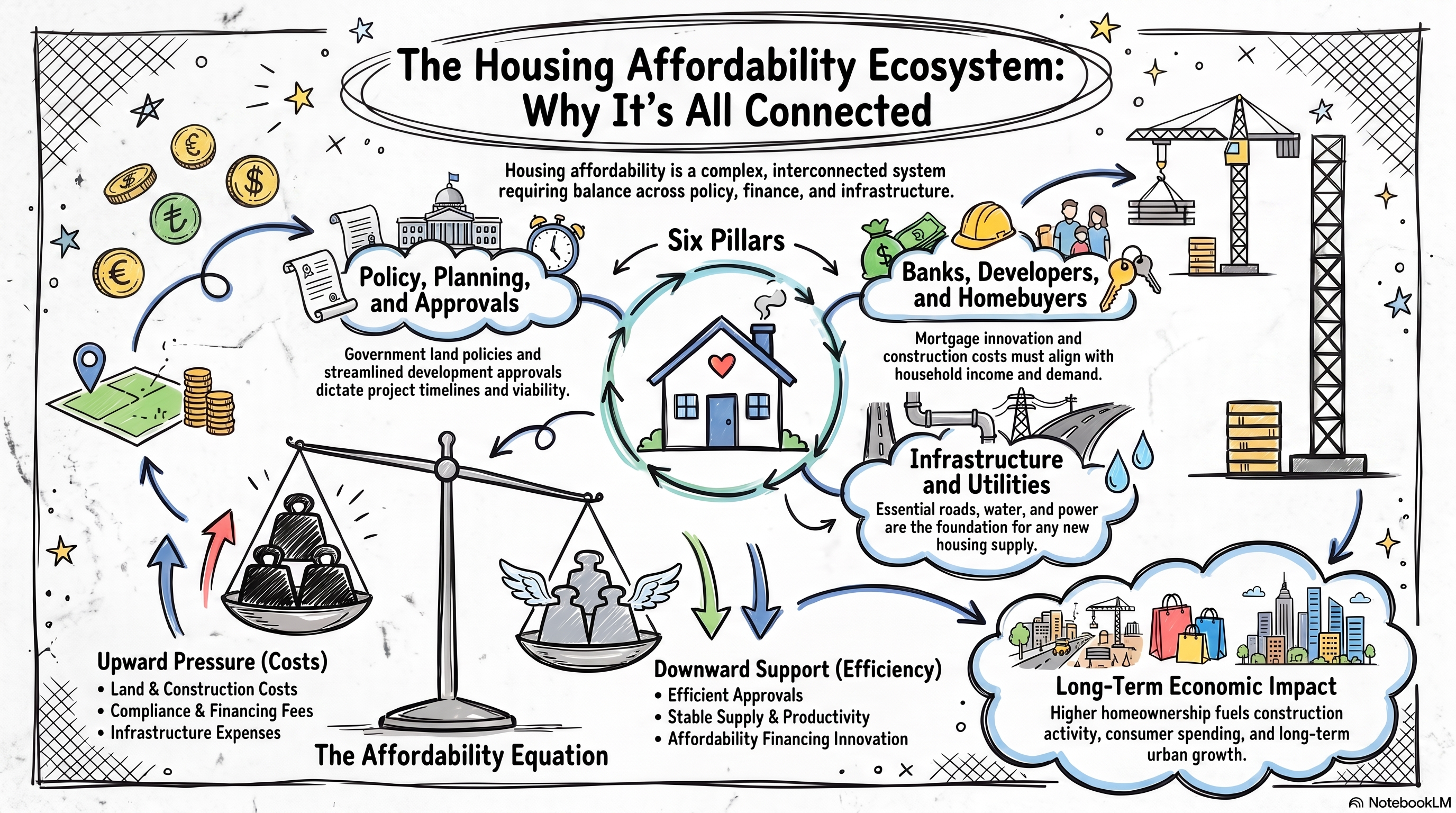
Systemic challenges: Affordability is tied to delivery sustainability, land policy, financing, infrastructure provision, approvals, and compliance. Delays and abandoned projects are symptoms of ecosystem fragility.
Foreign buyer stamp duty: Proposed increase from 4% → 8% on high-end/foreign purchases could reduce investment spillover benefits.
2. Impact Analysis
⚠️ For Homebuyers
M40 households are being squeezed: Higher prices, financing challenges, and limited supply for mid-range homes make homeownership more difficult.
First-time buyers may struggle without supportive financing mechanisms.
🏗️ For Developers
Pressure on margins: Cross-subsidisation and project risk are reducing viability of mixed developments.
Delays and abandoned projects may continue unless financing, approvals, and utility arrangements improve.
💰 For Financial Sector
Opportunity and risk: Banks could design tailored financing solutions (longer tenure, income-responsive repayment, risk-sharing) to support M40 buyers, but must manage credit risk.
🌍 For Foreign Investors
Stamp duty hike could deter investment: Potential slowdown in high-end property demand, affecting associated sectors like retail, education, and services.
3. Interpretation
The Malaysian property market faces structural pressure, not just cyclical affordability issues.
Cross-subsidisation, while well-intentioned, has unintended consequences, pushing M40 buyers out of the market.
Government policy, financing innovation, and developer collaboration are all needed to stabilize the market.
The foreign buyer tax increase is more symbolic than economic, but could have ripple effects in high-end real estate and the broader economy if implemented abruptly.
4. Recommended Actions for Stakeholders
🏘️ For Developers
Explore mixed-income models with risk-sharing mechanisms.
Engage proactively with utilities, financiers, and local authorities to streamline project delivery.
Maintain quality and pricing transparency to retain M40 buyers despite rising costs.
💳 For Banks/Financial Institutions
Offer preferential financing and income-responsive repayment structures for first-time M40 buyers.
Participate in risk-sharing frameworks with developers, potentially backed by policy incentives.
🏛️ For Policymakers
Streamline approvals and reduce compliance bottlenecks.
Consider a gradual or moderate approach to foreign buyer stamp duty, rather than a sudden hike.
Support long-term housing ecosystem resilience rather than short-term price control.
🌐 For Investors
Domestic property: Focus on developers with resilient business models, diversified portfolios, and strong government ties.
High-end segment / foreign buyer exposure: Monitor policy changes carefully; abrupt stamp duty hikes could reduce near-term demand.
✅ Bottom Line
Malaysia’s housing market challenges are structural and ecosystem-driven, not just price-driven. Stabilizing M40 homeownership will require coordinated action across developers, banks, utilities, and government agencies. Meanwhile, foreign investment policy needs balance to avoid deterring high-value inflows that support the broader economy.
1. Likely Policy Changes
a) Housing Affordability & Delivery
Stronger developer-bank-government collaboration: Policies encouraging risk-sharing, financing support, and infrastructure cost-sharing.
Incentives for mid-income (M40) housing: Preferential financing, longer repayment tenures, or subsidies targeting M40 buyers.
Streamlined approval processes: State and local governments could speed up permitting to reduce project delays.
Encouragement of mixed-income developments: Regulations or incentives to ensure cross-subsidisation doesn’t inflate prices disproportionately.
b) Financing & Banking
Policy-backed risk-sharing frameworks: Government guarantees or co-financing schemes to reduce developer and bank exposure.
Income-responsive loans: Rules enabling banks to offer flexible repayment structures for M40 households.
c) Foreign Buyer Stamp Duty
Moderated or staged increase: Instead of a sudden jump from 4% → 8%, the government may adopt gradual hikes or exemptions for long-term investors.
d) Utility & Infrastructure
Equitable cost-sharing: Policies ensuring utility and infrastructure costs are shared fairly between developers and consumers, reducing project risk.
2. Potential Beneficiaries
🏘️ M40 Homebuyers
Lower risk of project delays or abandonment.
Better access to financing, allowing more households to achieve homeownership.
🏗️ Developers
Reduced financial risk through risk-sharing frameworks and incentives.
Faster approvals and lower compliance bottlenecks improve project viability.
💳 Banks & Financial Institutions
Expanded lending opportunities through government-backed or income-responsive financing schemes.
Reduced non-performing loan risk if repayment structures are better aligned with M40 affordability.
🌍 Foreign Investors / High-End Buyers
If stamp duty increases are moderated, foreign buyers benefit from predictable policy and lower friction in high-end market participation.
✅ Overall Economy
More stable housing market, reduced abandoned projects, and improved economic spillovers to construction, retail, and services.