Purpose-built student accommodation (PBSA) has become one of the fastest-growing alternative real estate sectors globally. Investors have seen strong performance from PBSA in countries such as the United Kingdom and Australia, leading many to wonder whether Malaysia could be the next major growth market.
The answer is more nuanced than a simple yes or no.
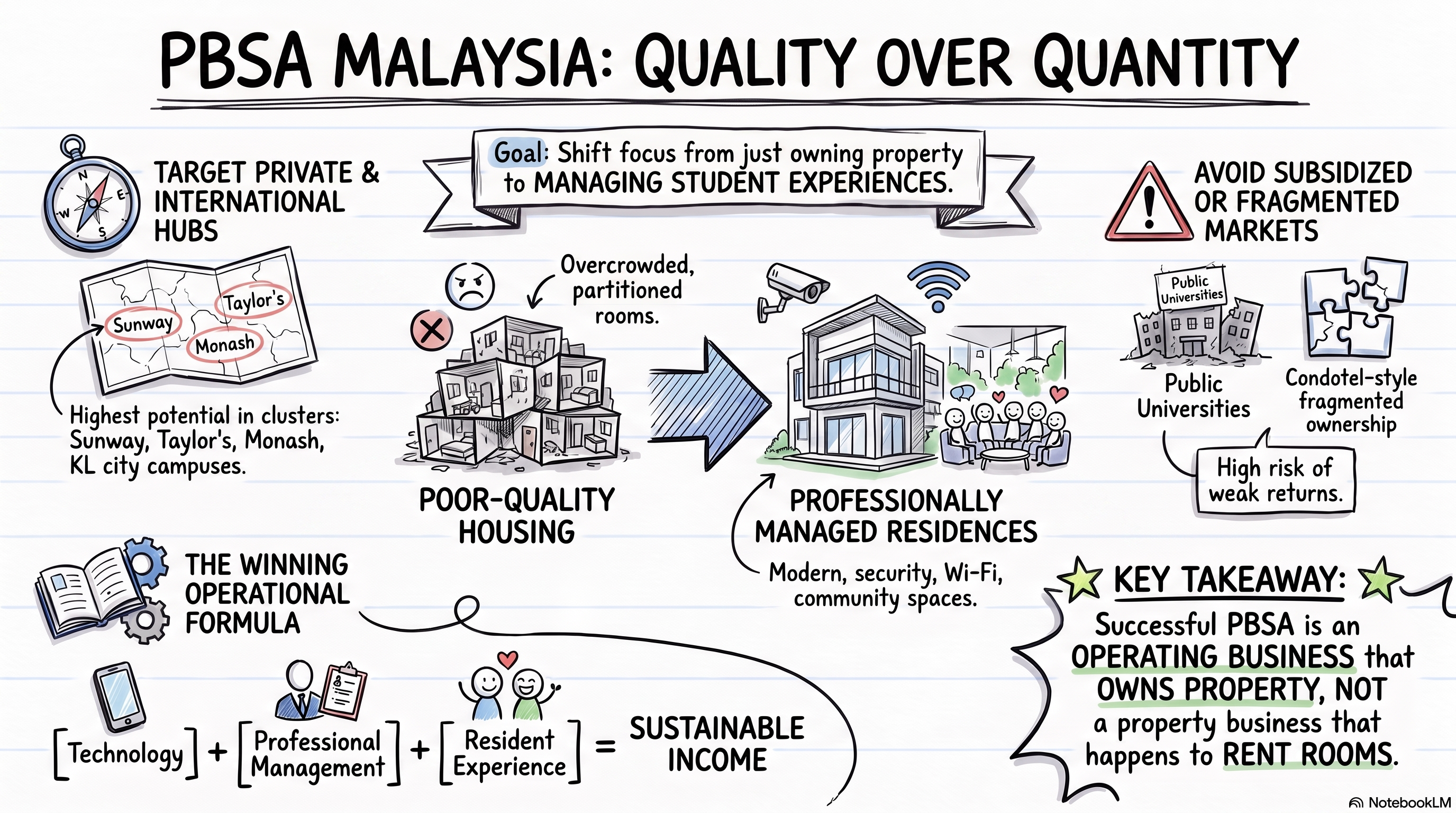
Malaysia does have genuine demand for purpose-built student accommodation, but the market is highly uneven. Demand is concentrated in specific locations, tenant profiles, and university ecosystems. Many projects have struggled because developers assumed that PBSA is simply another residential property product when, in reality, it is an operating business that happens to own real estate.
Understanding where demand exists, where it does not, and how successful operators create value is critical before investing in this sector.
Malaysia Has Genuine PBSA Demand, but It Is Highly Concentrated
Malaysia is widely recognised as an emerging PBSA market. Several structural trends continue to support long-term demand.
The country's student population continues to expand through both local enrolments and increasing numbers of international students. At the same time, student expectations have evolved significantly. Instead of simply renting the cheapest available room, many students now prioritise security, convenience, reliable internet, furnished accommodation, study facilities, and a managed living environment.
This shift is particularly visible among students attending private universities and international institutions.
Unlike previous generations, students increasingly view accommodation as part of their university experience rather than merely a place to sleep. Parents are also becoming more willing to pay for professionally managed housing that offers greater safety and predictable living standards.
However, this demand is not evenly distributed across Malaysia.
The strongest PBSA demand exists around private university clusters such as Sunway University, Taylor's University, Monash University Malaysia, INTI International University, and universities located within Kuala Lumpur city.
These education hubs attract large numbers of international students and affluent domestic students while often having limited on-campus accommodation. As a result, many students spill over into conventional rental markets where they occupy overcrowded terrace houses, partitioned apartments, or short-term Airbnb units.
This fragmented rental landscape creates an opportunity for professionally managed student accommodation that delivers consistent quality, transparent pricing, and a stronger community experience.
International Students Are the Real Engine Behind Malaysia's PBSA Market
While domestic students contribute to housing demand, international students represent the strongest economic foundation for purpose-built student accommodation.
Students arriving from China, Indonesia, the Middle East, Africa, and other regions typically have different priorities compared to local students. Many are unfamiliar with the local rental market and prefer accommodation that removes the complexity of dealing with multiple landlords, utility accounts, deposits, furnishing, and maintenance.
For these students, PBSA offers several advantages:
Fully furnished rooms ready for immediate occupancy
Professional management and customer support
Enhanced security and controlled access
High-speed internet and study facilities
Community activities that improve social integration
Predictable monthly costs with bundled utilities
These features significantly reduce friction during the transition into university life.
Ironically, the current inefficiencies within Malaysia's rental market actually strengthen the case for PBSA. The traditional student housing market remains highly fragmented, with inconsistent property standards, varying rental agreements, and little operational standardisation.
Professional operators are therefore competing less against perfect alternatives and more against an inefficient market.
Why Many PBSA Projects Fail Despite Strong Demand
Although Malaysia presents attractive opportunities, it differs fundamentally from mature PBSA markets like the United Kingdom and Australia.
Many investors mistakenly assume that successful overseas models can simply be replicated locally.
Several structural challenges make Malaysia a far more selective investment environment.
The first challenge is affordability.
Malaysian students remain significantly more price-sensitive than students in developed Western markets. Room sharing remains common, and many students prioritise affordability above premium amenities. If rental rates exceed what students are willing to pay, occupancy can decline rapidly regardless of how attractive the building appears.
The second challenge comes from public universities.
Major public institutions including Universiti Malaya and Universiti Kebangsaan Malaysia already provide subsidised on-campus accommodation. Since these housing options are often substantially cheaper than private alternatives, the addressable market for independent PBSA developments near public universities is considerably smaller.
The third challenge is Malaysia's extensive informal student housing market.
Across many university towns, landlords routinely convert terrace houses and apartments into multi-room rentals with flexible pricing structures. Although these properties may not deliver premium living standards, they offer significantly lower rental costs and can quickly adjust pricing in response to market conditions.
This informal supply creates intense competition, particularly in areas where students are highly price-sensitive.
As a result, PBSA cannot compete solely on providing a room. It must deliver an experience that clearly justifies its pricing premium.
Where Purpose-Built Student Accommodation Works Best in Malaysia
Success in Malaysia depends far more on location selection than overall national demand.
The strongest investment opportunities exist within premium private university ecosystems.
Areas surrounding Sunway University, Taylor's University, Monash University Malaysia, Subang Jaya, SS15, and Kuala Lumpur city campuses consistently demonstrate stronger demand for professionally managed accommodation because they combine high student density with limited quality housing options.
In these markets, students often value:
Ensuite rooms
Private studios
Reliable Wi-Fi
Shared study spaces
Modern communal facilities
Professional security
Community events
Rather than functioning as traditional dormitories, successful projects resemble modern co-living environments specifically designed for university students.
International student hubs also represent particularly attractive markets because incoming students generally place greater emphasis on convenience, safety, and move-in readiness.
Urban universities located within land-constrained city centres provide another favourable environment. Where land availability is limited and surrounding housing stock is scarce or expensive, professionally managed PBSA becomes a practical necessity rather than a lifestyle upgrade.
Conversely, several market segments remain challenging.
Affordable mass-market PBSA often struggles because construction costs make it difficult to achieve rental levels that students can comfortably afford while still generating acceptable investment returns.
Secondary cities without significant international student populations frequently lack sufficient pricing power to support dedicated PBSA developments.
Developments that adopt a condotel-style ownership model may also face structural weaknesses. Selling individual rooms or units to multiple investors often fragments ownership, creates inconsistent management standards, and weakens the overall resident experience. Over time, this misalignment can reduce occupancy and damage long-term asset performance.
The Biggest Opportunity Is Operating Student Housing, Not Selling Property
The most successful PBSA companies around the world are not primarily property developers.
They are operating businesses.
Global operators generate competitive advantages through branding, operational excellence, resident experience, technology integration, and sophisticated revenue management rather than simply owning buildings.
Their objective is to maximise long-term income per bed instead of maximising one-off property sales.
This principle creates an overlooked opportunity within Malaysia.
Rather than constructing large student accommodation towers, operators can pursue a micro-PBSA strategy by converting existing buildings such as shoplots, apartments, or small commercial properties located near universities into standardised student housing products.
This asset-light approach often reduces development risk while allowing operators to scale more efficiently.
Technology further strengthens this model.
A comprehensive student housing operating system can integrate:
Digital leasing and contract management
Automated room allocation
Dynamic rental pricing
Maintenance management
Community engagement
Laundry and cleaning services
Event management
Resident communication
CRM and payment systems
By treating accommodation as a service rather than merely a property asset, operators create recurring customer relationships that extend beyond rent collection.
Looking further ahead, future financing models may also evolve.
Instead of selling individual rooms or units, operators could potentially securitise or tokenise the recurring cash flow generated by diversified portfolios. Such structures may improve liquidity while avoiding the operational fragmentation commonly associated with traditional strata ownership.
Final Verdict: Malaysia's PBSA Market Rewards Operators, Not Speculators
Purpose-built student accommodation has genuine long-term potential in Malaysia, but it should not be viewed as a universal property investment opportunity.
The market is neither broadly undersupplied nor guaranteed to generate attractive returns simply because student numbers continue to grow.
Demand is highly concentrated within private university clusters, international student markets, and urban campuses where professionally managed accommodation clearly outperforms informal alternatives.
Projects targeting the wrong locations, relying solely on domestic price-sensitive tenants, or treating PBSA as a conventional residential development are significantly more likely to struggle.
The strongest opportunities belong to operators capable of building trusted brands, delivering consistent resident experiences, and optimising long-term rental income through technology and professional management.
The most important insight for investors is this:
Malaysia is not undersupplied with student accommodation in general.
Instead, the market is oversupplied with poor-quality, fragmented housing while remaining undersupplied with professionally managed, high-quality student living experiences.
That distinction is what separates successful PBSA investments from disappointing ones.