For any sovereign nation, being branded a global "money laundering paradise" is the ultimate kiss of death. It is financial suicide, guaranteed to isolate a country from the international banking system.
Yet, in a stunning move that has shocked the financial world, Indonesia has decided to play a high-stakes game with its own credibility.
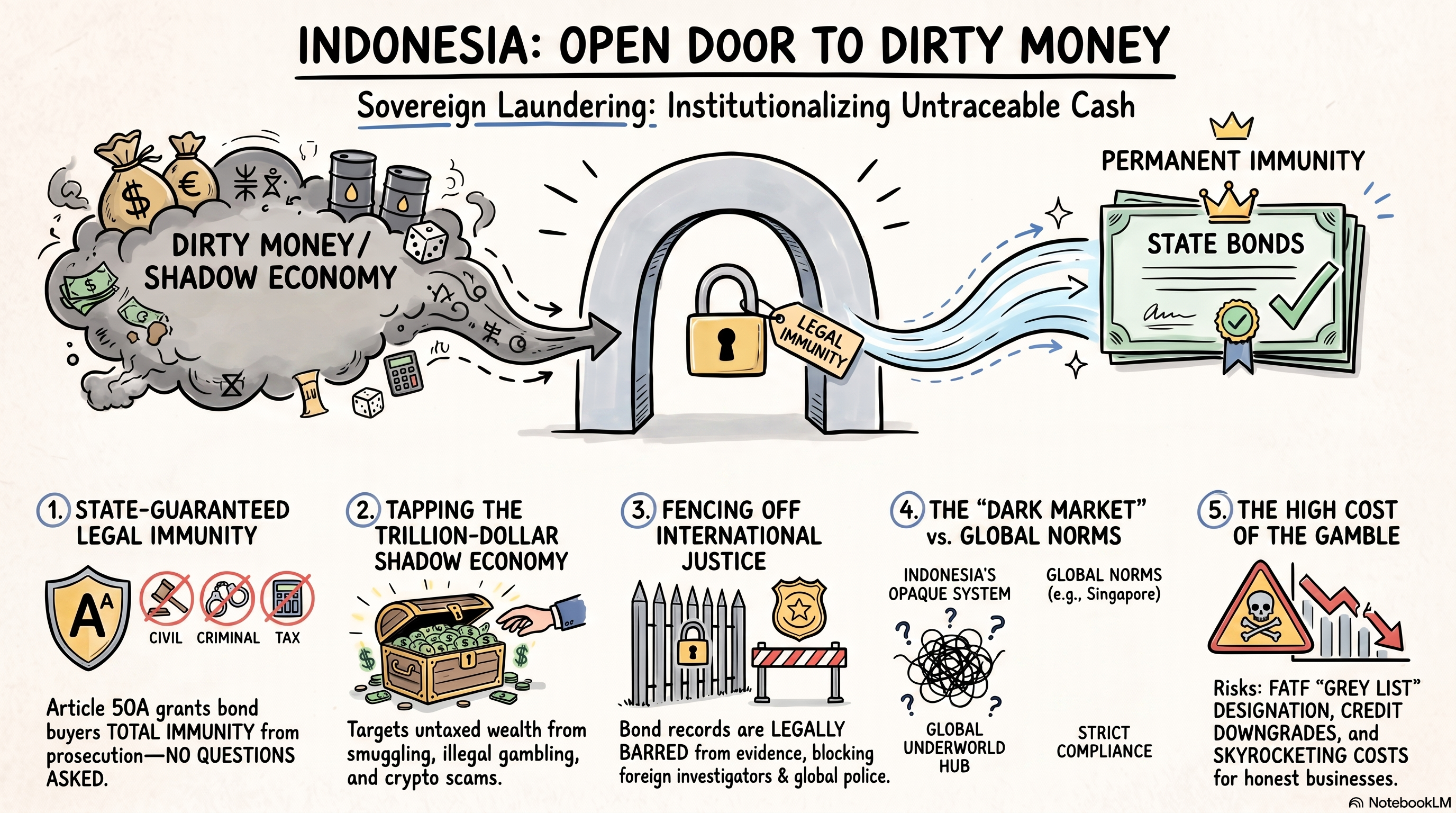
Through a controversial new amendment to its financial laws (specifically Article 50A of the UU P2SK), Jakarta has introduced a shocking clause: anyone who purchases special bonds issued by the country's new sovereign fund, Danantara, is granted permanent immunity from civil, criminal, and tax prosecution. No questions asked about where the money came from.
To fund President Prabowo’s ambitious national agenda, Indonesia is openly defying the global financial order. This isn't just a policy shift; it is a dangerous gamble that effectively leases the country’s sovereign credit to the world’s darkest capital.
The Underground Triad: How We Got Here
To understand how Indonesia arrived at this "dirty money festival," you have to connect three underlying economic realities that the government is trying to exploit.
1. The Trillion-Dollar Shadow Economy
For decades, an enormous parallel economy has thrived beneath Indonesia's surface. Worth quadrillions of rupiah, this mountain of untaxed, untraceable wealth is built on a legacy of resource smuggling and tax evasion. In recent years, it has been supercharged by explosive growth in illegal online gambling and cryptocurrency scams.
2. The Failure of Standard Financial Incentives
The government didn't jump straight to extreme measures. The previous administration tried standard "tax amnesties" to coax this capital back into the light. However, legitimate financial amnesties require paperwork, disclosure, and audits. For holders of truly black-market cash, the risk was too high, and the money stayed hidden offshore. Jakarta realized that to lure the deepest, darkest capital out of the shadows, it needed to offer something that even Swiss or Singaporean banks could no longer guarantee: absolute, legally binding anonymity.
3. Fencing Off International Justice
The new law takes asset protection to unprecedented lengths. It explicitly dictates that these bond transaction records cannot be used as evidence in a court of law. By doing this, Indonesia has effectively cut the chain of international judicial assistance, locking out foreign investigators and global police agencies from tracing the funds.
The Backfire: Why the Gamble is Inherently Flawed
While the policy is designed to bring a flood of liquidity into the state's coffers, global financial watchdogs and credit institutions are already raising the red flag. The strategy contains a fatal flaw that could devastate Indonesia's legitimate business sector.
Credit rating agencies are warning of an imminent downgrade of Indonesia's capital markets, citing a severe collapse in institutional independence and legal compliance. More alarmingly, the country is now on a fast track back to the Financial Action Task Force (FATF) "Grey List."
If Indonesia is grey-listed, the economic fallout will be severe:
Skyrocketing Costs: The cost of overseas fund transfers and international letters of credit for normal Indonesian companies will soar.
Capital Flight: Legitimate foreign investors, bound by strict compliance laws, will be forced to pull their money out of the country.
Collateral Damage: Honest, tax-paying businesses will ultimately foot the bill for the state's gamble on illicit cash.
A New Framework for Global Wealth
Indonesia's new stance reveals a cynical shift in the modern geopolitical landscape, pointing toward a fractured financial future for Asia.
The Rise of Sovereign Laundering
Historically, harboring illicit wealth was the domain of tiny, politically insignificant island tax havens. Indonesia, however, is a G20 member and the largest economy in Southeast Asia. When a regional giant chooses to institutionalize the protection of untraceable cash, it signals a dark evolution in geopolitics: sovereign states are now competing to become the world’s most powerful, legally protected financial laundromats. It proves that under intense economic pressure, international legal norms are easily commoditized.
The Fracturing of South East Asia Finance
This policy effectively splits Southeast Asia into a financial cold war, creating a stark divide between two competing capital ecosystems. On one side stands the Clean Market, typified by financial hubs like Singapore, which anchors its reputation on a philosophy of strict adherence to global compliance standards. In this hyper-transparent and strictly regulated environment, every dollar is audited to cater to global institutional wealth and Western capital that demands absolute institutional integrity.
Directly opposing this is the newly emerging Dark Market led by Indonesia, which offers sovereign-backed immunity for a price. Operating under a state-decreed guarantee of total opacity, this system asks zero questions about capital origins, effectively acting as a massive financial black hole engineered to capture the vast, untraceable global shadow economy.
By striking a bargain with the global underworld, President Prabowo may have secured the immediate funding needed to jumpstart his national projects. However, the long-term cost may be steep: anchoring Indonesia’s economic future to the dark side of the global financial system.