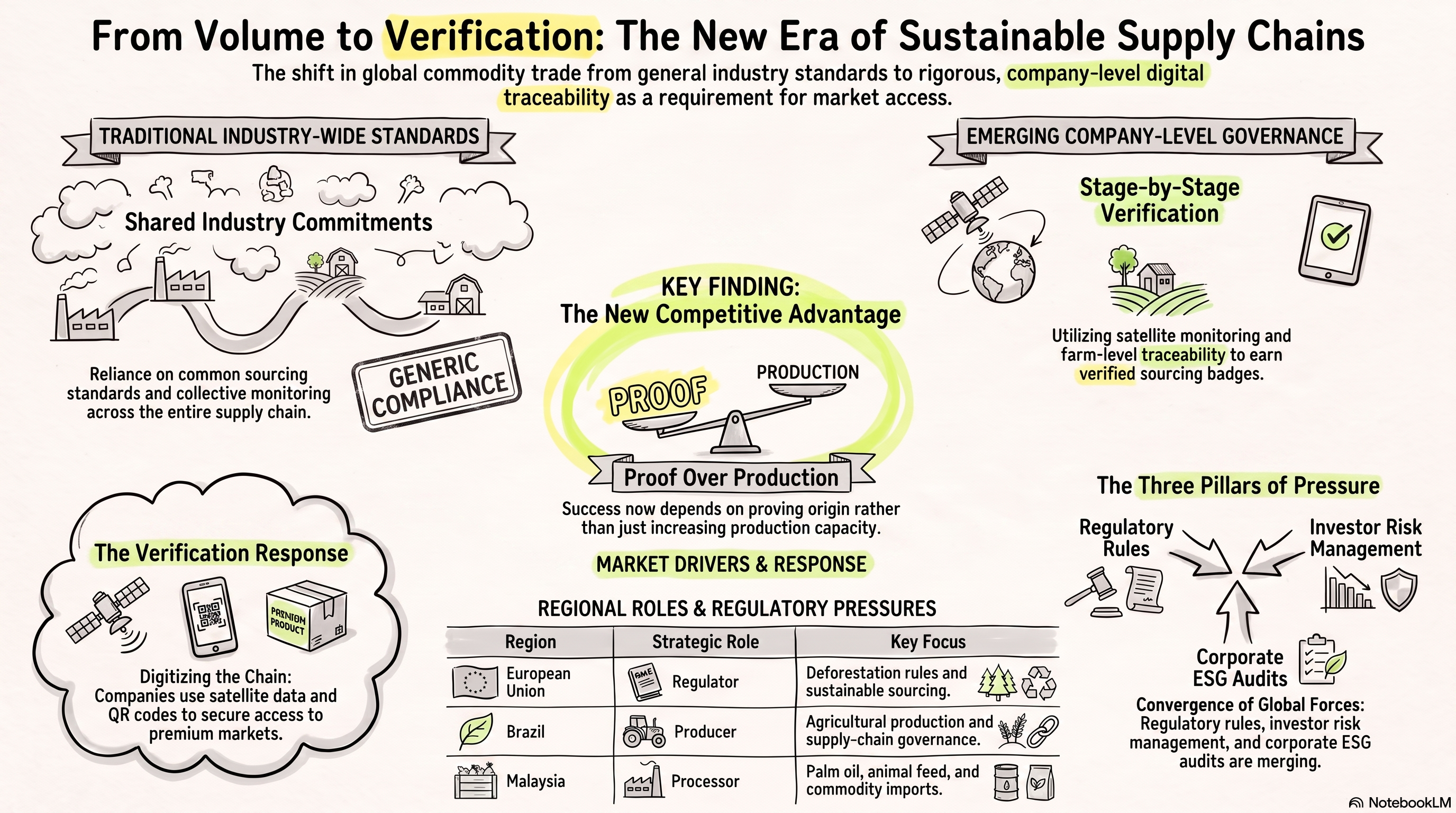
🟦 1. The Event (FACT)
Brazil’s largest soybean producers and traders, including Archer Daniels, Cargill, and Bunge, have withdrawn from the Amazon Soy Moratorium, which had prohibited buying soybeans from areas deforested after 2008. The moratorium, in place since 2006, had helped preserve over 13,000 sq km of forest.
🟨 2. Affected Channels (MECHANISM)
Trade / Logistics: Changes in sourcing patterns for Brazilian soy
Regulation: Shift in self-imposed sustainability compliance
Supply: Potential increase in soy production from previously restricted land
Sentiment: Investor and buyer perception regarding deforestation-linked commodities
🟩 3. Malaysia Exposure (WHO)
Exposed sectors: Palm oil and soy-based food manufacturers, animal feed producers
Company types: Importers of soy and soy-derived products, food processors using soy protein
Geographic relevance: Supply chains reliant on Brazilian soy imports
🟧 4. What to Watch (SIGNALS)
Changes in Brazilian soy export volumes and sourcing regions
Price movements in global soy and soy-derived products
Corporate sustainability reports or sourcing updates from Malaysian buyers
Shifts in import patterns or alternative sourcing strategies within Malaysia’s food and feed sector
1. What just happened
Brazil’s largest soybean producers and global traders (including ADM, Cargill, Bunge) have withdrawn from the Amazon Soy Moratorium, a voluntary industry pact that:
Prohibited buying soy grown on land deforested after 2008
Was widely regarded as one of the most effective environmental market mechanisms ever implemented
Helped ensure soy expansion occurred mainly on already-cleared land
This is not a law repeal.
It’s a voluntary industry exit.
That distinction matters.
2. Why this is happening now
This is not because the moratorium “failed”. The data clearly shows the opposite.
The drivers are structural and political:
1) Pushback against private ESG governance
Brazilian agribusiness has increasingly resisted:
Private-sector environmental rules
NGO-linked enforcement mechanisms
“Extra-territorial” ESG pressure from Europe and US buyers
Many producers argue:
“Land-use rules should be set by Brazilian law, not traders or NGOs.”
This is about sovereignty and control, not agronomy.
2) Cost and compliance fatigue
The moratorium:
Restricted land monetisation
Increased compliance, monitoring, and traceability costs
Reduced optionality for producers sitting on newly deforested land
In a world of:
Tight margins
Rising input costs
Competitive pressure from other origins
Producers want maximum flexibility.
3) Regulatory substitution gamble
Producers are betting that:
Brazilian Forest Code enforcement
Government land registries
National traceability systems
will replace the moratorium without causing buyer backlash.
That is a non-trivial risk.
3. Immediate impact (short-term)
Soy supply
Marginal supply increases possible
Especially from frontier regions
Land values in recently deforested areas may rise
Prices
Slight downward pressure on soy prices if supply expands
But limited in the short term — land conversion and planting take time
Environmental
The biggest risk is signalling, not immediate deforestation
It weakens a proven market deterrent
Once deterrents weaken, behaviour follows — usually with a lag.
4. Medium- to long-term impact
1) Trade friction risk increases
Major buyers (especially):
EU
UK
Multinational food companies
are moving toward deforestation-free supply chains (e.g. EU Deforestation Regulation).
Without the moratorium:
Traders must rely on more fragmented, legal-based verification
Compliance costs may actually increase, not fall
Ironically, leaving the moratorium may not simplify exports.
2) ESG capital divergence
Expect a split market:
ESG-sensitive capital:
Pension funds
European asset managers
Sovereign funds
→ Higher scrutiny, possible exclusion
Return-driven capital:
Emerging market funds
Domestic Brazilian investors
→ Less sensitive, more opportunistic
This does not kill capital flows — it changes who funds whom.
3) Reputation risk shifts to traders
ADM, Cargill, Bunge now bear:
Higher reputational exposure
More activist and regulatory pressure
Greater need for proprietary monitoring systems
Voluntary collective cover is gone.
Each firm now stands alone.
5. Interpreting this action correctly
This is not:
A declaration that deforestation will surge tomorrow
Proof ESG “doesn’t work”
A rejection of sustainability per se
This is:
A rejection of private, NGO-linked rule-setting
A shift from collective self-regulation to state-based enforcement
A calculated bet that markets will tolerate more flexibility
Whether that bet pays off depends on buyers, not producers.
6. What actions can stakeholders take?
A) Investors
Equity investors (agribusiness, traders)
Price in:
Higher compliance costs
Potential buyer exclusions
Watch for:
Long-term contracts with EU buyers
Traceability investments
Segregated supply chains
Avoid simplistic “deforestation = bullish” thinking.
That logic ignores demand-side constraints.
ESG / institutional investors
Expect more engagement, not immediate divestment
Focus on:
Company-specific traceability
Satellite monitoring investments
Jurisdictional sourcing commitments
Blanket exits often backfire.
B) Commodity buyers (food, feed, FMCG)
Move toward contract-level deforestation clauses
Increase:
Farm-level traceability
Third-party satellite verification
Possibly pay a traceability premium
The cost will be passed along the chain.
C) Brazilian policymakers
If Brazil wants to avoid trade fallout:
Enforcement of Forest Code must be credible
Land registry data must be transparent and auditable
Public enforcement must replace private discipline — or markets will punish.
You can’t remove one guardrail without strengthening another.
D) Producers
Smart producers will:
Keep moratorium-level practices anyway
Preserve access to premium buyers
Differentiate themselves within Brazil
The “race to the bottom” is optional, not mandatory.
7. The uncomfortable truth
The moratorium worked because:
It aligned economic incentives with environmental outcomes
It used market access as leverage
Removing it does not automatically cause deforestation,
but it removes a proven brake.
If replacement systems underperform, the backlash will come — from buyers, not NGOs.
Bottom line
This move:
Increases supply flexibility
Reduces collective ESG discipline
Raises trade and reputation risks
Forces sustainability responsibility down to the firm level
For investors and stakeholders, this is not a binary ESG story.
It is a supply-chain governance transition, and those who adapt fastest — with traceability, transparency, and buyer alignment — will still win.