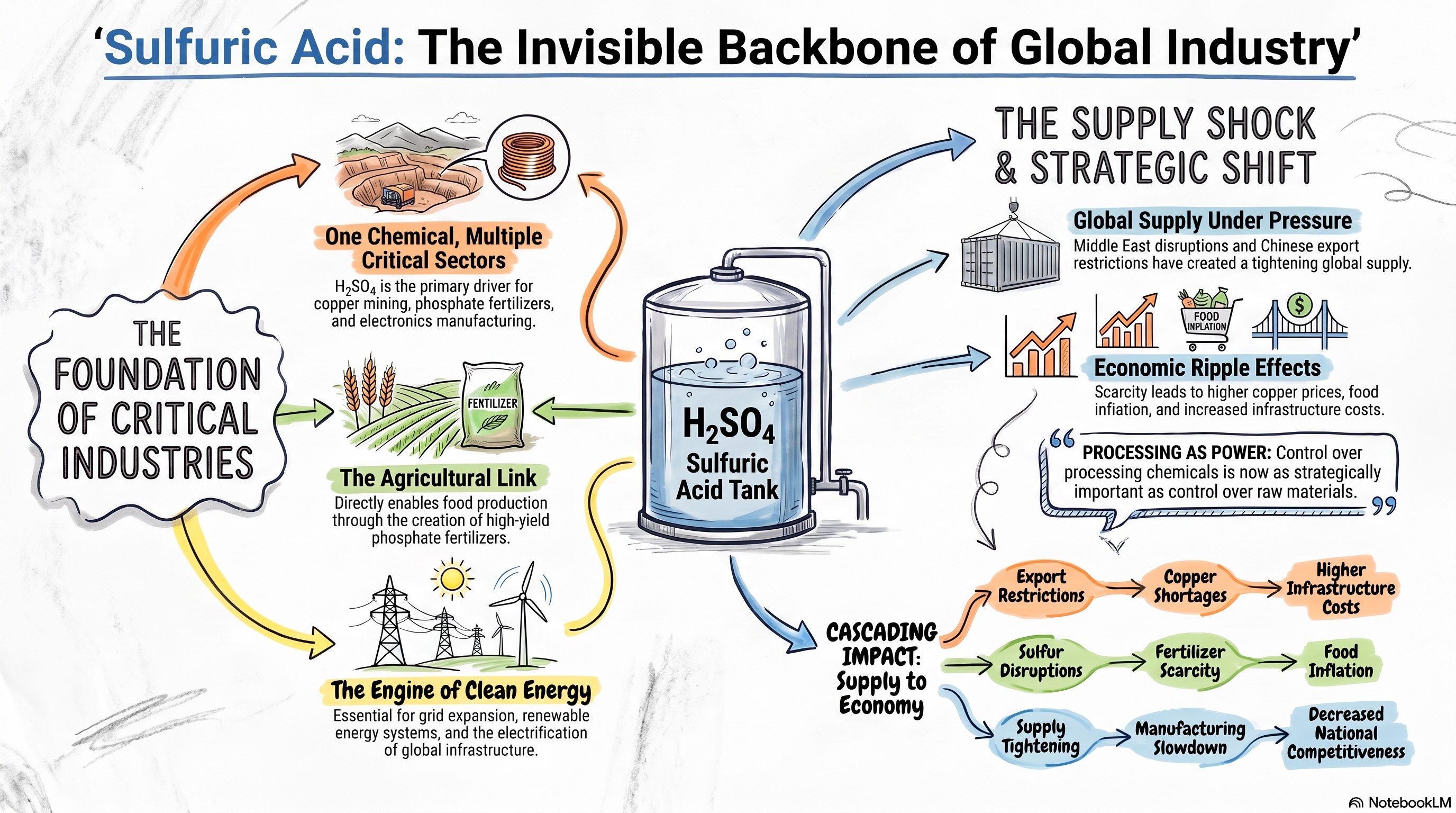
🟦 1. The Event (FACT)
China will reportedly restrict exports of by-product sulfuric acid from 1 May 2026, with only limited exemptions such as electronic-grade sulfuric acid. The move comes amid an already tight global sulfur supply following disruptions in the Middle East, increasing pressure on copper production and phosphate fertilizer manufacturing worldwide.
🟨 2. Affected Channels (MECHANISM)
Supply: Reduced global availability of sulfuric acid for copper mining and fertilizer production.
Cost: Higher sulfur, sulfuric acid and phosphate fertilizer input costs.
Trade / Logistics: Export restrictions alter global sulfuric acid trade flows and sourcing patterns.
Production: Hydrometallurgical copper mining and phosphate fertilizer production face input constraints.
Sentiment: Supply security concerns increase across industrial metals and agricultural input markets.
🟩 3. Malaysia Exposure (WHO)
Exposed sectors
Fertilizer and agriculture
Plantation
Copper and industrial metals
Electrical and electronics manufacturing
Industrial chemicals
Mining support and commodity trading
Types of Malaysian companies
Fertilizer manufacturers and distributors
Plantation companies reliant on phosphate fertilizers
Chemical manufacturers using sulfuric acid as an industrial input
Copper product manufacturers
Cable, wire and electrical equipment producers
Industrial commodity importers and distributors
Geographic relevance
Malaysia is exposed indirectly through higher global prices and supply chain adjustments for fertilizers, industrial chemicals and copper-related products.
🟧 4. What to Watch (SIGNALS)
Confirmation and implementation details of China's sulfuric acid export restrictions.
Global sulfur and sulfuric acid price movements.
Phosphate fertilizer price trends and import costs.
Procurement activity by Malaysian fertilizer distributors and industrial chemical users.
Copper production updates from Chile, the Democratic Republic of the Congo and Zambia.
Global copper treatment and refining charges (TC/RCs).
Corporate disclosures on raw material costs, supply disruptions or sourcing diversification by Malaysian manufacturers.
Developments affecting Middle East sulfur production and shipping routes.
China's sulfuric acid export ban transforms a chemical byproduct into a strategic geopolitical commodity
2. Executive Summary
China's suspension of sulfuric acid exports represents a strategic choke point across two critical global value chains: copper production and phosphate fertilizers, amplifying the effects of Middle East sulfur supply disruptions.
The combination of the Strait of Hormuz disruption and China's export restrictions creates a dual supply shock, revealing that downstream processing capacity—not just raw material ownership—is a major source of geopolitical leverage.
Copper supply risks are shifting from mine availability to processing inputs, potentially delaying energy transition projects and AI-related grid expansion while increasing inflationary pressure on agricultural inputs.
Investors should view sulfuric acid as an emerging strategic industrial chemical whose availability could influence metals, food security, industrial policy, and capital allocation over the coming decade.
Important note: The article cites market reports about China's planned export restrictions beginning May 1, 2026. If confirmed by official policy implementation, the strategic implications below become significantly stronger. Some details (such as the estimated supply deficit) should be treated as informed projections rather than confirmed outcomes.
3. Key Insights
Insight 1: Sulfuric acid has become a strategic industrial input rather than a low-value byproduct
Observation
A material traditionally viewed as a byproduct of copper smelting is now constraining global mining and fertilizer production.
Why it matters
Industrial bottlenecks increasingly arise from intermediate chemicals rather than headline commodities.
Second-order implication
Governments may begin classifying sulfuric acid and sulfur processing as strategic industries, encouraging domestic production, storage, and supply diversification.
Insight 2: The global copper industry faces a new bottleneck
Observation
Around one-fifth of global copper production depends on heap leaching processes requiring substantial sulfuric acid.
Why it matters
Copper availability is increasingly constrained by chemical inputs rather than geological resources alone.
Third-order implication
Higher copper prices could accelerate substitution, recycling, and investment in alternative extraction technologies while reinforcing the strategic value of integrated mining and chemical operations.
Insight 3: Fertilizer inflation could become a second-round macroeconomic shock
Observation
Sulfuric acid is essential for phosphate fertilizer production, and shortages are raising production costs.
Why it matters
Higher fertilizer prices feed into agricultural costs, food inflation, and fiscal pressures in import-dependent economies.
Second-order implication
Governments may expand fertilizer subsidies, strategic reserves, or domestic chemical capacity to protect food security.
Insight 4: China is increasing leverage through downstream processing
Observation
China's influence stems not only from production scale but also from its role in processing sulfur into sulfuric acid.
Why it matters
Control over intermediate processing stages can provide strategic leverage comparable to ownership of upstream resources.
Third-order implication
Other countries may seek to replicate China's integrated industrial model by investing across the full value chain rather than focusing solely on raw material extraction.
Insight 5: Geopolitical and industrial risks are compounding
Observation
The disruption combines upstream sulfur shortages linked to Middle East tensions with downstream export restrictions.
Why it matters
Multiple supply-chain failures occurring simultaneously are more difficult to offset than isolated disruptions.
Second-order implication
Companies may increase inventories, diversify suppliers, and redesign procurement strategies, raising working capital requirements and reducing efficiency.
Insight 6: Industrial policy is likely to accelerate globally
Observation
Export controls on a critical industrial chemical demonstrate how governments can use processing capacity as an instrument of economic statecraft.
Why it matters
Countries dependent on imported sulfuric acid may reassess strategic vulnerabilities.
Third-order implication
Expect greater support for domestic refining, recycling, and chemical processing industries through subsidies, tax incentives, or public-private investment.
4. Interpretation
What is really happening beneath the headlines?
This development signals a shift in geopolitical competition from control of raw materials to control of industrial processing.
The traditional supply chain—Middle East sulfur → China processing → global consumers—relied on stable upstream production and unrestricted downstream exports. With both links disrupted, the vulnerability of concentrated supply chains has become evident.
The strategic logic resembles earlier episodes:
The CHIPS and Science Act prioritized semiconductor fabrication rather than only chip design.
The Inflation Reduction Act sought to localize clean energy manufacturing rather than rely solely on imports.
China's dominance in rare earth processing showed that refining and separation can provide more leverage than mining alone.
Sulfuric acid now illustrates the same principle: intermediate processing capacity is becoming a strategic asset.
5. What Changes Next?
Next 6 Months
Likely (70%)
Sulfuric acid prices remain elevated.
Copper heap-leach producers in Chile, the DRC, and Zambia experience margin pressure.
Fertilizer producers face higher costs and tighter supply.
Possible (45%)
Governments introduce temporary subsidies or strategic allocations for fertilizer production.
Copper consumers increase recycling to mitigate supply constraints.
Low Probability, High Impact (20%)
A prolonged closure of the Strait of Hormuz combined with sustained export restrictions causes severe disruptions to global copper and fertilizer supply.
Next 12 Months
Likely (65%)
Investment accelerates in sulfur recovery and sulfuric acid production outside China.
Mining companies seek long-term sulfuric acid supply agreements.
Fertilizer producers diversify sourcing and expand inventories.
Next 3 Years
Likely (75%)
New sulfur processing capacity emerges in resource-rich regions.
Governments encourage domestic production of strategic industrial chemicals.
Copper recycling becomes increasingly important as primary production faces input constraints.
6. Winners
Direct Winners
Countries
China (through enhanced strategic leverage if restrictions persist)
Countries with surplus sulfur or sulfuric acid production capacity
Resource-rich economies investing in downstream chemical processing
Industries
Sulfur recovery
Sulfuric acid production
Copper recycling
Industrial chemicals
Logistics for alternative supply routes
Companies
Integrated mining and chemical producers
Sulfur recovery technology providers
Copper recyclers
Engineering firms building new chemical plants
Secondary Winners
Infrastructure funds financing chemical facilities
Ports handling diversified chemical trade
Industrial equipment manufacturers
Environmental technology providers
Storage and tank terminal operators
7. Losers / Pressure Points
Copper miners using heap leaching
Higher sulfuric acid costs reduce margins and may lower output.
Nature: Potentially cyclical if supply normalizes, but structural if export restrictions persist.
Fertilizer manufacturers
Input cost inflation compresses profitability and may require government support.
Agricultural importers
Face higher food production costs and potential inflationary pressures.
Economies reliant on concentrated supply chains
Countries heavily dependent on imported sulfuric acid or fertilizer become more exposed to geopolitical disruptions.
8. Investment Implications
Equities
Opportunities
Integrated mining and chemical companies
Copper recyclers
Industrial chemical producers
Agricultural input firms with diversified supply
Risks
Margin compression for copper miners reliant on purchased sulfuric acid
Earnings pressure for fertilizer manufacturers
Private Equity
Potential investment areas:
Sulfur recovery infrastructure
Industrial chemical plants
Recycling facilities
Supply-chain logistics
Infrastructure
High-conviction themes:
Sulfur processing facilities
Chemical storage
Port infrastructure
Copper recycling plants
Venture Capital
Emerging opportunities:
Alternative copper extraction technologies
Recycling automation
Fertilizer efficiency technologies
Industrial process optimisation
Commodities
Watchlist
Copper
Sulfur
Sulfuric acid
Phosphate rock
Phosphate fertilizers
Fixed Income
Potential increase in financing for strategic chemical and mining infrastructure through green and industrial bonds.
Currencies
Commodity-exporting countries with diversified processing capabilities may benefit, while fertilizer-importing economies could face balance-of-payments pressures if import costs remain elevated.
Real Assets
Chemical industrial parks, storage terminals, and processing facilities become more strategically valuable.
9. Malaysia / ASEAN Implications
Malaysia
Opportunities to expand downstream chemical processing and industrial infrastructure if supply chains diversify.
Fertilizer producers may face higher input costs, with potential implications for plantation agriculture.
Copper-intensive sectors (electrical equipment, renewable energy, and grid expansion) may experience cost pressures if global copper prices rise.
Singapore
Benefits as a regional trading, financing, and logistics hub for industrial chemicals and metals.
Increased demand for commodity risk management and trade finance.
Indonesia
Opportunity to strengthen domestic downstream processing of minerals and chemicals, complementing its broader resource industrialisation strategy.
Fertilizer costs may rise if imported sulfuric acid becomes more expensive.
Thailand
Manufacturing sectors using copper could face higher input costs.
Agricultural producers may encounter higher fertilizer prices.
Vietnam
Electronics manufacturing remains exposed to copper supply disruptions.
Fertilizer cost inflation could affect agricultural competitiveness.
10. Long-Term Structural Trend
Megatrend | Assessment | Why |
Resource nationalism | Strongly reinforces | Export controls extend to industrial intermediates. |
Industrial policy | Strongly reinforces | Governments are likely to support domestic chemical processing. |
Supply-chain resilience | Strongly reinforces | Firms diversify suppliers and build redundancy. |
Deglobalisation | Moderately reinforces | Cross-border dependence becomes a strategic vulnerability. |
Friend-shoring | Moderately reinforces | Countries seek trusted partners for critical inputs. |
Re-industrialisation | Moderately reinforces | Investment shifts toward domestic refining and chemicals. |
Energy transition | Moderately reinforces | Copper constraints may slow deployment but increase strategic investment. |
Multipolar world | Moderately reinforces | Control over processing capacity becomes another arena of competition. |
Financial fragmentation | Weakly reinforces | Strategic financing increasingly aligns with industrial priorities. |
Defence spending | Weakly reinforces | Secure access to critical materials supports broader resilience planning. |
11. Hidden Insights
Intermediate chemicals are becoming geopolitical assets. Future competition may increasingly focus on processing stages rather than only raw materials or finished products.
Copper supply security depends on chemical infrastructure as much as mining. Investors should monitor sulfur and sulfuric acid markets alongside traditional copper indicators.
Food security and energy transition are now linked through sulfuric acid. A single industrial input influences both agricultural productivity and critical minerals production.
Working capital requirements may structurally increase. Companies are likely to hold larger inventories of strategic chemicals, reducing supply-chain efficiency but improving resilience.
ASEAN has an opportunity to attract new investment in downstream chemical processing. As firms diversify away from concentrated supply chains, countries with supportive policy frameworks and infrastructure could capture new industrial capacity.
12. Signals to Monitor
Bullish Confirmation
Official confirmation and implementation of China's export restrictions.
Sustained elevation in sulfuric acid and sulfur prices.
Announcements of new sulfur recovery or sulfuric acid plants outside China.
Long-term supply agreements between miners and chemical producers.
Increased investment in copper recycling.
Bearish Confirmation
Easing of Middle East supply disruptions.
Relaxation or reversal of Chinese export controls.
Rapid expansion of alternative sulfuric acid supply from Japan, South Korea, or other producers.
Invalidation Signals
Global sulfuric acid prices normalize quickly despite export restrictions.
Copper output remains largely unaffected due to successful substitution or alternative technologies.
Fertilizer markets stabilize without sustained cost increases, indicating the supply shock was temporary rather than structural.
13. Bottom Line
Sulfuric acid has evolved from a byproduct into a strategic industrial input with geopolitical significance.
The simultaneous disruption of upstream sulfur supply and downstream processing highlights the fragility of concentrated global value chains.
Control over processing capacity can confer strategic leverage comparable to ownership of raw materials.
Copper, fertilizers, and food security are increasingly interconnected through shared chemical dependencies.
Governments are likely to expand industrial policies supporting domestic chemical production, recycling, and supply diversification.
Companies may permanently redesign procurement and inventory strategies to reduce exposure to concentrated suppliers.
ASEAN economies have an opportunity to attract investment in downstream chemicals and recycling if they strengthen industrial ecosystems.
Investors should monitor sulfuric acid markets alongside copper and fertilizer prices, as these intermediate inputs may increasingly determine the resilience and profitability of critical industries.