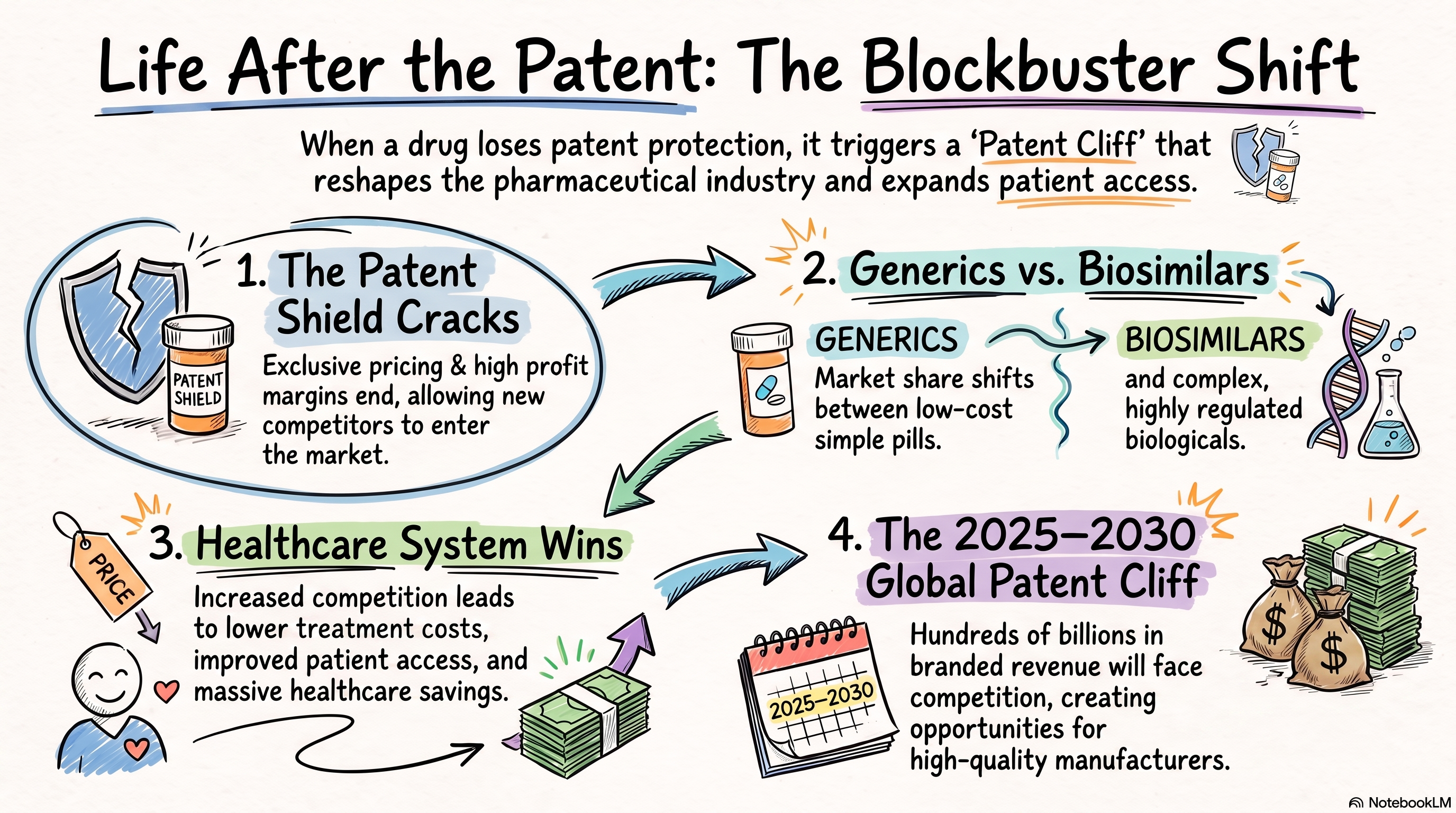
The pharmaceutical industry is approaching one of its most significant structural shifts in decades. Between 2025 and 2030, a large number of blockbuster medicines are expected to lose patent protection, opening the door for generic drugs and biosimilars to capture market share. For healthcare investors, pharmaceutical manufacturers, policymakers, and businesses across the medical supply chain, this period represents more than routine patent expirations—it marks a potential redistribution of hundreds of billions of dollars in annual pharmaceutical revenue.
Rather than being an isolated event affecting a handful of companies, the patent cliff is an industry-wide transition that is already influencing capital allocation, mergers and acquisitions, manufacturing investments, and long-term research strategies among global pharmaceutical companies.
The Pharmaceutical Patent Cliff Explained
A pharmaceutical patent gives an innovator company exclusive rights to manufacture and sell a medicine for a limited period, allowing it to recover research and development costs while earning premium margins. Once patent protection expires, competitors can introduce generic drugs or biosimilars, often at significantly lower prices.
This transition is commonly known as the patent cliff because revenue from a blockbuster medicine can decline sharply once competitors enter the market.
Unlike previous patent cycles, the 2025–2030 period involves multiple medicines generating billions of dollars in annual sales across cardiovascular disease, diabetes, oncology, and immunology. Industry analysts estimate that hundreds of billions of dollars in branded pharmaceutical revenue could become exposed to generic and biosimilar competition during this period.
For investors, understanding the pharmaceutical patent cliff is increasingly important because it affects not only large pharmaceutical companies but also contract manufacturers, distributors, healthcare providers, and regional generic drug producers.
Blockbuster Drugs Losing Patent Protection Between 2025 and 2030
Several of the world's highest-selling medicines are approaching the end of their exclusivity period.
Among the earliest is Entresto from Novartis, a leading heart failure treatment generating approximately US$7.8 billion annually, with exclusivity ending in 2025.
Farxiga, developed by AstraZeneca for diabetes and heart failure, records annual sales of around US$7.7 billion and is also approaching key patent expirations beginning in 2025.
One of the largest near-term events involves Eliquis, jointly marketed by Bristol Myers Squibb and Pfizer. The anticoagulant generates more than US$13 billion annually and is expected to encounter generic competition around 2026.
The second half of the decade becomes even more significant.
Pfizer's Ibrance, an important breast cancer therapy, is expected to lose patent protection around 2027.
Bristol Myers Squibb's immunotherapy Opdivo follows with important patent expirations around 2028.
Perhaps the most closely watched event is Keytruda, Merck's flagship cancer immunotherapy and one of the world's highest-selling medicines, generating approximately US$29 billion in annual revenue. Core patents are expected to expire around 2028, creating one of the largest opportunities ever seen for biosimilar developers.
Beyond these headline medicines, numerous biologics, vaccines, autoimmune treatments, and specialty therapies are also expected to lose exclusivity before 2030, collectively reshaping competitive dynamics across the global pharmaceutical industry.
Why Generic Drugs and Biosimilars Could Benefit
Patent expiration does not automatically guarantee success for competitors. However, it significantly changes market economics.
For traditional small-molecule medicines, generic manufacturers typically enter the market quickly after patent expiry. Competition often drives prices substantially lower while allowing generics to capture a large proportion of prescription volume within a relatively short period.
The situation differs for biosimilars, which are follow-on versions of complex biological medicines. Developing biosimilars requires extensive clinical evidence, sophisticated manufacturing capabilities, and regulatory approval processes that are considerably more demanding than conventional generics.
As a result, biosimilar adoption is usually slower than generic substitution. Nevertheless, once healthcare providers and reimbursement systems accept biosimilars, branded drug manufacturers often experience meaningful revenue erosion.
This creates opportunities for pharmaceutical companies possessing:
High-quality manufacturing facilities
Strong regulatory expertise
International compliance capabilities
Efficient distribution networks
Established relationships with hospitals and healthcare providers
Companies able to satisfy these requirements may be well positioned to participate in the next wave of pharmaceutical market expansion.
Apex Healthcare's Privatisation Signals Growing Confidence in Generics
The global patent cliff also provides useful context for recent developments in Malaysia's pharmaceutical sector.
Apex Healthcare Berhad, a long-established Malaysian manufacturer and distributor of generic medicines, has recently been taken private after a consortium led by Quadria Capital Investment Management launched an offer of RM2.64 per share. Following the acquisition of more than 90% ownership, the takeover became unconditional and paved the way for delisting.
The transaction attracted particular attention because it received backing from major institutional investors, including the Employees Provident Fund (EPF) and 65 Equity Partners Pte Ltd, an investment platform owned by Temasek Holdings (Private) Ltd.
Such collaboration between Malaysia's largest retirement fund and a Temasek-linked investment platform is relatively uncommon, particularly within a domestic pharmaceutical company focused primarily on generic medicines and healthcare distribution.
Although every investment has company-specific considerations, the transaction highlights growing institutional interest in healthcare businesses that may benefit from long-term structural trends rather than short-term market cycles.
Private ownership may also provide greater flexibility for management to invest in manufacturing expansion, regulatory compliance, product development, and regional growth without the quarterly reporting pressures associated with public markets.
What the Patent Cliff Means for Investors, Healthcare Businesses and Asia
The approaching patent cliff is not simply a challenge for multinational pharmaceutical companies—it also represents a potential growth catalyst for selected participants throughout the healthcare ecosystem.
Generic drug manufacturers may gain access to larger addressable markets as blockbuster medicines lose exclusivity. Biosimilar developers could benefit from expanding opportunities in oncology, immunology, and specialty care. Pharmaceutical distributors may experience higher product volumes, while contract manufacturers with regulatory expertise could secure additional production partnerships.
Asia also remains relatively underpenetrated in advanced generics and biosimilars compared with North America and Europe. As healthcare spending continues to rise across emerging Asian economies, regional manufacturers with strong quality standards and distribution capabilities may have opportunities to expand both domestically and internationally.
However, patent expiry alone does not guarantee commercial success. Companies must still compete on manufacturing reliability, product quality, pricing, regulatory approvals, physician adoption, reimbursement access, and supply chain execution.
For investors, evaluating pharmaceutical companies solely on the number of expiring patents may overlook these critical competitive factors.
As the pharmaceutical industry moves through the 2025–2030 patent cycle, businesses that combine operational excellence with regulatory strength and scalable manufacturing capacity are likely to be better positioned than those relying solely on market timing. The patent cliff may create one of the largest shifts in global pharmaceutical revenue in years, but the ultimate winners will be determined by execution rather than opportunity alone.