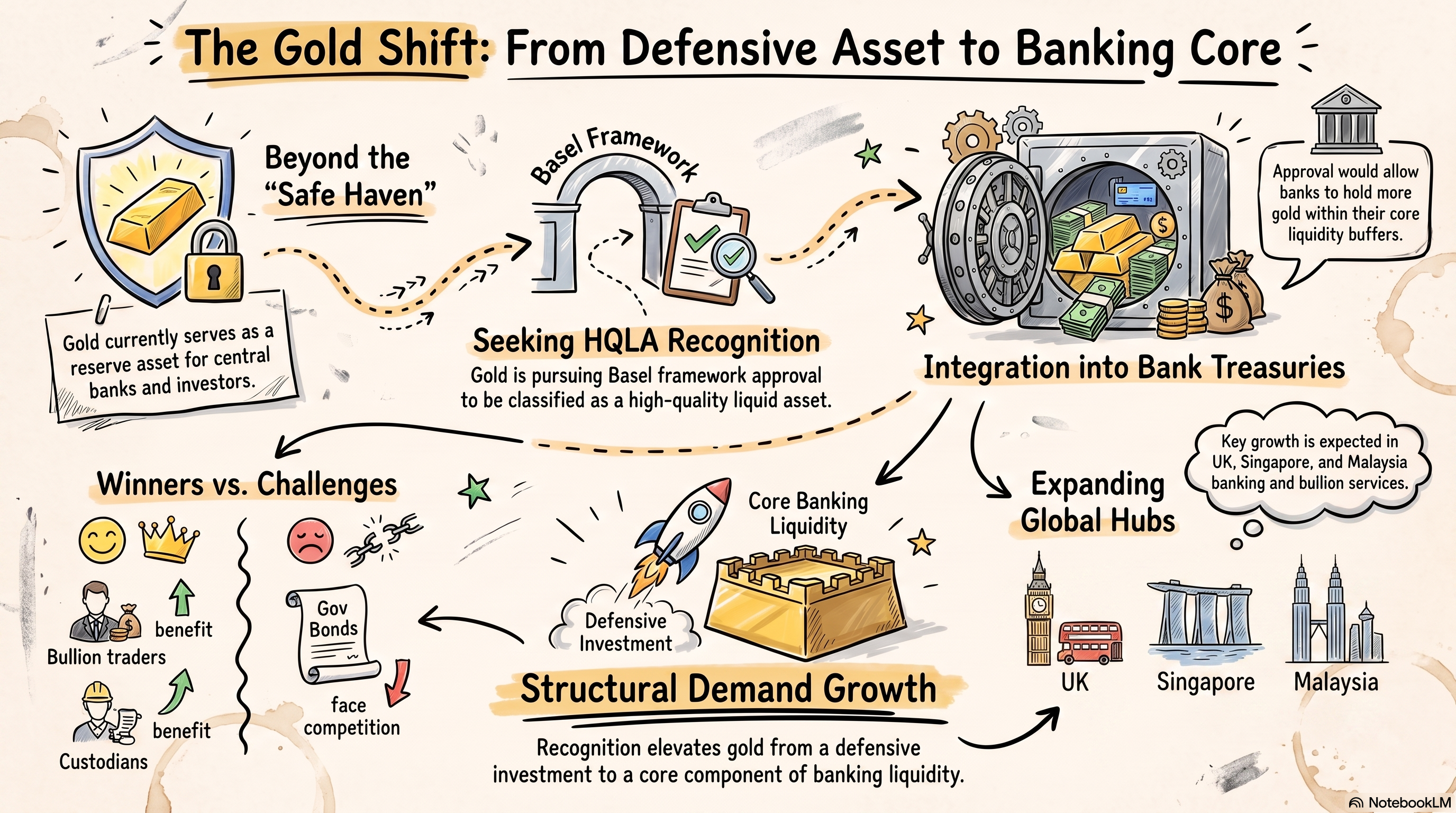
🟦 1. The Event (FACT)
The World Gold Council (WGC) and the London Bullion Market Association (LBMA) are collaborating to support the recognition of gold as a High-Quality Liquid Asset (HQLA) for banks. The initiative follows the availability of new trading data that may address previous liquidity measurement gaps that led to gold's removal from the HQLA framework.
🟨 2. Affected Channels (MECHANISM)
Regulation: Potential future changes to bank liquidity treatment of gold under prudential standards.
Financing: Recognition as HQLA could affect how banks manage liquidity buffers and balance sheets.
Demand: Banks' demand for gold could change if regulatory treatment evolves.
Sentiment: Reinforces gold's role as a potential liquidity and safe-haven asset in the financial system.
🟩 3. Malaysia Exposure (WHO)
Exposed sectors
Banking
Precious metals
Gold trading and bullion
Financial services
Types of Malaysian companies
Commercial banks.
Gold bullion dealers and precious metals traders.
Financial institutions providing gold-related products and custody services.
Geographic relevance
Malaysia would be affected if international banking standards or domestic regulatory frameworks adopt changes to gold's HQLA treatment.
🟧 4. What to Watch (SIGNALS)
Responses from the Basel Committee on Banking Supervision regarding HQLA eligibility.
Regulatory consultations or policy updates from banking supervisors.
Changes in banks' gold holdings or treasury asset allocation.
Growth in institutional gold trading and liquidity.
Updates from the World Gold Council and LBMA on supporting research and market data.
Any guidance from Bank Negara Malaysia on liquidity requirements that references international regulatory developments.
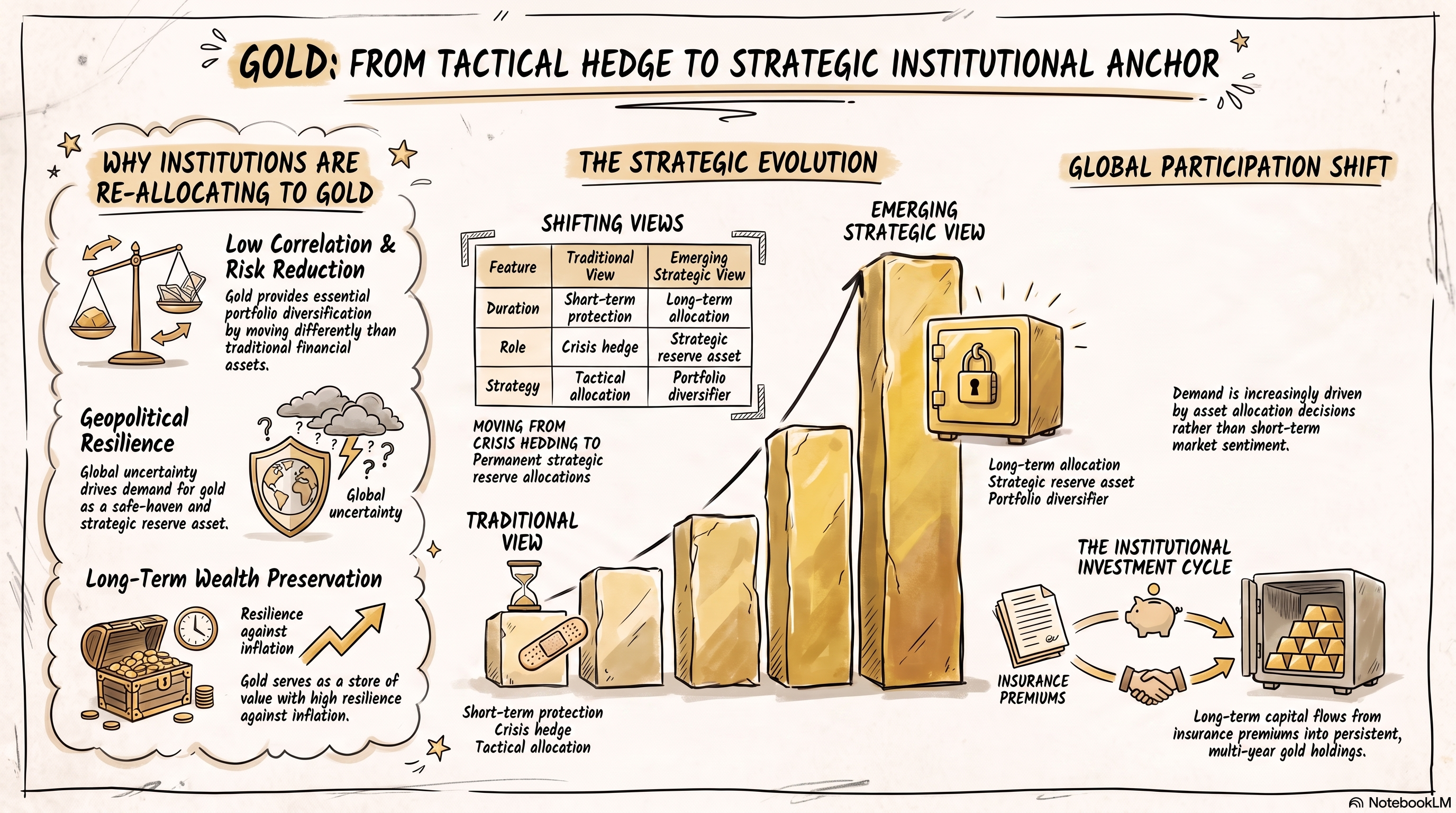
Gold's bid for HQLA status could elevate bullion from a reserve asset to a core banking liquidity instrument
2. Executive Summary
The joint effort by the World Gold Council and the London Bullion Market Association is not merely about gold classification—it seeks to change gold's regulatory role within the global banking system.
If gold is recognized as a High-Quality Liquid Asset (HQLA) under Basel liquidity rules, banks could hold significantly more physical gold as part of regulatory liquidity buffers, potentially creating a new structural source of demand.
This would represent one of the most important regulatory changes for the gold market since the Basel III reforms, reinforcing gold's position alongside government bonds and cash as a strategic reserve asset.
Investors should focus less on jewelry demand or central bank purchases and more on potential institutional balance-sheet demand, which could permanently reshape bullion markets.
3. Key Insights
Insight 1: Gold is seeking a regulatory upgrade, not just an investment upgrade
Observation
The WGC and LBMA are working to have gold recognized as an HQLA.
Why it matters
HQLA designation would transform gold from primarily an investment and reserve asset into a regulatory liquidity asset for banks.
Second-order implication
Banks could materially increase gold holdings because they would directly contribute to Liquidity Coverage Ratio (LCR) and Net Stable Funding Ratio (NSFR) compliance.
Third-order implication
Regulatory demand becomes a structural pillar of the gold market, reducing reliance on cyclical investment flows.
Insight 2: Liquidity—not inflation—is becoming gold's strongest investment case
Observation
The discussion centers on market liquidity and regulatory treatment rather than inflation hedging.
Why it matters
Gold's value proposition expands beyond "safe haven" status to become recognized financial infrastructure.
Second-order implication
Institutional investors may increasingly evaluate gold alongside sovereign bonds rather than as an alternative asset.
Insight 3: Data availability is changing regulatory outcomes
Observation
Gold was previously excluded because regulators lacked sufficient liquidity data.
Why it matters
Improved trading transparency through LBMA data removes a technical barrier rather than a fundamental one.
Second-order implication
Financial market infrastructure and data quality increasingly influence regulatory classification.
Insight 4: Basel regulation could become a major demand catalyst
Observation
Recognition depends on Basel liquidity standards rather than monetary policy.
Why it matters
Regulatory changes often create long-lasting demand because banks must comply regardless of market sentiment.
Third-order implication
Gold demand becomes less cyclical and more policy-driven.
Insight 5: Gold's competitive position against sovereign bonds could strengthen
Observation
Banks currently rely primarily on government securities and cash for HQLA.
Why it matters
If gold joins this category, banks gain an additional liquid reserve asset with different risk characteristics.
Second-order implication
Portfolio diversification within bank treasury operations could increase.
Insight 6: Central bank behavior may reinforce commercial bank demand
Observation
Central banks have already been increasing gold reserves in recent years.
Why it matters
Commercial banks could follow a similar trajectory if regulatory incentives change.
Third-order implication
The gold market would gain support from both sovereign and commercial balance sheets simultaneously.
4. Interpretation
What is really happening beneath the headlines?
This initiative reflects a broader transformation in the global financial system where trust in traditional reserve assets is becoming more diversified.
Since the Global Financial Crisis, Basel regulations have emphasized liquidity and resilience. Meanwhile:
Central banks have steadily accumulated gold.
Geopolitical fragmentation has increased.
Sovereign debt burdens have expanded.
Financial sanctions have heightened interest in politically neutral reserve assets.
Recognizing gold as HQLA would institutionalize these trends.
The move resembles earlier regulatory shifts under Basel III, where changes in capital and liquidity rules significantly altered bank balance sheets. Unlike previous gold rallies driven by inflation or interest rates, this would create regulatory demand, which is generally more persistent.
5. What Changes Next?
Next 6 Months
Likely (65%)
Continued submission of liquidity studies and market evidence to regulators.
Increased industry advocacy.
Broader discussion within banking and regulatory communities.
Possible (40%)
Consultation papers or technical reviews by Basel-related bodies.
Low Probability, High Impact (15%)
Early regulatory endorsement accelerating institutional gold accumulation.
Next 12 Months
Likely (60%)
Greater engagement between regulators and market participants.
Expanded research on gold's liquidity characteristics.
Increased attention from bank treasury departments.
Next 3 Years
Likely (70%)
Partial or conditional recognition of gold within liquidity frameworks.
Greater use of gold in repo and secured funding markets.
Expanded institutional demand if regulatory treatment improves.
6. Winners
Direct Winners
Countries
Major gold-producing nations
Countries with significant gold reserves
Industries
Gold mining
Bullion trading
Precious metals custody
Clearing and settlement
Precious metals financing
Organizations
London Bullion Market Association
World Gold Council
Secondary Winners
Vault operators
Precious metals exchanges
Banks with established bullion businesses
Gold ETF service providers
Precious metals logistics companies
7. Losers / Pressure Points
Government bond markets
If banks allocate a portion of liquidity portfolios toward gold, demand for some sovereign securities could be marginally reduced.
Nature: Incremental rather than disruptive.
Banks without bullion infrastructure
May need to invest in custody, trading, and risk management capabilities.
Alternative safe-haven assets
Assets competing for defensive allocations could face relative demand pressure if gold's regulatory role expands.
8. Investment Implications
Equities
Opportunities
Gold miners
Bullion banks
Precious metals infrastructure
Custody providers
Risks
Regulatory approval may take longer than expected.
Market expectations could outpace actual implementation.
Private Equity
Potential investment themes:
Precious metals logistics
Secure storage
Vault infrastructure
Commodity financing platforms
Infrastructure
High-conviction themes:
Gold vaults
Precious metals storage
Clearing systems
Secured financing infrastructure
Venture Capital
Emerging opportunities:
Digital bullion platforms
Tokenized gold
Precious metals settlement technology
Risk management software
Commodities
Watchlist
Gold
Silver (potential indirect beneficiary)
Platinum (limited spillover)
Fixed Income
Potential marginal reallocation within bank liquidity portfolios if regulatory treatment changes.
Currencies
Gold's enhanced regulatory role could reinforce its position as a reserve asset, with potential implications for currencies whose reserve status depends heavily on sovereign debt markets.
Real Assets
Vault facilities, secure logistics networks, and precious metals storage infrastructure become more valuable.
9. Malaysia / ASEAN Implications
Malaysia
Malaysian banks with bullion operations could benefit if gold gains broader regulatory recognition.
Institutions involved in Islamic finance may explore how gold-backed liquidity products fit within evolving regulatory frameworks.
Domestic gold investment products could see stronger institutional interest.
Singapore
As one of Asia's major bullion trading and storage hubs, Singapore stands to benefit from higher institutional trading, custody, and financing activity if commercial bank demand increases.
Indonesia
Gold producers could benefit indirectly from stronger long-term structural demand.
Domestic financial institutions may gradually expand bullion-related services.
Thailand
Thailand's active retail gold market and bullion ecosystem may see increased institutional participation if gold's regulatory standing improves.
Vietnam
Strong retail affinity for gold could be complemented over time by greater institutional market development.
10. Long-Term Structural Trend
Megatrend | Assessment | Why |
Financial fragmentation | Strongly reinforces | Institutions seek diversified reserve assets beyond traditional sovereign debt. |
Multipolar world | Strongly reinforces | Gold's political neutrality becomes increasingly valuable. |
Supply-chain resilience | Weakly reinforces | Greater emphasis on secure custody and settlement infrastructure. |
Industrial policy | Neutral | Primarily a financial regulatory development. |
Resource nationalism | Weakly reinforces | Gold-producing countries may benefit from stronger demand. |
Re-industrialisation | Neutral | No direct implication. |
Energy transition | Neutral | No material connection. |
AI infrastructure | Neutral | No direct implication. |
Friend-shoring | Weakly reinforces | Trusted financial infrastructure gains importance. |
Defence spending | Neutral | No direct implication. |
11. Hidden Insights
This is a demand-side regulatory story, not a supply-side commodity story. If HQLA status is granted, gold demand could become driven by compliance requirements rather than investor sentiment.
Bank treasury behavior may change more than investment portfolios. The largest structural impact would likely come from liquidity management desks rather than traditional asset managers.
Gold's repo market could deepen significantly. Greater HQLA recognition would increase the attractiveness of gold as collateral, strengthening secured funding markets.
Reserve diversification may extend from central banks to commercial banks. Recent central bank buying could foreshadow broader institutional adoption if regulatory incentives align.
Financial infrastructure providers could be overlooked beneficiaries. Vault operators, custodians, clearing systems, and bullion logistics firms may benefit alongside gold producers if institutional holdings increase.
12. Signals to Monitor
Bullish Confirmation
Basel Committee consultations on HQLA treatment.
Publication of new liquidity studies using LBMA trading data.
Growth in gold-backed repo market activity.
Increased commercial bank bullion holdings.
Expansion of bullion custody and settlement infrastructure.
Bearish Confirmation
Regulators conclude gold still does not satisfy HQLA criteria.
Limited engagement from banking supervisors.
Weak commercial bank interest despite advocacy efforts.
Invalidation Signals
Basel standards remain unchanged after comprehensive review.
Regulators determine gold's volatility or liquidity characteristics remain inconsistent with HQLA requirements.
Commercial banks show little appetite to increase bullion holdings even if technical barriers are addressed.
13. Bottom Line
The initiative seeks to reposition gold from an investment asset to a regulatory liquidity asset within the banking system.
HQLA recognition would create a new, potentially durable source of institutional demand tied to banking regulation rather than market cycles.
Improved market data has reopened a regulatory debate that was largely closed in 2013.
The strategic significance extends beyond gold prices to treasury management, collateral markets, and financial infrastructure.
If adopted, commercial bank demand could complement ongoing central bank purchases, reinforcing gold's role in the global financial system.
Singapore is well positioned to benefit through its established bullion trading and custody ecosystem, while Malaysia and other ASEAN markets could see increased institutional interest in gold-related services.
Investors should monitor regulatory developments from Basel-related bodies more closely than short-term gold price movements, as changes in liquidity rules could have far-reaching effects on demand and market structure.
Over the long term, the most significant consequence would be gold's transition from a defensive investment to a core component of banking liquidity architecture.