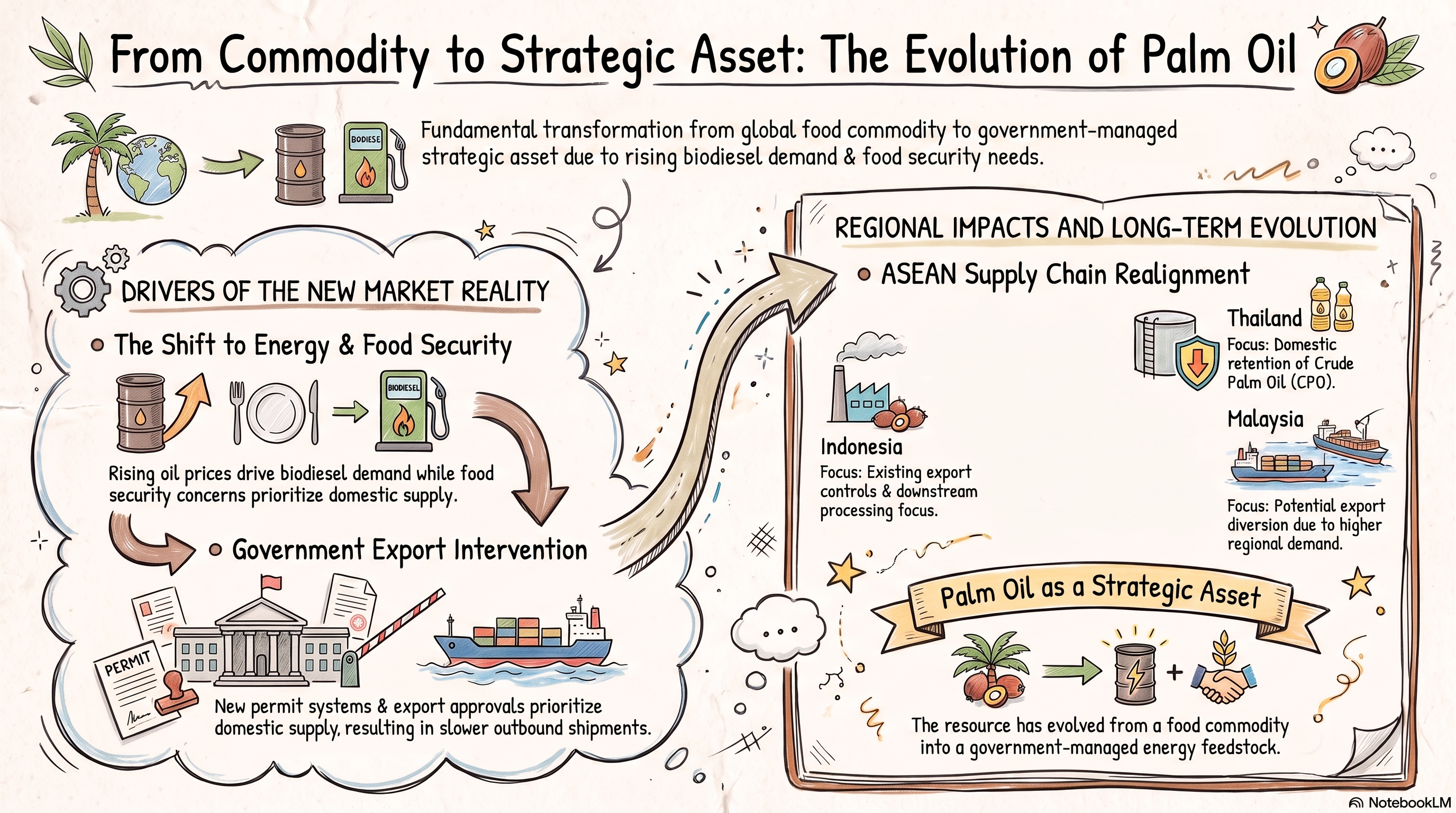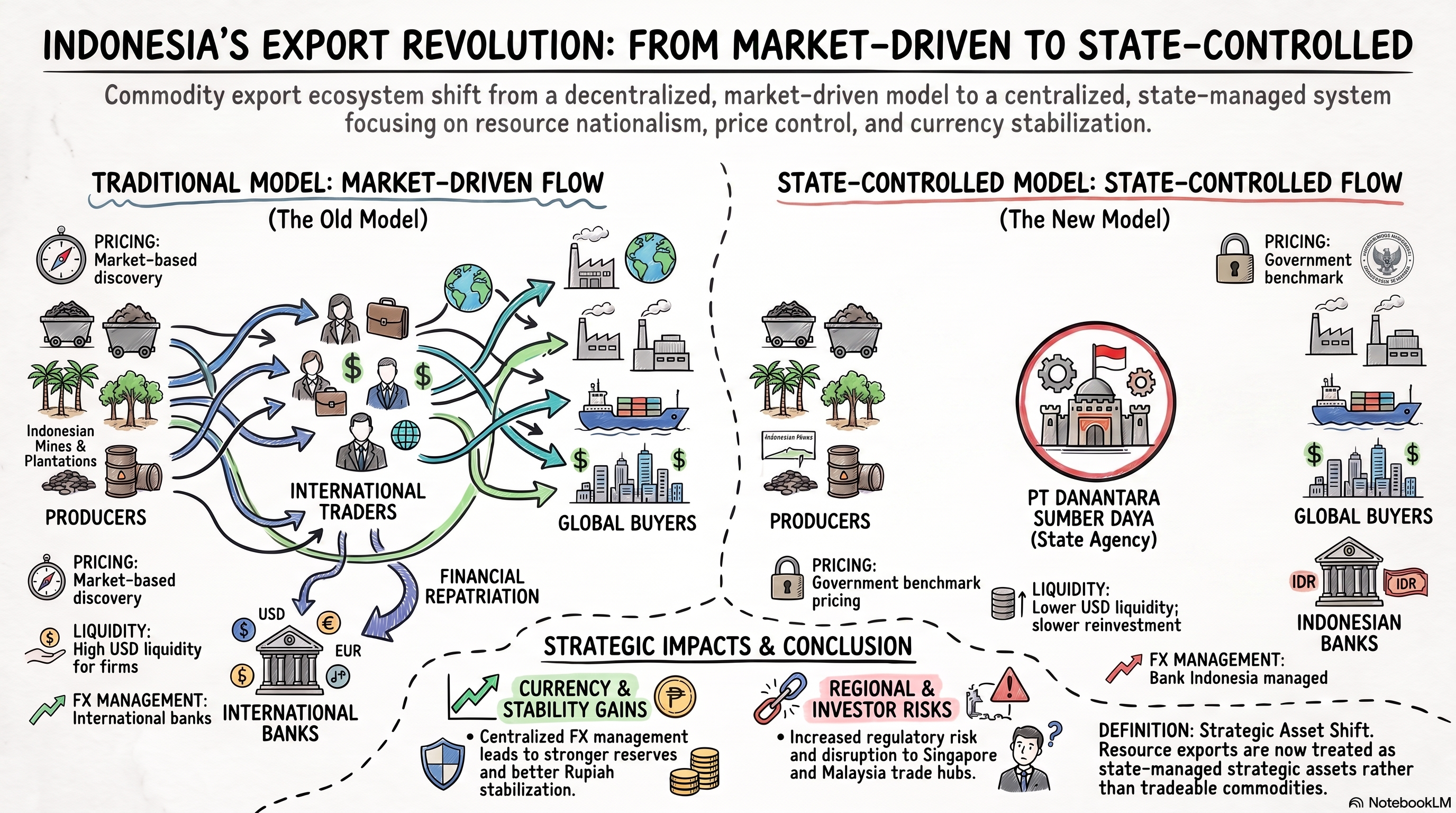
Indonesia is moving toward a more centralized model for exporting strategic commodities such as coal, palm oil, and ferroalloys. Instead of allowing companies to negotiate directly with global buyers, exports would increasingly be routed through a state-owned institution, while export earnings are required to return to Indonesia's domestic banking system.
At first glance, this appears to be an administrative change to export procedures. In reality, it represents a much broader shift in how a resource-rich country manages foreign exchange, fiscal revenues, commodity pricing, and economic sovereignty during a period of currency pressure and global capital uncertainty.
The implications extend far beyond Indonesia. If implemented over the long term, the policy could reshape commodity pricing, alter Southeast Asia's investment landscape, redefine trade finance, and accelerate the regional trend toward greater economic nationalism.
Indonesia Is Moving Beyond Export Control Toward Resource Sovereignty
The proposed framework introduces three structural changes that fundamentally alter Indonesia's export model.
First, strategic commodity exports would increasingly be conducted through a state-owned export institution, PT Danantara Sumber Daya, rather than through individual producers dealing directly with overseas buyers. This effectively transfers a significant portion of pricing power and commercial negotiation from private companies to the state.
Second, exporters are required to repatriate 100% of their foreign exchange earnings into Indonesia's domestic financial system. Instead of export proceeds remaining in offshore accounts or being distributed across multiple international banks, foreign currency liquidity becomes concentrated within Indonesia's banking sector.
Third, commodity pricing gradually shifts away from purely market-driven negotiations toward benchmark pricing supported by centralized state marketing. This reduces the traditional price discovery role played by independent exporters and international commodity traders.
Taken together, these changes represent more than tighter regulation. They indicate a gradual transformation in which producers increasingly become manufacturing and extraction operators, while the state assumes the central role in international marketing, pricing, and foreign exchange management.
Why Indonesia Is Centralizing Commodity Exports
The timing of these reforms is significant.
Indonesia has experienced periods of rupiah weakness, volatile capital flows, and growing scrutiny from international investors and credit rating agencies. Under such conditions, governments often seek greater control over foreign currency inflows to stabilize domestic financial markets.
Centralizing exports offers several immediate policy advantages.
By concentrating export proceeds within domestic banks, authorities gain greater visibility over dollar liquidity and improve the central bank's ability to manage foreign exchange reserves and support the rupiah during periods of volatility.
A centralized export platform also allows the government to capture a larger share of trading margins that previously remained with private exporters or international commodity merchants. This strengthens fiscal revenues while increasing state influence over strategic natural resources.
However, these benefits come with meaningful trade-offs.
Private exporters lose flexibility in managing overseas cash flows, working capital becomes more constrained, and reinvestment decisions may slow as companies face tighter liquidity conditions. Businesses also become increasingly dependent on government-controlled export mechanisms rather than market-based commercial relationships.
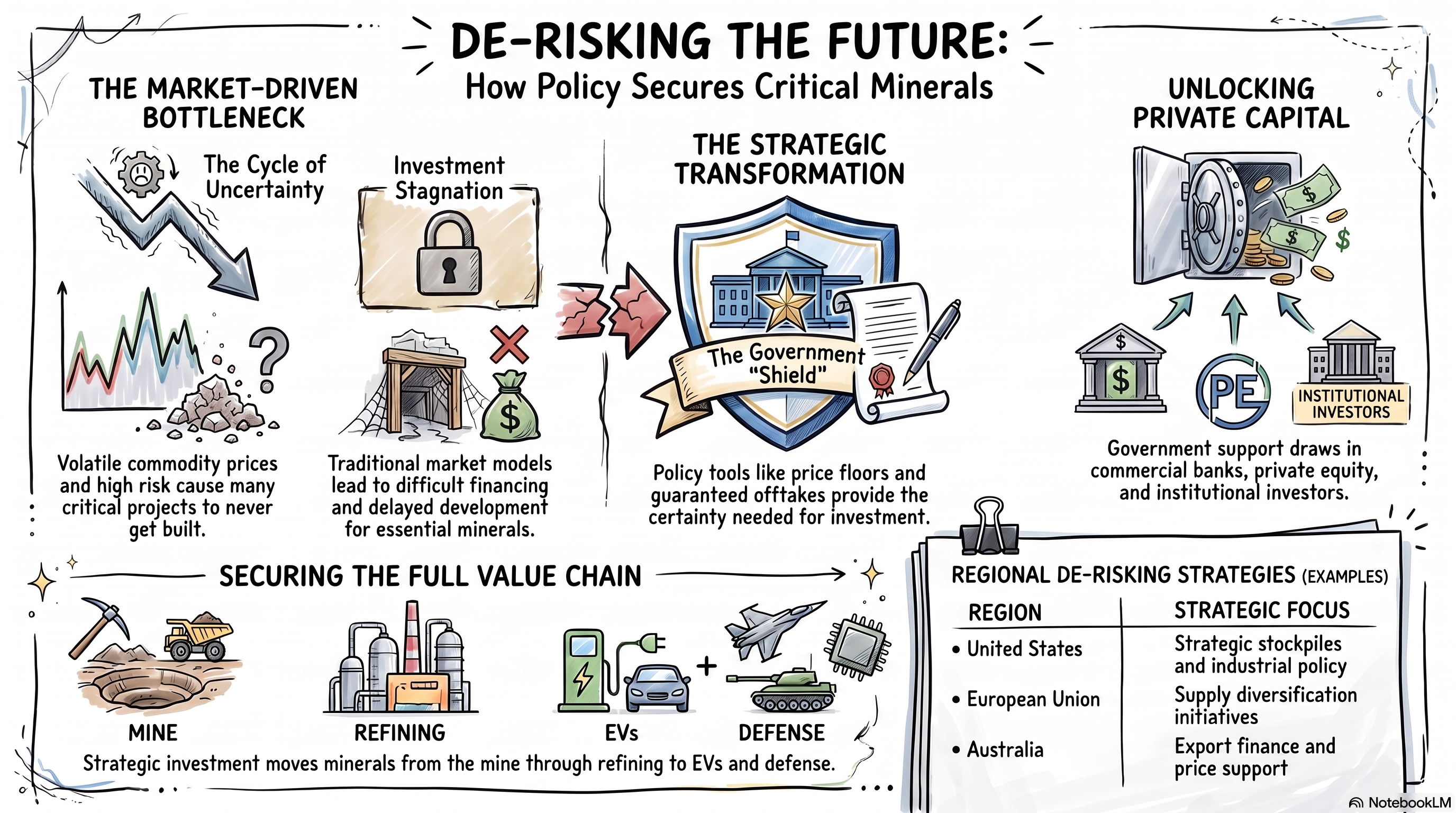
For international investors, the shift may be interpreted as rising policy intervention. Even if corporate earnings remain relatively stable in the short term, higher regulatory uncertainty typically leads investors to demand larger risk premiums, placing downward pressure on valuation multiples.
How State-Controlled Exports Could Transform Commodity Markets
The longer-term implications extend well beyond Indonesia's domestic economy.
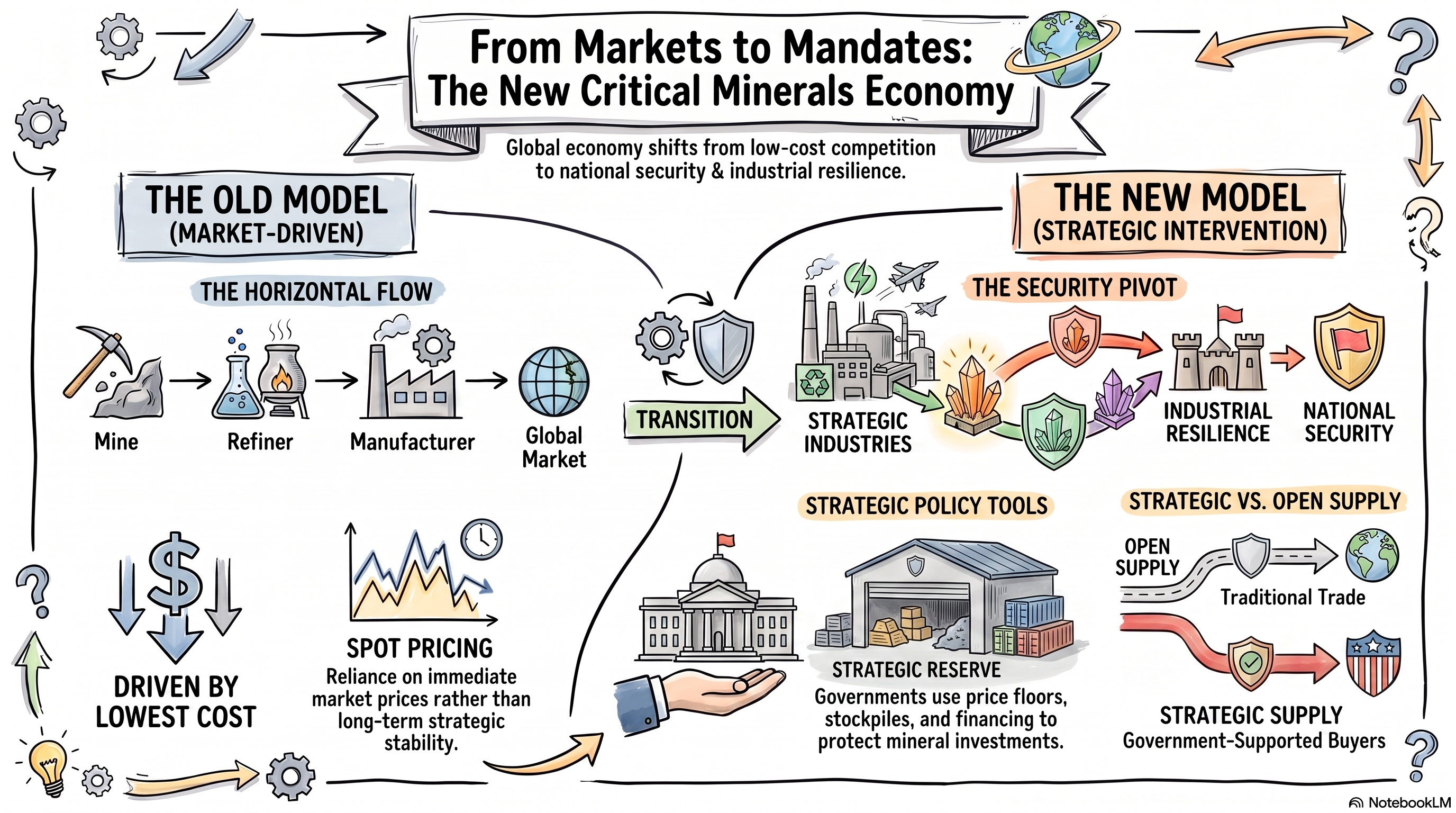
Traditional commodity markets function through decentralized negotiations among producers, traders, and buyers. Prices emerge from competitive market activity involving numerous participants across different jurisdictions.
A centralized export system changes that structure.
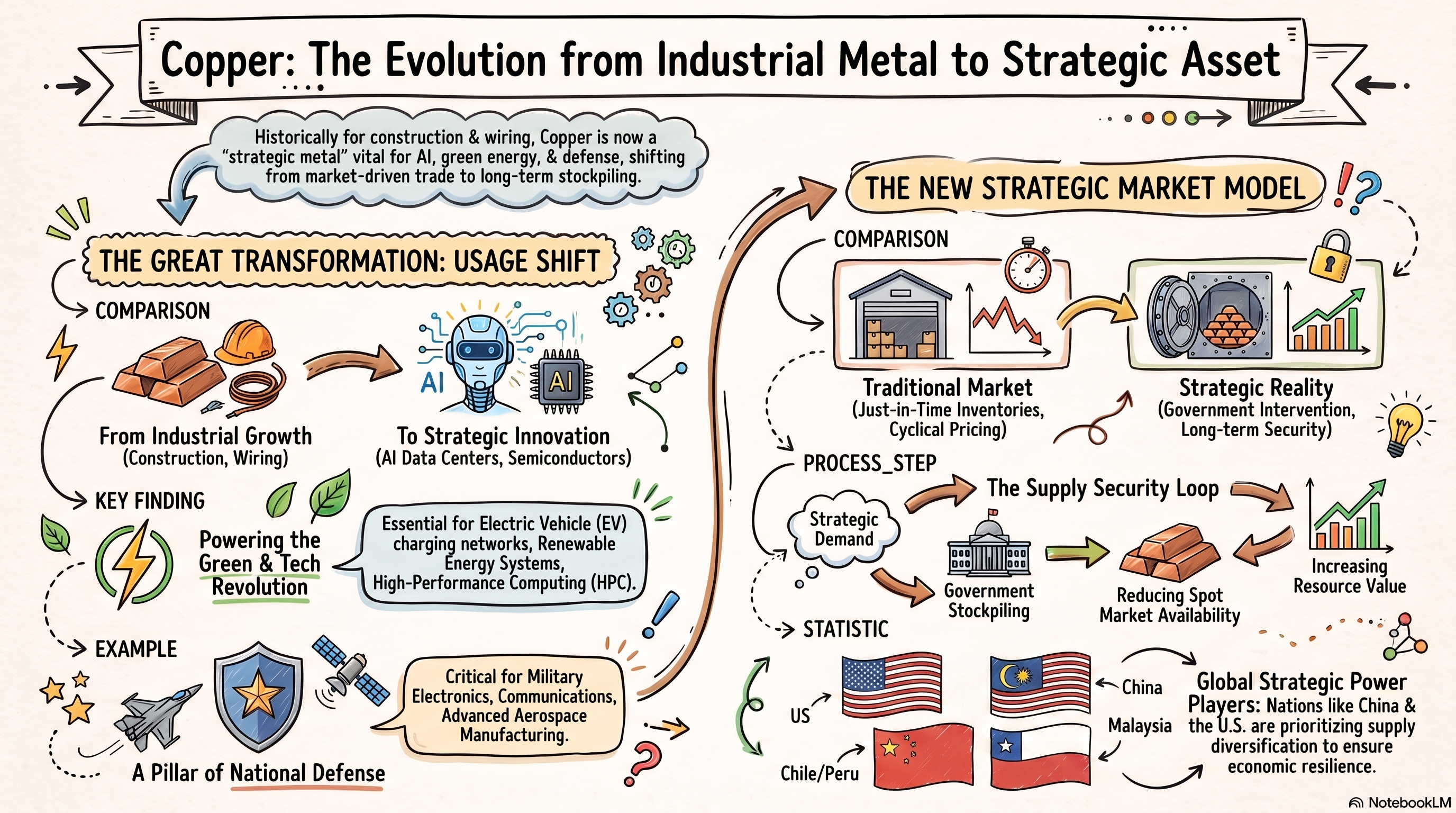
Instead of commodities functioning purely as market goods, strategic resources increasingly become instruments of national economic policy. Export decisions begin serving multiple objectives simultaneously, including foreign exchange management, fiscal revenue generation, industrial policy, and geopolitical strategy.
As a result, commodity pricing may become less responsive to immediate market forces and more influenced by government objectives.
This evolution also reduces the role of international trading houses that historically acted as intermediaries between producers and global consumers. Their business models, built around arbitrage, logistics optimization, and market-making, become less valuable when a single state-controlled seller dominates exports.
Over time, commodity markets could gradually shift from decentralized price discovery toward state-directed pricing mechanisms, particularly if other resource-rich countries adopt similar approaches.
Implications for Malaysia, Singapore, and Southeast Asian Capital Markets
Indonesia's policy changes are unlikely to remain confined within its borders.
Malaysia's plantation sector represents one of the most immediate areas of impact. Companies with Indonesian plantation assets, including Sime Darby Plantation and IOI Corporation, may face direct operational changes if exports increasingly move through centralized government channels.
Even Malaysian palm oil producers operating exclusively within Malaysia may not be immune. As investors reassess regulatory risks across regional resource sectors, valuation multiples for plantation companies could experience broader repricing despite unchanged business fundamentals.
The effects also extend into energy, logistics, and financial services.
Companies involved in regional energy investments, commodity transportation, and cross-border trade finance may encounter more complex settlement structures as Indonesia centralizes foreign exchange flows. Financial institutions facilitating commodity financing could face adjustments in liquidity management, trade documentation, and currency hedging strategies.
Singapore may experience even greater structural implications.
Global commodity merchants such as Trafigura and Glencore have historically relied on open export markets where multiple producers compete for buyers. Under a centralized export framework, these firms could lose bargaining power as negotiations increasingly occur through a single national export channel.
Singapore's banking sector may also encounter evolving dynamics. As Indonesia retains a larger share of export-related dollar liquidity within its domestic financial system, regional trade finance could become increasingly influenced by government-directed capital flows rather than purely market-driven liquidity allocation.
This may gradually alter funding costs, trade finance structures, and regional dollar liquidity distribution across Southeast Asia.
Could Indonesia Signal a Broader Global Trend?
Perhaps the most important question is whether Indonesia represents an isolated case or the beginning of a wider structural shift.
Many resource-rich economies face similar challenges: currency volatility, external financing pressures, geopolitical uncertainty, and increasing competition over critical minerals and strategic commodities.
In such an environment, governments may find centralized export systems increasingly attractive because they simultaneously strengthen foreign exchange management, enhance fiscal revenues, and reinforce national control over strategic resources.
If more countries adopt similar policies, the implications could extend far beyond commodity markets.
Global supply chains would become more politically influenced, international commodity pricing could become less market-driven, and multinational corporations would increasingly operate within government-controlled trading frameworks rather than open commercial markets.
For investors, this would represent a fundamental change in valuation methodology. Resource companies may no longer be evaluated primarily based on production growth, operational efficiency, or commodity prices. Instead, policy stability, regulatory predictability, and state intervention could become equally important determinants of long-term shareholder value.
Indonesia's export centralization therefore represents more than a domestic trade policy. It reflects an emerging model in which natural resources become integrated into national monetary, fiscal, and strategic policy objectives. Whether other resource-exporting nations follow the same path may determine the future direction of global commodity markets, Southeast Asian capital flows, and the next phase of economic deglobalization.