When one company spends S$2.476 billion to acquire a trophy office tower while another decides it is the perfect time to sell the very same asset, the immediate assumption is simple: one is optimistic, the other is pessimistic.
That explanation, however, misses what is actually happening.
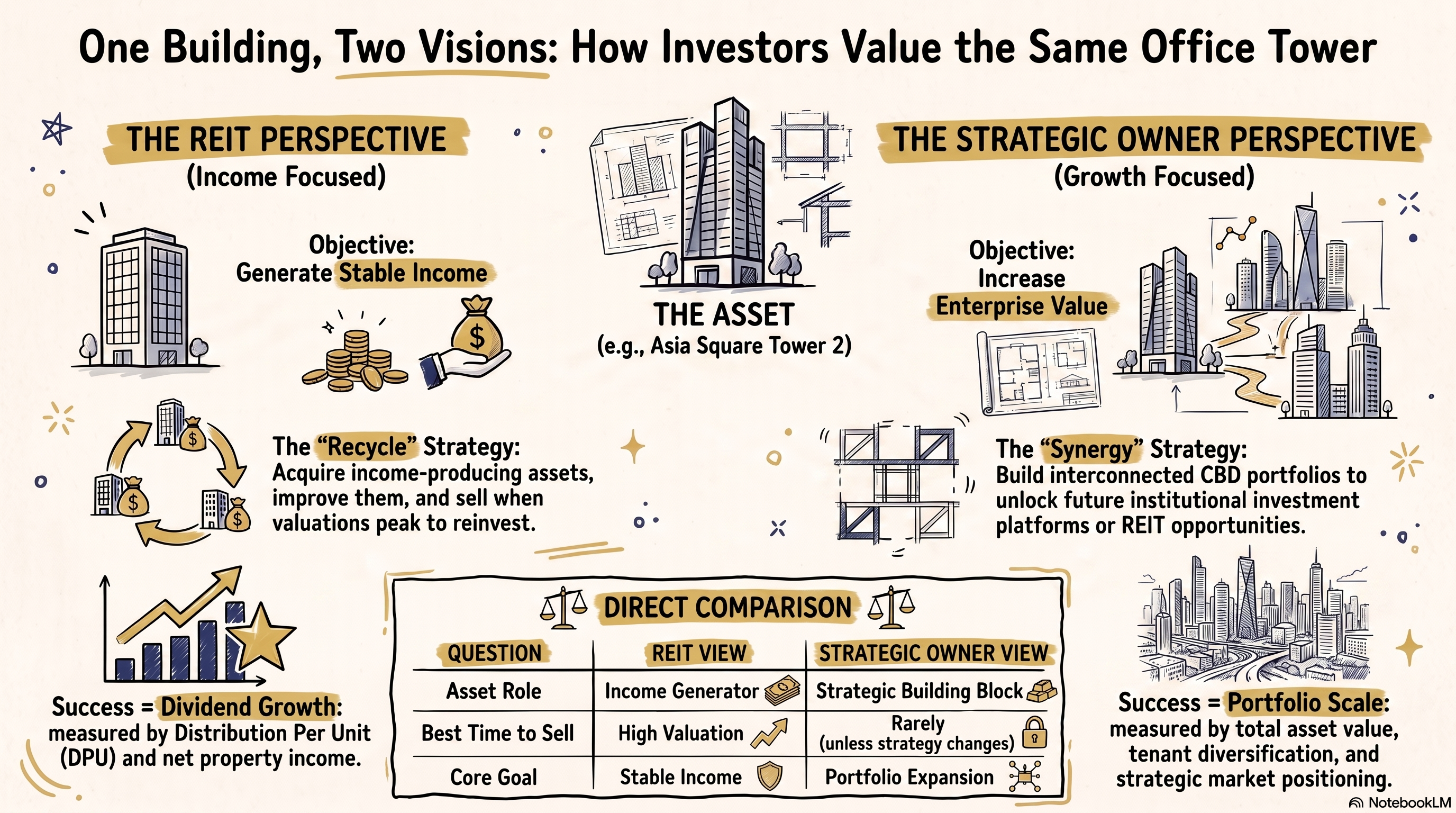
The transaction between IOI Properties Group Berhad (IOIPG) and CapitaLand Integrated Commercial Trust (CICT) is less about differing views on Singapore's office market and more about two companies pursuing fundamentally different investment strategies. The building has not changed—but its role within each owner's portfolio is completely different.
Understanding that distinction explains why both buyer and seller can be making the right decision simultaneously.
The Price Wasn't the Story—The Strategy Was
One detail immediately caught investors' attention.
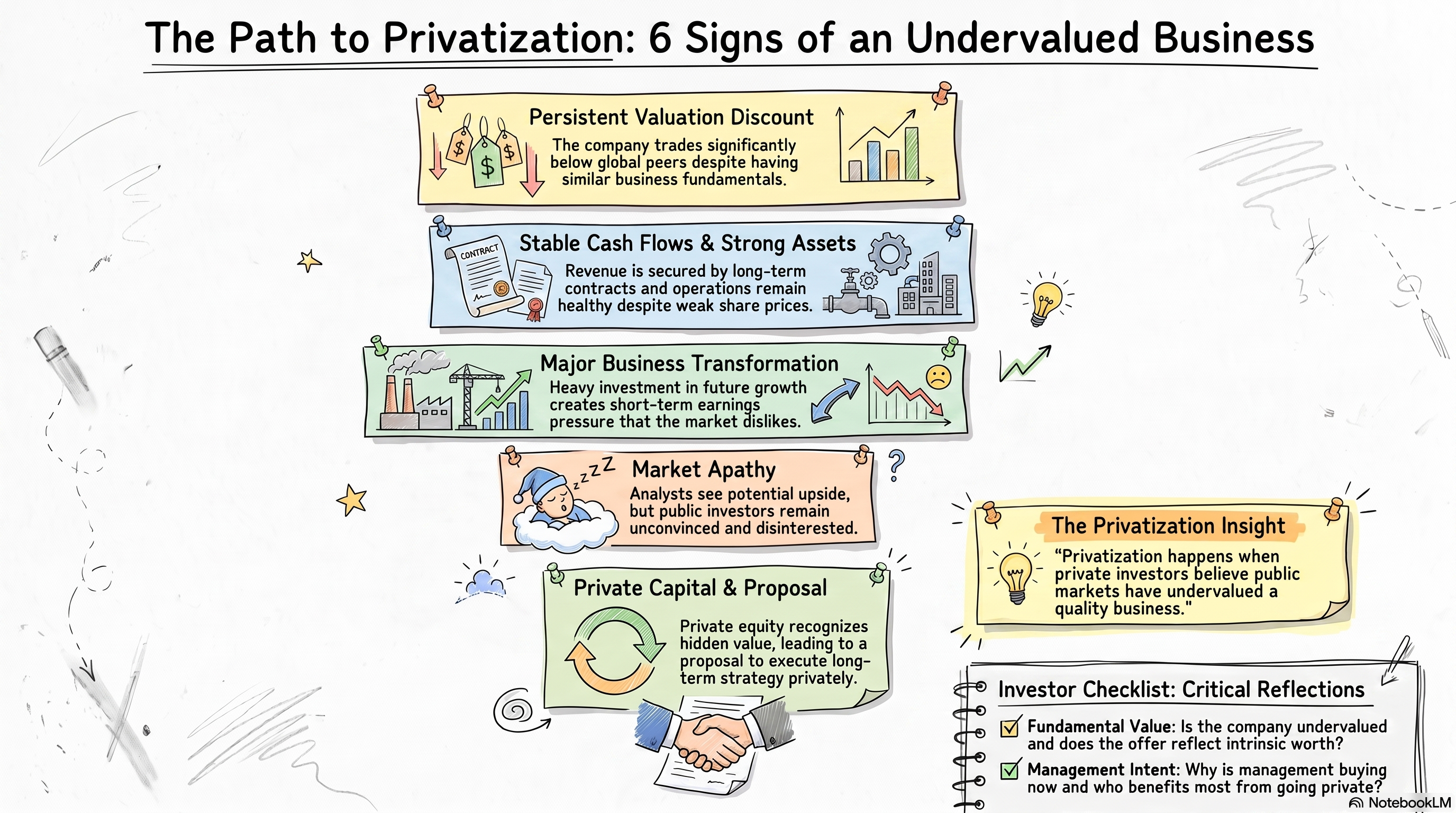
IOI stated that it acquired Asia Square Tower 2 below an independent valuation prepared by Savills. Meanwhile, CICT highlighted that the sale price represented almost a 10% premium over the valuation prepared by Cushman & Wakefield.
How can the same building be considered both a bargain and a premium purchase?
The answer is that commercial real estate valuation is not an exact science.
Different valuers make different assumptions regarding rental growth, occupancy, discount rates, future capital expenditure, and market conditions. More importantly, financial value is not always the same as strategic value.
To CICT, the building was an investment asset that had already delivered most of its expected returns.
To IOI, the building is part of something much larger.
The acquisition only makes sense when viewed in the context of IOI's long-term strategy rather than as an isolated property purchase.
Why Selling Makes Perfect Sense for CICT
Looking only at the headline, some investors may wonder whether CICT is signalling concerns about Singapore's office market.
The available evidence suggests otherwise.
Asia Square Tower 2 remains one of the country's premier Grade A office buildings. Occupancy is approximately 96%, with multinational tenants including Mizuho Bank, Mitsui Group, and KPMG providing stable rental income.
In other words, CICT is not disposing of an underperforming asset.
Instead, it is monetising a mature investment.
Since acquiring the property in 2017, CICT has enjoyed years of recurring rental income while benefiting from capital appreciation. The transaction allows the trust to realise an estimated capital gain of nearly S$200 million.
This is exactly how many successful REITs create long-term value.
REIT managers are expected to recycle capital—selling mature assets when valuations are attractive and redeploying proceeds into opportunities that improve future returns, strengthen the balance sheet, or enhance portfolio quality.
For CICT, Asia Square Tower 2 had become a stable, fully performing asset with relatively limited upside compared to earlier years. Selling at today's valuation is therefore consistent with disciplined portfolio management rather than a negative view on Singapore's commercial property market.
IOI Isn't Just Buying an Office Tower—It's Building Scale
The acquisition looks very different when viewed from IOI's perspective.
This is not the company's first major investment in Singapore's Central Business District.
Over recent years, IOI has steadily assembled a portfolio that already includes South Beach Tower and IOI Central Boulevard Towers.
With the addition of Asia Square Tower 2, IOI's Singapore commercial portfolio now approaches S$10 billion in asset value and exceeds 2.5 million square feet of lettable office space.
That level of ownership changes the investment case completely.
Rather than owning several individual office buildings, IOI is creating one of the largest privately owned premium office portfolios in Singapore's CBD.
Scale matters in commercial real estate.
A larger portfolio offers operational efficiencies, stronger leasing capabilities, broader tenant diversification, greater negotiating power with service providers, and a more attractive platform for institutional capital.
The value of Asia Square Tower 2 therefore extends beyond its rental income. It strengthens the overall quality and scale of IOI's entire Singapore portfolio.
The Real Opportunity May Lie in Future Capital Markets
The acquisition becomes even more interesting when viewed alongside IOI's broader corporate strategy.
The group is progressing with plans to list Malaysian assets through a REIT structure. At the same time, its Singapore commercial portfolio continues to expand rapidly.
This raises an important strategic consideration.
A single premium office tower—even one as attractive as South Beach Tower—is relatively small as a standalone institutional investment vehicle.
Large institutional investors generally prefer diversified portfolios that offer multiple assets, diversified tenants, larger recurring income streams, and lower concentration risk.
By combining South Beach Tower, IOI Central Boulevard Towers, and Asia Square Tower 2, IOI creates a significantly more compelling investment platform.
Instead of presenting investors with one office building, IOI can potentially offer a portfolio of prime Singapore CBD assets with multinational tenants and substantial recurring income.
Whether or not a Singapore REIT listing is pursued in the future, the portfolio itself becomes more valuable because of its scale.
Capital markets frequently assign stronger valuations to institutional-quality portfolios than to individual assets.
That additional strategic value cannot be captured through a conventional property valuation alone.
Why Both Companies Can Win from the Same Transaction
Many investors instinctively interpret major acquisitions and disposals as opposing views on the property market.
This transaction demonstrates why that assumption is often too simplistic.
CICT is harvesting value from an asset that has already generated years of stable income and capital appreciation. Selling now improves capital flexibility and supports future portfolio optimisation.
IOI is deploying capital into an asset that enhances an existing strategic portfolio. The building strengthens its Singapore presence, increases recurring income, improves portfolio diversification, and potentially creates opportunities for future capital market initiatives.
Neither company is necessarily making a directional bet on Singapore office prices.
Instead, each is making a capital allocation decision based on its own business model.
The same building supports two very different corporate objectives.
Key Takeaways for Investors
The acquisition of Asia Square Tower 2 offers an important lesson in how institutional investors think.
Assets are rarely bought or sold solely because they are considered cheap or expensive. More often, transactions are driven by how an asset fits within a broader strategy.
For CICT, the tower represented a mature investment whose value had largely been realised.
For IOI, the tower is another building block in a growing Singapore commercial platform that could unlock greater long-term value than the asset could generate on its own.
That is why this deal should not be viewed simply as one company buying while another exits.
Instead, it illustrates how portfolio strategy, capital recycling, and long-term positioning often matter far more than the headline purchase price.
The most interesting question is therefore not whether IOI paid too much or whether CICT sold too early.
The real question is whether IOI's expanding Singapore portfolio will eventually be worth significantly more than the sum of its individual buildings. That is where the market will ultimately judge whether this S$2.476 billion acquisition was merely another property purchase—or a strategic move that reshaped the company's future.