When Nippon Steel, one of the world's largest steel manufacturers, announced it was acquiring a 10% stake in Leform Berhad, many investors questioned the logic behind the deal. The investment was neither a takeover nor a controlling stake, making it appear relatively insignificant compared to Nippon Steel's global operations.
However, strategic investments are not always about ownership. Sometimes they are about securing a position within an important supply chain before competitors recognise its value.
The investment may reveal how global steel companies are changing their expansion strategies. Instead of prioritising new factories, they are increasingly investing in companies that control distribution, inventory and customer access. Understanding this shift helps explain why Leform became an attractive partner despite its relatively small size.
Why Leform Was More Attractive Than Larger Malaysian Steel Companies
At first glance, Malaysia has several larger steel companies that might seem like more logical investment targets. If production capacity were the primary objective, Nippon Steel could have pursued a much bigger manufacturer.
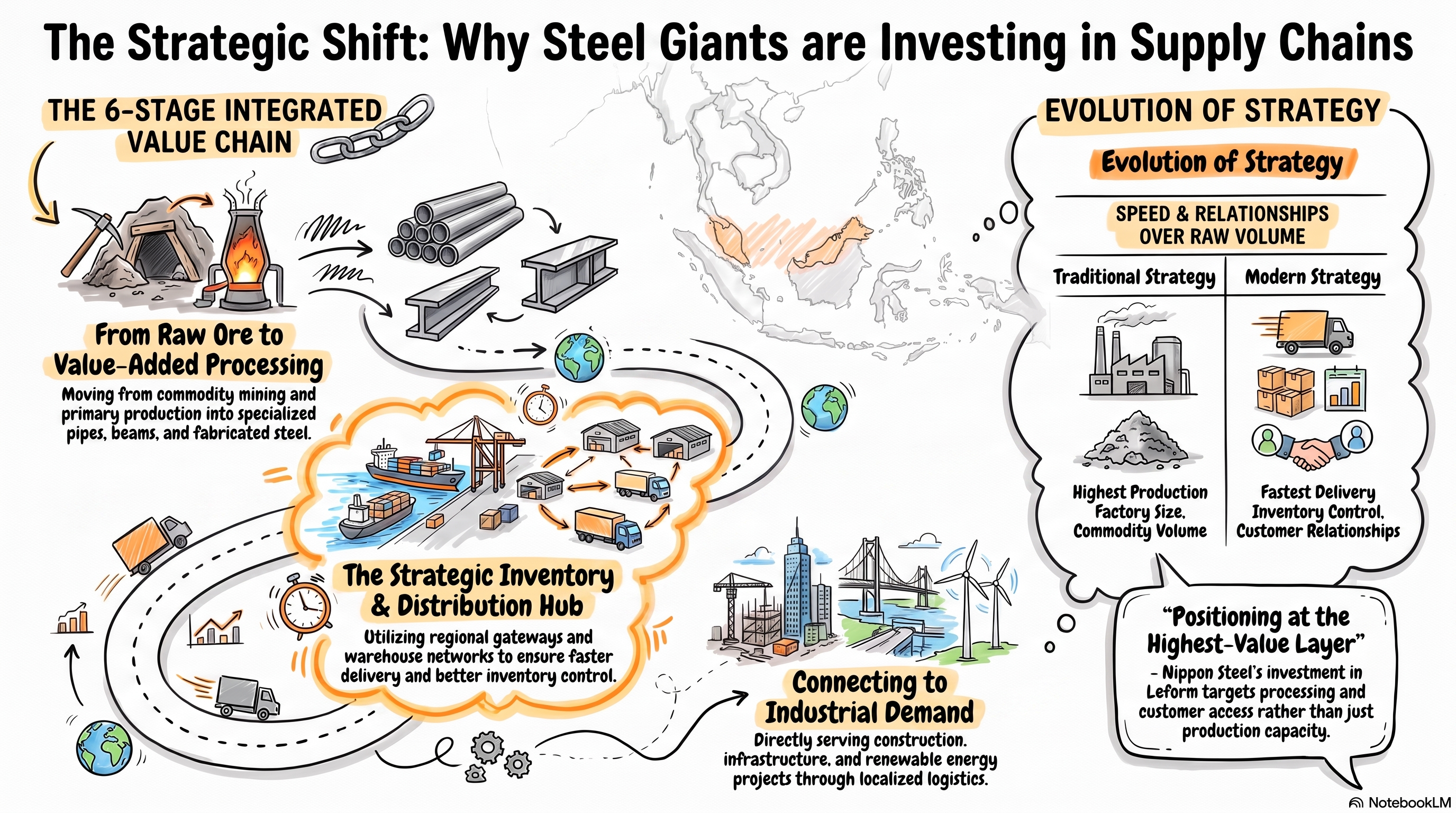
The key difference is that Leform operates further downstream in the steel value chain. Rather than focusing solely on manufacturing, the company specialises in steel processing, pipes, highway guardrails, warehousing and distribution.
These businesses place Leform much closer to contractors, infrastructure developers and industrial customers.
In today's manufacturing environment, customer relationships often matter more than production capacity. Companies that can consistently supply products, maintain inventory and provide reliable delivery become deeply embedded within local industries. Those relationships are difficult for overseas manufacturers to replicate through exports alone.
For Nippon Steel, acquiring access to an established distribution network may provide significantly greater long-term value than purchasing additional manufacturing assets.
Southeast Asia Is Becoming a Global Industrial Growth Region
Japan's domestic steel demand has matured over the past decade, limiting opportunities for rapid expansion within its home market. Southeast Asia presents a very different picture.
The region continues to benefit from several long-term structural trends, including infrastructure development, industrialisation, manufacturing relocation and supply chain diversification driven by the China+1 strategy.
Malaysia occupies an important position within ASEAN due to its established logistics network, strategic location and growing industrial base.
As multinational manufacturers expand operations across Southeast Asia, demand for processed steel products, industrial components and construction materials is expected to increase alongside new factories, warehouses and infrastructure projects.
Successfully serving this demand requires more than exporting steel from Japan. It requires established local distribution channels, trusted customer relationships and operational capabilities within the region.
Leform already possesses these assets, allowing Nippon Steel to strengthen its regional presence through an existing market participant rather than building an entirely new network.
Why Warehousing and Distribution Are Becoming Strategic Assets
One of the most overlooked aspects of the investment is Leform's continued expansion of integrated warehousing and inventory capabilities.
Although warehouses may appear to be operational infrastructure, they increasingly represent strategic competitive advantages.
Companies that control inventory can respond more quickly to customer demand, shorten delivery times and improve supply reliability. They also become preferred partners for contractors and manufacturers that depend on predictable material availability.
Control over warehousing allows a business to influence inventory positioning, delivery scheduling, customer fulfilment and product availability throughout the supply chain.
Rather than functioning solely as a steel processor, Leform is gradually positioning itself as a regional logistics and inventory platform.
For a global producer like Nippon Steel, participation in this downstream infrastructure provides direct access to industrial demand while improving supply chain efficiency across Southeast Asia.
Why Nippon Steel Chose a Minority Investment Instead of a Takeover
Many investors assume that acquiring only 10% indicates limited strategic importance. In reality, minority investments are a common feature of Japanese corporate strategy.
Rather than pursuing full acquisitions, Japanese industrial groups have historically built long-term ecosystems through strategic partnerships, commercial agreements and cross-shareholdings.
A 10% investment can strengthen collaboration without disrupting existing management or local customer relationships.
The stake allows both companies to align commercial interests, develop preferred supply arrangements and explore future business opportunities while preserving operational flexibility.
The objective is not necessarily ownership.
Instead, it is securing a trusted position inside an important industrial network that may continue expanding over many years.
Viewed from this perspective, the investment appears less like a financial transaction and more like long-term strategic positioning.
What This Investment Signals for Investors and the Future of Industrial Supply Chains
If the partnership develops as expected, investors may eventually observe stronger supply cooperation between Nippon Steel and Leform, increasing volumes of Nippon Steel products moving through Malaysia, expanded logistics infrastructure and greater participation in regional infrastructure and industrial projects.
More importantly, the transaction highlights a broader transformation occurring across global manufacturing.
Industrial leadership is no longer determined solely by factory size or production capacity. Increasingly, competitive advantage belongs to companies that control distribution networks, inventory management, customer relationships and regional demand gateways.
As supply chains become more regionalised, downstream businesses capable of efficiently moving products across growing markets become increasingly valuable strategic assets.
Leform may appear to be a relatively small Malaysian steel company, but its position within processing, logistics and customer distribution gives it influence that extends well beyond its production capacity.
For investors, the more important question is no longer why Nippon Steel bought a 10% stake in Leform.
The better question is whether other multinational industrial companies are quietly investing in similar downstream platforms across Southeast Asia before the market fully recognises their strategic importance.