Why Are Multi-National Giants Leaving Bursa Malaysia?
In the 1970s through the 1990s, when a multi-national corporation (MNC) listed its local subsidiary on Bursa Malaysia, it was celebrated as a massive win-win. Today, the tide has turned.
With Ajinomoto launching a premium privatization bid and DKSH attempting one earlier, we are left with a puzzling question:
Why are these foreign parent companies, which have been listed in Malaysia for decades, suddenly willing to spend massive amounts of cash to buy out minority shareholders and delist?
The economics of global business have fundamentally changed. Why they came then, and why they want to leave now, comes down to a few simple factors.
Why they listed initially (The 1970s–1990s):
Political & Regulatory Alignment: Historically, Malaysia strictly encouraged local equity participation. Listing was the fastest way to build a local shareholder base, smooth out government relations, and gain local legitimacy.
High Cost of Local Capital: Decades ago, global capital markets weren't as interconnected. Borrowing locally in Malaysia was expensive. Listing on Bursa allowed these subsidiaries to tap into a eager pool of Malaysian equity investors for cheap expansion capital.
Brand & Public Credibility: For consumer-facing businesses like Ajinomoto, being a publicly traded company on Bursa was free marketing. It built deep trust among local distributors, suppliers, and consumers.
Why they are leaving now:
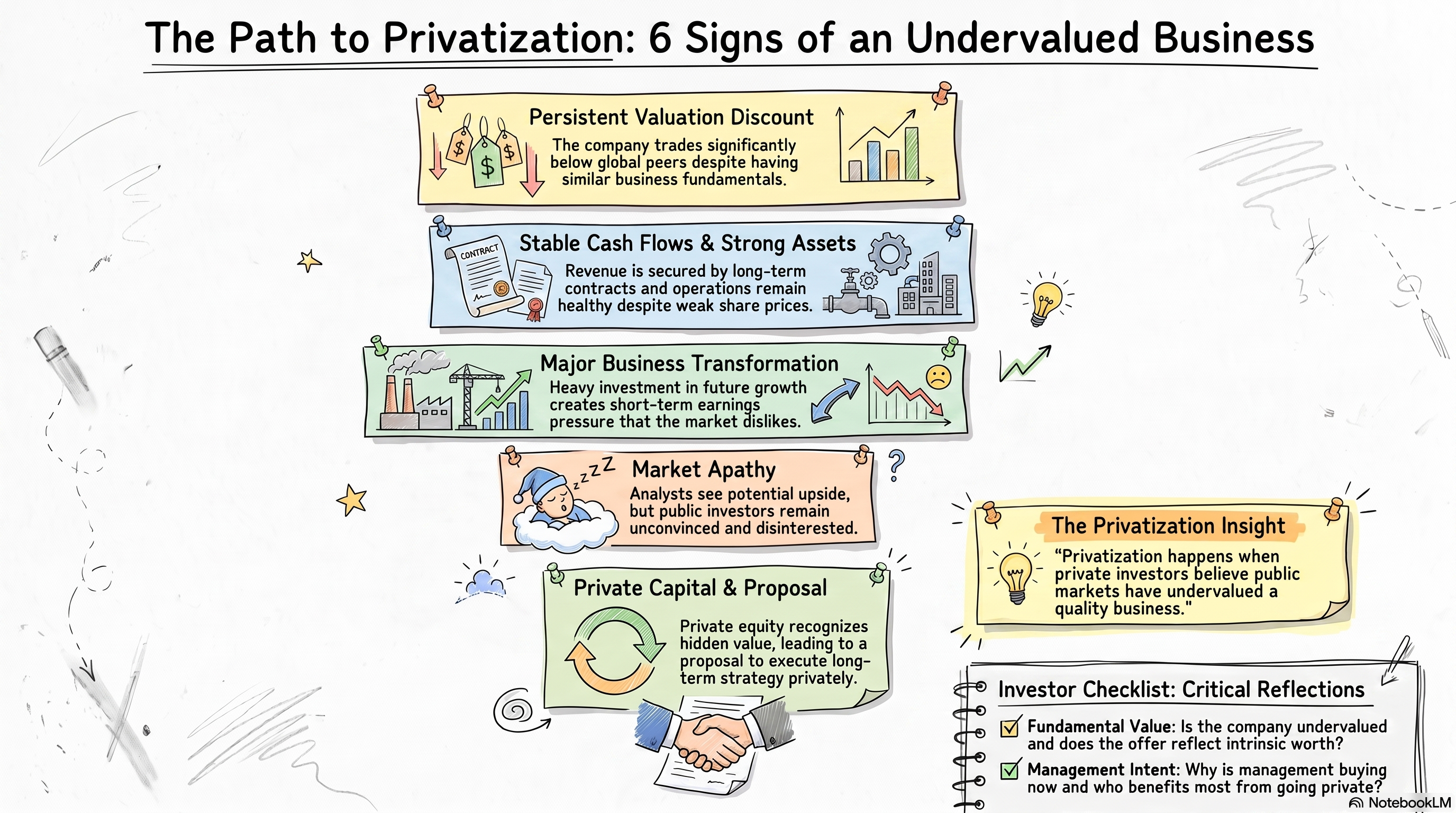
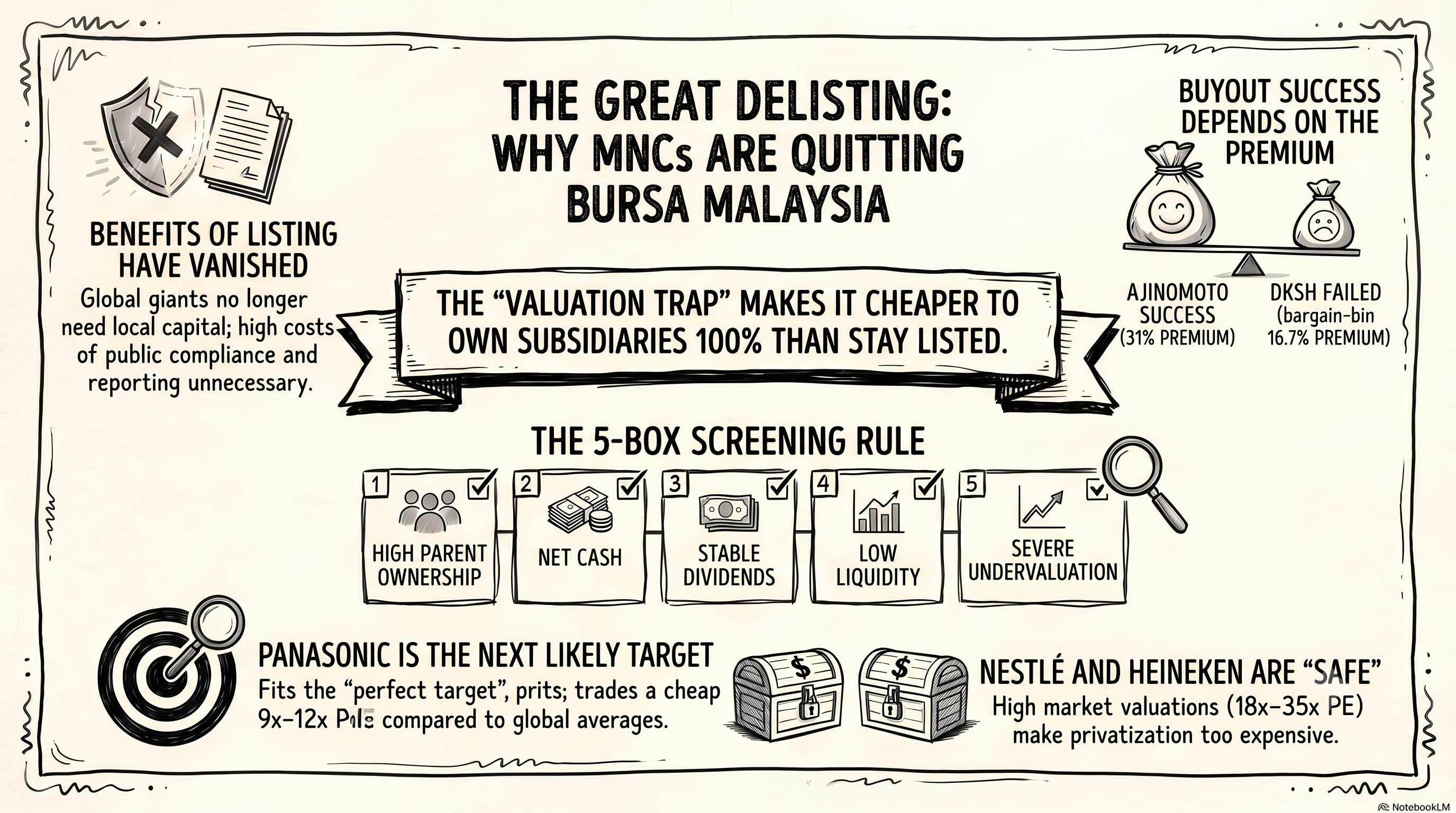
The Valuation Trap: Foreign parents believe Bursa is heavily discounting their subsidiaries. If a parent company values its subsidiary internally at a 15x price-to-earnings (PE) multiple, but Bursa continuously prices it at 8x–10x, buying out the public becomes a massive bargain.
No Need for Malaysian Money: Titans like Ajinomoto Japan or DKSH Switzerland are massive. They can secure funding faster and much cheaper at the global group level. Bursa is no longer needed for fundraising.
The Cost of Being Public: Maintaining a listing requires heavy compliance, quarterly financial reporting, strict disclosure rules, corporate governance audits, and investor relations. For a subsidiary with a small public float, these costs outweigh the benefits.
Strategic Control: Going private gives the parent total operational flexibility. They can restructure, shift regional supply chains, alter transfer pricing, or execute asset sales without needing approval from noisy minority shareholders.
However, Malaysia shareholders are not in hurry to sell their stake. Recent corporate actions show us that when it comes to privatization, price and valuation determine whether the buyout succeeds or fails.
Case A: Ajinomoto Malaysia
Operating in Malaysia since 1961, Ajinomoto is one of the oldest Japanese-listed legacy stocks on Bursa.
The Offer: A cash buyout at RM20.00 per share, offering a hefty 31% premium over its last traded price.
The Valuation: Based on its earnings, the parent willingly paid a PE multiple of 20x–22x.
The Evidence: This was not a cheap offer. The Japanese headquarters sent a clear signal: this business is a highly mature, cash-generative machine with deep long-term value in the ASEAN region, making it well worth paying a premium to fully own.
Case B: DKSH Malaysia
Listed in 1994, DKSH's privatization story ended very differently.
The Offer: A buyout attempt at RM6.15 per share, offering a modest 16.7% premium.
The Valuation: The parent attempted to snatch the company at a low-teens PE multiple of just 11x–12x.
The Evidence: Minority shareholders saw right through it. DKSH Malaysia boasted a strong market position, a net cash balance sheet, and reliable dividends. Trying to take it private at a bargain-bin valuation was deemed opportunistic, public shareholders rejected, and the proposal failed.
The Forgotten Precedent: Many investors forget JT International (Japan Tobacco). They once operated a highly profitable listed vehicle on Bursa. Once the business matured, had plenty of cash, and no longer needed local funding, the Japanese parent bought out minorities and delisted it using this exact same playbook.
Using the evidence above, we can build a highly effective Screening Rule to spot which foreign subsidiary might be targeted for privatization next.
The perfect privatization target usually checks these 5 boxes:
High Parent Ownership
Net Cash Balance Sheet
Consistent & Stable Dividends
Low Trading Liquidity
Severely Undervalued
If we run this formula across the prominent foreign-owned consumer and manufacturing stocks on Bursa today, we can clearly separate the likely targets from the distractions.
Privatization Probability = High Parent Ownership × Cheap Valuation × Low Liquidity × Strong Cash Flow
Tier 1: Highly Likely Target — Panasonic Manufacturing Malaysia Berhad
Probability: Extremely High.
Analysis: It fits the profile perfectly. It has a heavy Japanese parent presence, a highly mature manufacturing business, and zero reliance on Bursa for capital. Most importantly, it trades at a very cheap 9x–12x PE multiple. If Panasonic Japan believes the business is fundamentally worth 15x–18x, buying out Bursa minorities at today's low prices is an absolute no-brainer arbitrage play.
Tier 2: Unlikely Targets
Heineken Malaysia & Carlsberg Malaysia
Analysis: Both have incredible brands and fantastic cash flows, but they already trade at healthy valuations of 18x–22x PE. Because they are already fairly valued by the market, a privatization would require the parents to pay an astronomically expensive premium, making it financially unviable.
Nestlé (Malaysia) Berhad
Analysis: Nestlé Malaysia commands a premium valuation of 25x–35x PE on Bursa. Nestlé Switzerland would have to write a huge cheque to buy out the public, which defies commercial logic.
Dutch Lady Milk Industries Berhad
Analysis: Similar to Nestlé, its valuation is not distressed or ignored by the Malaysian public. The parent has no urgent financial incentive to buy it out.
This delisting trend underscores a bittersweet reality for Malaysia's equity market. On one hand, it confirms that Bursa is a hunting ground for deeply undervalued, cash-rich gems. On the other hand, it exposes a lack of market vibrancy. When quality companies suffer from prolonged low valuations, listing becomes a burden rather than a tool for cheap capital generation.