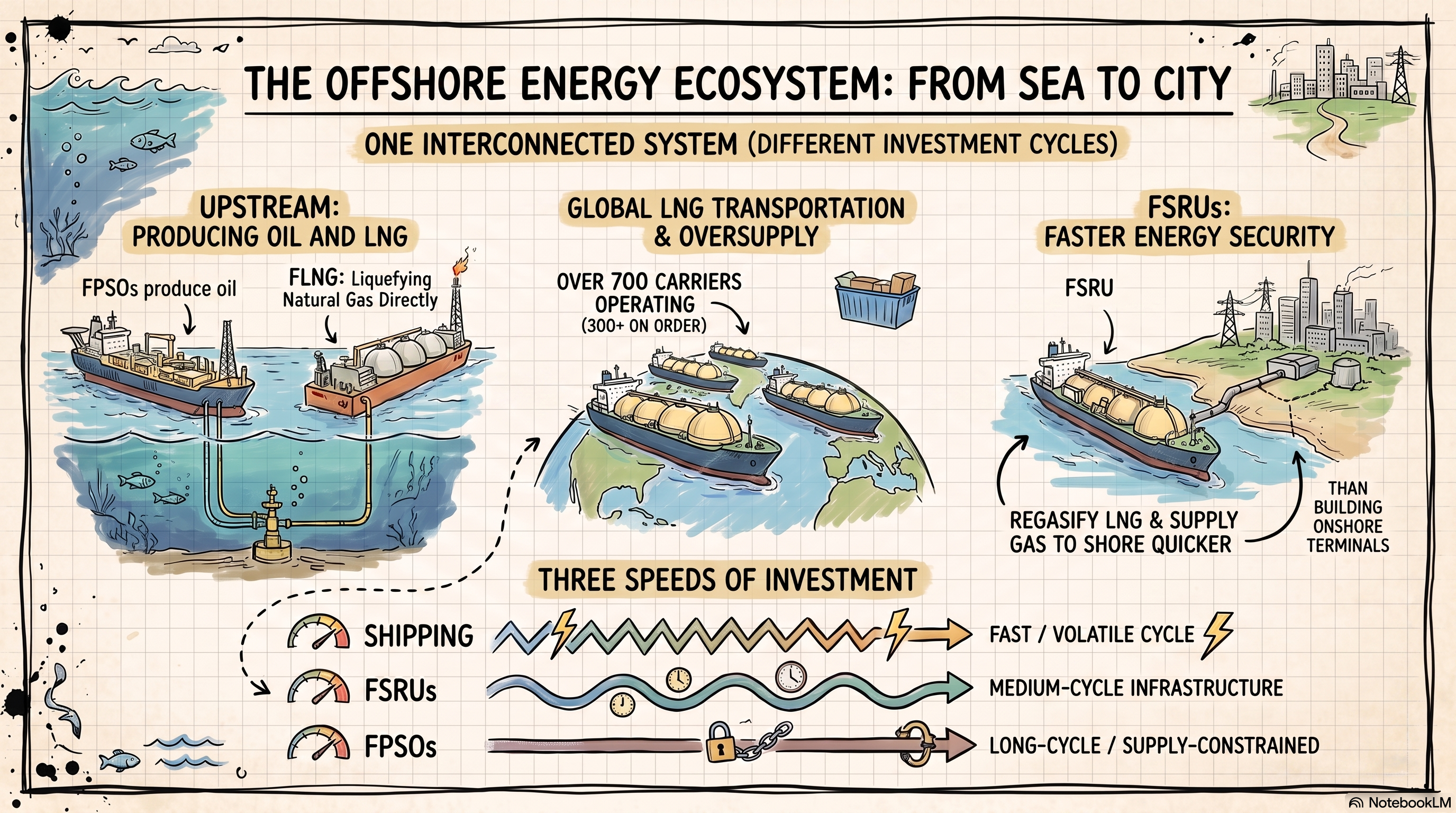
The offshore energy industry often appears fragmented, consisting of LNG carriers, floating storage and regasification units (FSRUs), floating production storage and offloading vessels (FPSOs), shipyards, offshore leasing companies and engineering contractors. In reality, these businesses form a highly interconnected ecosystem driven by investment cycles, engineering constraints, project lead times and energy security policies.
Understanding how these segments interact explains several important developments shaping today's offshore energy market. It reveals why LNG shipping has entered an oversupply cycle, why FPSOs remain structurally tight despite previous oil downturns, why Seatrium dominates the global FSRU conversion market, and how companies such as SBM Offshore, MODEC, Yinson, Bumi Armada, MISC Berhad and Malaysia Marine and Heavy Engineering (MMHE) fit within the global offshore energy value chain.
Rather than viewing these industries independently, investors should understand them as different layers of the same offshore energy architecture, each responding to different economic cycles and infrastructure bottlenecks.
Understanding LNG Carriers, FSRUs, FPSOs and FLNG
Although LNG carriers, FSRUs, FPSOs and FLNG facilities are frequently discussed together, they perform very different roles within the offshore energy value chain.
An LNG carrier is designed solely to transport liquefied natural gas between exporting and importing countries. Natural gas is cooled to approximately −162°C, reducing its volume by about 600 times and making long-distance marine transportation commercially viable.
A Floating Storage Unit (FSU) stores LNG offshore without processing it. These vessels are commonly used when countries require additional LNG storage capacity but do not yet need regasification capability.
A Floating Storage and Regasification Unit (FSRU) performs two functions. Besides storing LNG, it converts the liquefied gas back into natural gas before delivering it to shore through subsea pipelines. An FSRU effectively functions as a floating LNG import terminal.
FSRUs have become increasingly popular because they solve four structural challenges faced by many countries.
First, they can be deployed much faster than traditional onshore LNG terminals. While an onshore terminal typically requires four to six years to build, an FSRU can usually be converted and deployed within approximately 1.5 to 2.5 years.
Second, they are significantly cheaper. An onshore LNG terminal often costs between US$1 billion and US$3 billion, whereas converting an LNG carrier into an FSRU generally costs around US$200 million to US$400 million.
Third, FSRUs offer flexibility. Unlike permanent land-based infrastructure, they can be relocated when market demand changes.
Finally, they enhance national energy security by allowing countries to rapidly diversify gas imports following geopolitical disruptions or supply shortages.
Unlike FSRUs, an FPSO (Floating Production Storage and Offloading) vessel operates upstream. Rather than importing energy, an FPSO produces crude oil directly from offshore reservoirs, processes the oil onboard, stores it temporarily and transfers production to shuttle tankers for export.
An FLNG (Floating Liquefied Natural Gas) facility performs the opposite role of an FSRU. Instead of converting LNG back into gas, FLNG facilities liquefy natural gas offshore before loading LNG onto export carriers.
Together, these assets form different layers of the offshore energy supply chain.
Asset | Primary Function | Industry Segment |
|---|---|---|
LNG Carrier | LNG transportation | Shipping |
FSU | LNG storage | Midstream |
FSRU | LNG import and regasification | Midstream |
FPSO | Offshore oil production | Upstream |
FLNG | Offshore LNG production | Upstream |
Why LNG Carrier Shipping Is Facing Oversupply
The LNG shipping industry is currently experiencing one of its familiar boom-and-bust investment cycles.
During the 2021–2022 global energy crisis, demand expectations for LNG surged as countries searched for alternatives to Russian pipeline gas. Freight rates for LNG carriers climbed to record highs, generating exceptional returns for shipowners.
These high profits encouraged companies to order large numbers of new LNG carriers.
However, constructing an LNG carrier typically requires two to three years.
By the time many of these vessels were delivered, market conditions had changed. Demand growth had normalised while hundreds of newly built ships entered the market almost simultaneously.
The result is structural oversupply.
This cycle repeatedly occurs because investment decisions are made during periods of extremely high freight rates, while new capacity arrives during a completely different market environment.
Today, the global LNG fleet consists of more than 700 operating LNG carriers, with over 300 additional vessels on order, creating a substantial supply wave expected to influence freight markets for years.
The construction of LNG carriers is itself highly concentrated.
South Korea dominates global LNG shipbuilding through:
Hyundai Heavy Industries
Samsung Heavy Industries
Daewoo Shipbuilding & Marine Engineering
Their competitive advantage stems from decades of expertise in cryogenic containment systems required for LNG transportation.
Major participants across the LNG ecosystem include QatarEnergy, Mitsui O.S.K. Lines, NYK Line, Shell, TotalEnergies and CNOOC, which collectively own vessels, charter capacity or control global LNG trading flows.
Why the FPSO Market Remains Structurally Tight
Unlike LNG shipping, the FPSO market follows much longer investment cycles.
Between 2015 and 2020, low oil prices caused many offshore developments to be postponed or cancelled. Shipyards reduced capacity, engineering resources declined and new FPSO investments slowed considerably.
When oil prices later recovered above approximately US$70 per barrel, offshore developments once again became economically viable.
However, engineering capacity could not expand quickly enough to meet renewed demand.
This explains why FPSO supply remains structurally tight today.
Building an FPSO is significantly more complex than constructing a conventional ship.
Each project integrates:
Hull construction
Oil and gas processing systems
Compression facilities
Separation equipment
Electrical systems
Offshore mooring systems
Safety-critical engineering
Offshore commissioning
An FPSO is therefore often described as a floating offshore refinery rather than simply a vessel.
Because every project is unique, only a limited number of shipyards possess the engineering capability, execution experience and financial strength required to deliver complete FPSO projects.
Major FPSO operators include:
SBM Offshore
MODEC
BW Offshore
Yinson
Bumi Armada
MISC Berhad
Approximate fleet ownership includes:
MODEC – approximately 19 FPSOs
SBM Offshore – approximately 17 FPSOs
Yinson – approximately 8 FPSOs
Bumi Armada – approximately 6–7 FPSOs
MISC Berhad – approximately 6 FPSOs
Malaysia also participates in this market through MMHE, which contributes fabrication, offshore platform construction and FPSO topside module integration. While Malaysia possesses strong engineering capability, it has yet to establish global leadership in full FPSO integration comparable to Seatrium, Samsung Heavy Industries or Hyundai Heavy Industries.
Why Seatrium Dominates Global FSRU Conversions
FSRU conversion is among the most specialised engineering segments within the offshore energy industry.
Historically, Seatrium has completed more than 20 FSU and FSRU conversions since 2007, accounting for over 90% of historical global FSRU conversion projects.
This remarkable market concentration reflects several structural advantages.
The company entered the industry early when FSRU technology was still emerging, allowing decades of engineering experience to accumulate before competitors entered the market.
FSRU conversion also requires integration of highly specialised systems including cryogenic LNG storage, regasification equipment, offshore pipeline interfaces, marine engineering, automation systems and regulatory certification.
Very few shipyards possess expertise across all of these disciplines.
Client relationships further strengthen Seatrium's competitive position.
Once a successful conversion has been completed, shipowners often reuse engineering designs, benefit from faster regulatory approvals and reduce execution risks by working with the same contractor.
This creates strong repeat business and reinforces Seatrium's market leadership.
Unlike mass shipbuilding, FSRU conversion is characterised by relatively few global projects, extremely high engineering complexity and a heavy reliance on proven execution capability.
These factors combine to create exceptionally high barriers to entry, allowing Seatrium to maintain a position resembling a quasi-monopoly within this specialised market.
How the Offshore Energy Cycle Connects LNG Carriers, FSRUs and FPSOs
Although LNG carriers, FSRUs and FPSOs serve different purposes, they should not be viewed as separate industries.
Instead, they operate within one interconnected offshore energy ecosystem driven by different investment cycles.
LNG shipping represents the shortest cycle. Freight markets respond quickly to changes in global gas demand, leading to recurring periods of boom and oversupply.
FSRUs occupy the middle of the value chain. Demand rises when governments require rapid LNG import infrastructure, particularly during periods of heightened energy security concerns. Oversupplied LNG carriers can also create opportunities for vessel conversions into FSRUs.
FPSOs operate on the longest cycle. Demand depends on multi-billion-dollar offshore oil developments that require years of planning, financing and engineering execution. Because only a handful of shipyards can build and integrate FPSOs, supply remains constrained even when offshore investment recovers.
Viewed together, the offshore energy industry forms a layered investment ecosystem.
LNG carriers reflect short-term shipping sentiment and freight market conditions.
FSRUs capture opportunities created by infrastructure shortages, energy security needs and surplus LNG vessels.
FPSOs reflect long-term oil investment cycles constrained by engineering capacity.
Understanding these relationships allows investors to move beyond analysing individual companies and instead recognise how changes in one segment create opportunities—or risks—across the broader offshore energy value chain.
The offshore energy industry is therefore not a collection of isolated businesses. It is a connected system where capital allocation, engineering capability, infrastructure investment and energy security continuously shape global investment cycles. Recognising these structural relationships provides a more comprehensive framework for analysing offshore assets, shipyards and energy infrastructure companies.