Malaysia's 13th Malaysia Plan (13MP) for 2026–2030 is expected to accelerate one of the country's most significant infrastructure transformations in decades. Led by the Ministry of Energy Transition and Water Transformation (PETRA), the strategy focuses on strengthening electricity supply, expanding renewable energy, modernising water infrastructure, and preparing Malaysia for long-term economic growth.
The government's priorities include managing surging electricity demand from data centres, deploying Battery Energy Storage Systems (BESS), evaluating nuclear energy, expanding the ASEAN Power Grid (APG), and reducing non-revenue water (NRW). Together, these initiatives support the National Energy Transition Roadmap (NETR) while positioning Malaysia as a regional clean energy hub.
For investors, businesses, and infrastructure stakeholders, the 13MP presents opportunities across utilities, engineering, renewable energy, industrial development, and water infrastructure.
Data Centres Are Reshaping Malaysia's Electricity Demand
What is driving Malaysia's future electricity demand?
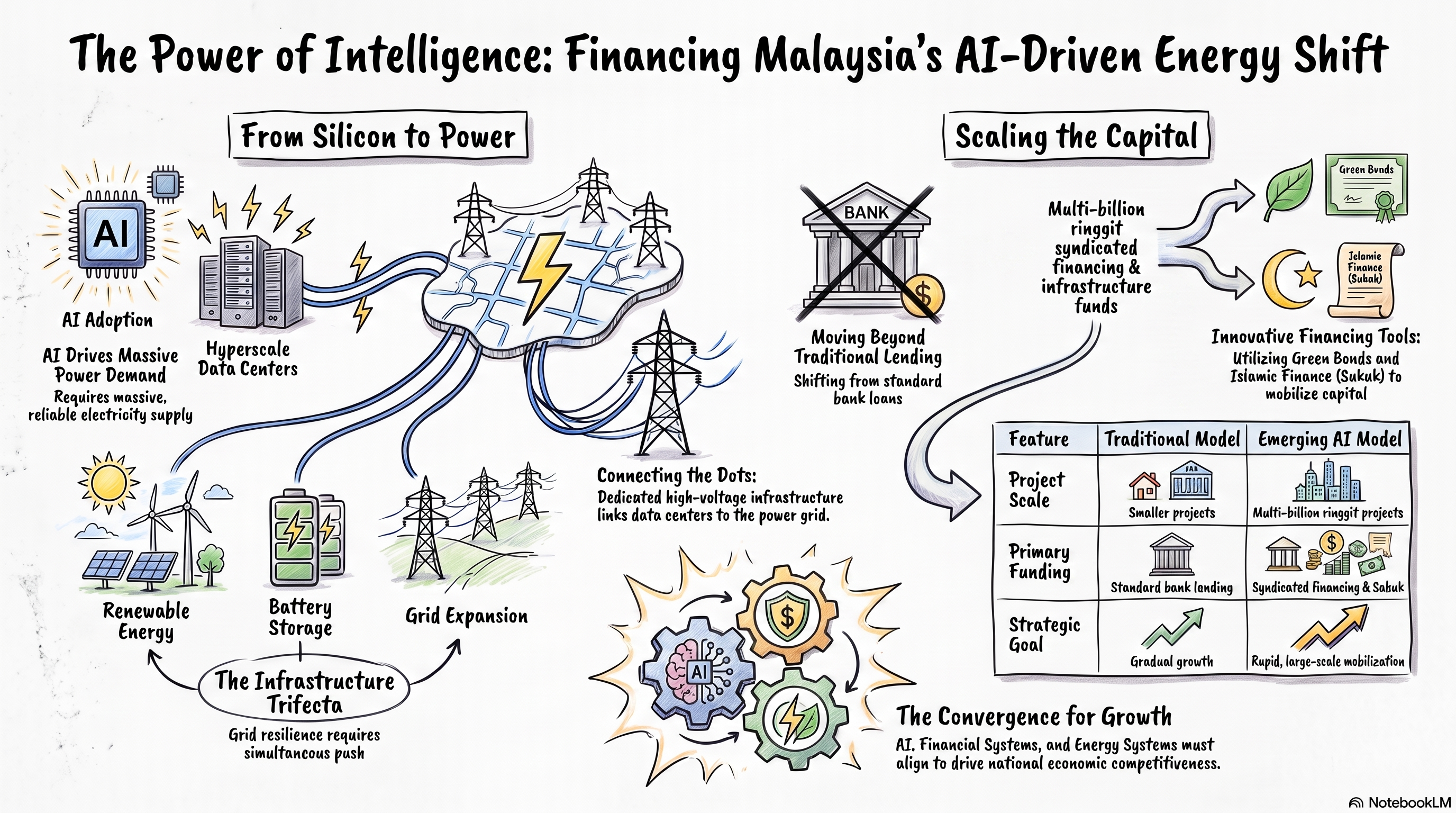
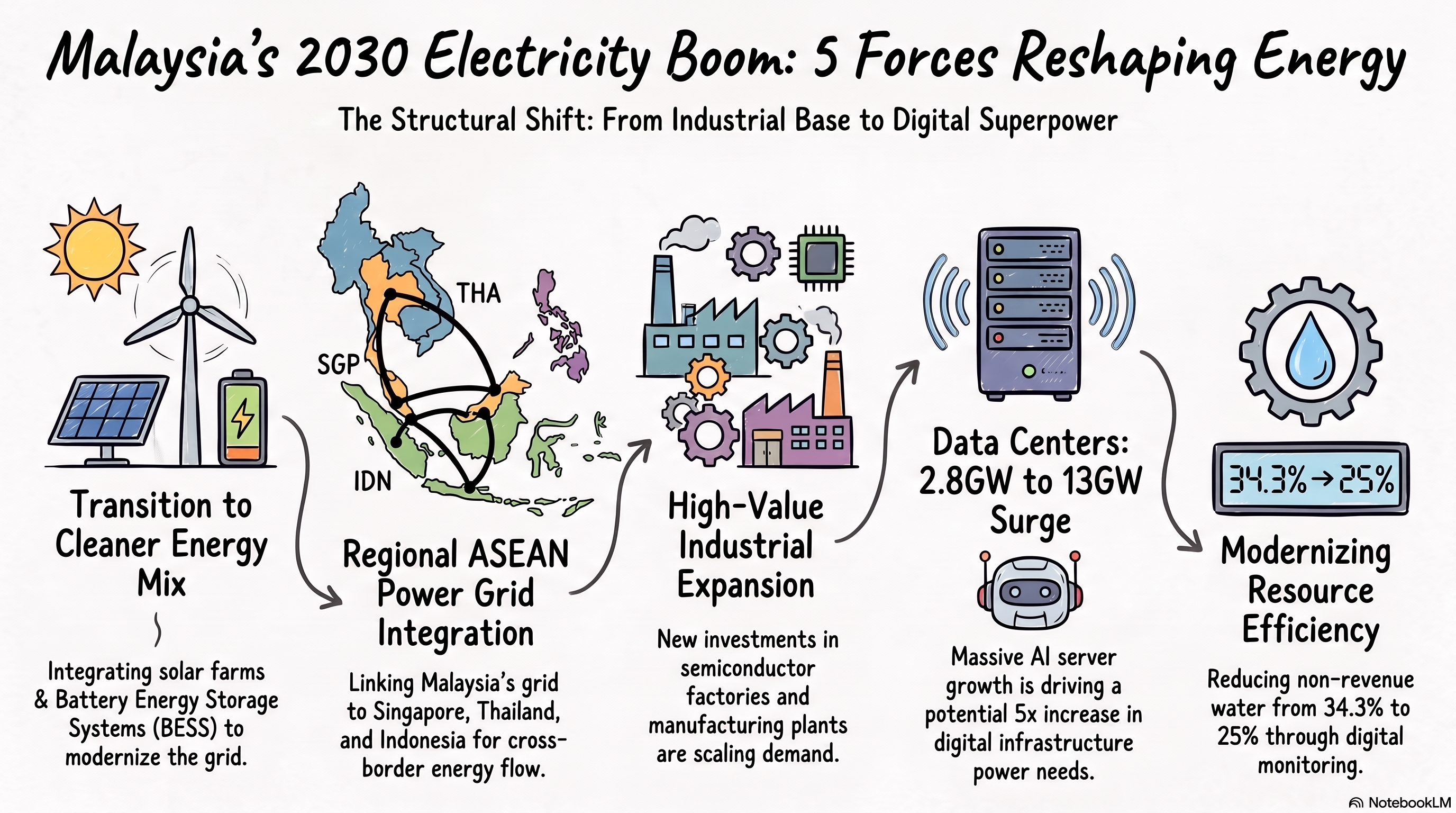
The rapid expansion of data centres is becoming the single largest driver of electricity consumption in Malaysia. Current connected demand is approximately 2.8GW, but projections indicate total demand could reach between 5GW and 13GW over the next five to six years.
However, many data centre operators reserve more electrical capacity than they immediately require because facilities are typically developed in multiple phases. This creates a risk of unused capacity while limiting available supply for other industries.
To improve planning efficiency, PETRA is evaluating mechanisms that could penalise prolonged underutilisation of reserved capacity.
Another important policy development is the Corporate Renewable Energy Supply Scheme (CRESS), which allows large corporate consumers, including data centres, to purchase renewable electricity directly from power generators. As electricity tariffs increase under Regulatory Period 4 (RP4) and Malaysia prepares to introduce carbon pricing from 2026, demand for renewable electricity is expected to accelerate.
The immediate beneficiaries include integrated utilities responsible for grid expansion and renewable energy developers capable of supplying green electricity. At the same time, policymakers must carefully balance investment with the risk of overcommitting transmission capacity.
Grid Expansion, Battery Storage and Renewable Energy Will Define the Next Growth Phase
Malaysia's previous Power Generation Development Plan (PGDP) 2021–2039 underestimated the pace of electricity demand growth. In response, the Joint Planning Committee for Peninsular Malaysia Electricity Supply (JPPPET) has increased its planning frequency to twice yearly, allowing generation capacity to be reviewed more regularly.
While the government maintains its commitment to not approving new coal-fired power plants, existing gas-fired generation may continue playing an important transitional role through extensions of expiring Power Purchase Agreements (PPAs).
Alongside generation planning, Battery Energy Storage Systems (BESS) are becoming increasingly important.
As solar penetration rises across the national grid, battery storage provides the flexibility needed to store excess renewable electricity and release it during periods of peak demand, improving grid stability and reliability.
Malaysia's first utility-scale project is Tenaga Nasional Berhad's 100MW/400MWh BESS facility in Terengganu, scheduled for commissioning by the end of 2026. Energy regulators also plan to procure four additional BESS projects of similar capacity.
Future Large Scale Solar (LSS) programmes are also expected to transition from standalone solar farms towards integrated solar-plus-storage developments, creating new opportunities for engineering companies, battery suppliers, solar developers, and energy technology providers.
Nuclear Energy Enters Malaysia's Long-Term Energy Strategy
Is Malaysia building nuclear power plants?
Not yet.
Malaysia remains in the exploration phase, evaluating whether nuclear energy should become part of its long-term electricity mix.
The government has initiated technical cooperation and knowledge-sharing with several international partners, including Russia, France and the United States, while further engagement with China is expected.
Several technologies are currently being assessed, including conventional nuclear reactors, floating nuclear plants and Small Modular Reactors (SMRs).
Rather than committing immediately to construction, Malaysia is following the International Atomic Energy Agency's (IAEA) Milestone Approach. During Phase One, attention will focus on feasibility studies, regulatory frameworks, legal preparedness, workforce development, public engagement and nuclear safety standards.
Only after these requirements are completed would Malaysia make a formal national decision regarding nuclear deployment.
Should the programme progress, engineering consultants, heavy industrial contractors, technical training institutions and nuclear safety specialists are likely to experience increased demand. However, nuclear development remains subject to political acceptance, financing requirements and lengthy implementation timelines.
ASEAN Power Grid Positions Malaysia as a Regional Energy Hub
One of the most strategically significant components of the 13MP is Malaysia's commitment to strengthening the ASEAN Power Grid (APG).
The initiative aims to improve regional electricity connectivity while enabling cross-border renewable energy trading throughout Southeast Asia.
Several major interconnection projects are currently under discussion or development, including:
Vietnam–Malaysia–Singapore subsea transmission for offshore wind exports.
Sarawak–Singapore electricity interconnection targeting approximately 1GW by 2031.
Sarawak–Peninsular Malaysia transmission studies.
Potential transmission upgrades connecting Peninsular Malaysia with Sumatra and Thailand.
Greater regional connectivity offers multiple advantages. Countries can share surplus renewable electricity, improve energy security during supply disruptions, optimise generation resources, and reduce overall carbon emissions.
For Malaysia, becoming a regional electricity transit and trading hub would strengthen its strategic position while creating long-term opportunities for utilities, transmission operators, energy infrastructure developers and engineering contractors.
Water Infrastructure Modernisation Becomes a National Priority
While energy transition dominates headlines, water infrastructure remains equally critical under the 13MP.
Malaysia's Non-Revenue Water (NRW) rate remains approximately 34.3%, significantly above the national target of 25%. NRW represents treated water lost before reaching consumers due to leaks, ageing pipelines, theft or inaccurate metering.
The government is expected to revise funding mechanisms under the 13MP so that all states can access federal assistance, while introducing matching grants to reward stronger-performing water operators.
Labuan has already been selected as a pilot project for replacing ageing asbestos cement water pipes.
Another emerging priority is supplying sustainable water to rapidly expanding data centres.
PETRA is exploring recycled water solutions through collaboration with Indah Water Konsortium (IWK), with pilot initiatives underway in Johor, Selangor and Negeri Sembilan. The primary challenges remain regulatory coordination, infrastructure investment and pipeline connectivity.
Companies specialising in water treatment, pipe manufacturing, leak detection, engineering services and water recycling technologies are expected to benefit as investment accelerates.
Investment Outlook: Who Benefits from Malaysia's Energy Transition?
The 13th Malaysia Plan represents more than a collection of infrastructure projects. It provides the institutional framework for implementing Malaysia's National Energy Transition Roadmap over the coming decade.
Several long-term themes are expected to dominate:
Modernisation of the national electricity grid.
Expansion of renewable energy generation and battery storage.
Institutional preparation for future nuclear energy.
Regional electricity integration through the ASEAN Power Grid.
Upgraded water infrastructure, recycled water systems and NRW reduction.
Integrated utility companies are well positioned to benefit from transmission expansion, electricity demand growth and infrastructure investment. Renewable energy developers, battery storage providers, engineering contractors and water infrastructure specialists also stand to gain as implementation accelerates.
Investors should nevertheless monitor several risks, including policy changes affecting renewable energy or nuclear development, delays in project execution, volatility in coal and energy prices, and rising costs for renewable energy equipment and supply chains.
Overall, Malaysia's 13MP signals a structural shift toward cleaner, smarter and more resilient infrastructure. As electricity demand continues to rise and sustainability becomes central to national planning, the companies supporting grid modernisation, renewable integration and water efficiency are likely to become some of the country's most significant long-term beneficiaries.