🟦 1. The Event (FACT)
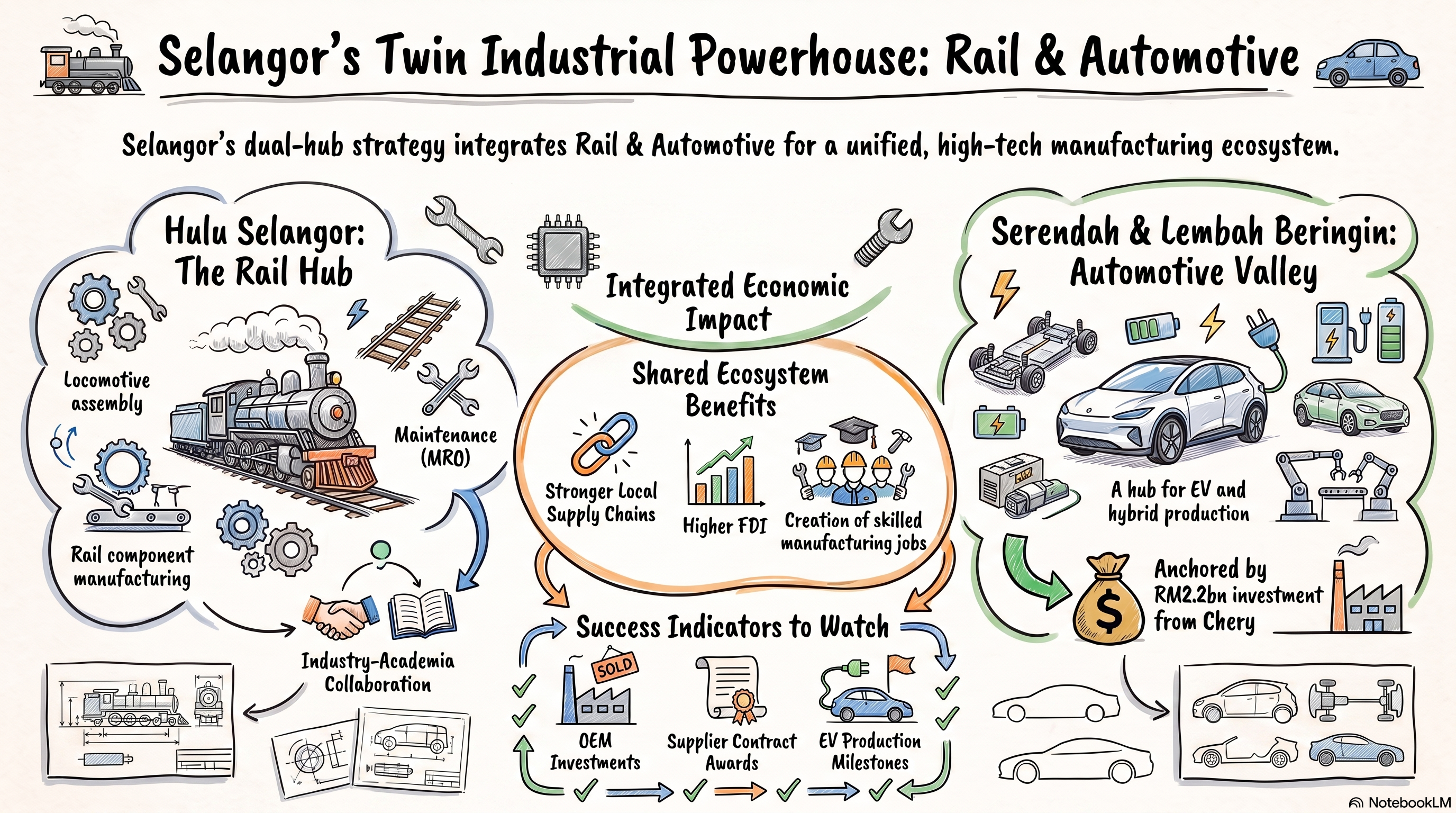
The Selangor government announced plans to develop a rail industry hub in Hulu Selangor for manufacturing train components and maintenance, and an Automotive Valley in Serendah and Lembah Beringin focused on conventional and electric vehicles.
The initiatives involve collaboration with industry, academia, and operators, and build on existing investments like Chery’s RM2.2 billion auto park.
🟨 2. Affected Channels (MECHANISM)
Demand: Increased local sourcing of rail and automotive components
Supply: Expansion of manufacturing capacity and local supply chains
Trade / Logistics: Potential increase in component exports and regional distribution
Financing: Infrastructure and industrial park investments
Regulation: State-level industrial and investment policies
🟩 3. Malaysia Exposure (WHO)
Exposed sectors: Rail manufacturing, automotive manufacturing, EV production, component suppliers
Company types: Rail component manufacturers, vehicle OEMs, auto parts suppliers, logistics operators, industrial park developers
Geographic relevance: Selangor (Hulu Selangor, Serendah, Lembah Beringin), with potential export connections
🟧 4. What to Watch (SIGNALS)
Announcements of new industrial park developments or expansions
Manufacturing contract awards or supply agreements with rail/automotive OEMs
Investment inflows and JV announcements in rail and automotive sectors
Policy releases or incentives by Invest Selangor targeting the supply chain
Production milestones or export activity from Chery and other OEMs
1. Overview
The Selangor state government is developing two strategic industrial clusters to strengthen Malaysia's manufacturing ecosystem:
Rail Industry Hub in Hulu Selangor
Automotive Valley in Serendah and Lembah Beringin
The initiative aims to expand domestic manufacturing capabilities, attract foreign direct investment (FDI), strengthen technology transfer, enhance export competitiveness, and build integrated industrial supply chains.
2. Key Development Initiatives
Rail Industry Hub (Hulu Selangor)
The Rail Industry Hub is designed to develop Malaysia's domestic rail manufacturing and maintenance capabilities through collaboration between industry players, academic institutions, and experienced rail operators.
Key priorities include:
Local production of rail components and locomotives
Expansion of maintenance, repair and overhaul (MRO) capabilities
Technology transfer and workforce development
Reduced reliance on imported rail technologies
Local manufacturers, including SMH Rail, are already producing locomotives for MRT projects and export markets.
Automotive Valley (Serendah & Lembah Beringin)
The Automotive Valley will establish an integrated automotive manufacturing cluster supporting:
Internal combustion engine vehicles
Hybrid vehicles
Electric vehicles (EVs)
The development is anchored by Chery's RM2.2 billion industrial park investment and benefits from proximity to existing automotive manufacturers including Proton, Perodua and international OEMs, creating opportunities for supply chain integration and export-oriented production.
3. Economic and Industry Impact
The industrial clusters are expected to generate benefits across multiple sectors.
Rail Industry
Expansion of domestic manufacturing capacity
Growth in maintenance and engineering services
Increased technology transfer
Export opportunities for locally manufactured rail products
Higher demand for skilled technical workers
Automotive Industry
Stronger automotive supply chains
Increased FDI into manufacturing
Acceleration of EV ecosystem development
Expansion of component manufacturing
Improved export competitiveness
State Economy
Greater industrial diversification
Higher manufacturing value-added
Growth in logistics and supporting industries
Development of advanced manufacturing capabilities
4. Strategic Significance
The initiative supports Selangor's transition toward high-value manufacturing by developing specialized industrial clusters with integrated supply chains.
Key strategic outcomes include:
Increased industrial localization
Enhanced technology transfer
Improved supply chain resilience
Greater export capacity
Attraction of high-value manufacturing investment
Development of advanced engineering capabilities
The initiative also aligns with Malaysia's broader industrial objectives of strengthening domestic manufacturing, promoting innovation, and expanding export-oriented industries.
5. Implementation Considerations
Several factors will influence the successful development of both industrial clusters.
Opportunities
Rising demand for rail infrastructure
Growth of regional EV markets
Expansion of local supplier networks
Industry-academia collaboration
Workforce upskilling initiatives
Challenges
High capital investment requirements
Shortage of skilled technical talent
Infrastructure readiness
Environmental and sustainability requirements
Competition from regional manufacturing hubs
Dependence on anchor investors during early development
6. Outlook
The Rail Industry Hub and Automotive Valley represent long-term industrial development initiatives aimed at strengthening Selangor's position as a regional manufacturing and innovation centre.
Successful implementation could expand domestic production capabilities, deepen industrial supply chains, increase export competitiveness, and support the growth of advanced manufacturing industries. Continued investment in infrastructure, technology, workforce development, and industry collaboration will be important to achieving these objectives.